|
Camping Los Coihues,
[website]
, Bariloche,
Argentina, 04-03-10
Get me to the wedding on time!
Barrancas to Panguipulli (9 cycle days; 1 rest
day; 600km; 6938m)
Barrancas to 22 km. after Buta Ranquil (60km;
673m)
22 km. after Buta Ranquil to Chos Malal (66km; 859m)
Chos Malal to 23 km. after Chorriaca (95km; 1087m)
23 km. after Chorriaca to Las Lajas (64km; 513m)
Las Lajas to 500 m. before Argentinian border (55km;
1080m)
500 m. before Argentinian border to 19 km. after Liucura
- Chile (48km; 723m)
19 km. after Liucura to 9 km. after Melipeuco (63km;
558m)
9 km. after Melipeuco to Villarrica (88km; 664m)
Villarrica to Chauquen - Panguipulli (62km 781m)
Better off wild
Last night, we disagreed on a few too many points and
the sour mood is brought over into the new day. Our
departure is somewhat delayed, but once we are out pedalling
the undulating road to Buta Ranquil, all is forgotten
and forgiven. The camping municipal is difficult to
find and hardly worth the trouble. It's more like a
dumping ground for the roadwork department and pedestrian
course, from one side of the town to the other, for
locals. We sit and have lunch and decide after an hour
and a half, we'll move on. The highway continues its
ups and downs through a contrast of barren brown, pink
and red rock. Road conditions are excellent though there
is no shoulder, but with little traffic to contend with,
we hardly notice. Even the light breeze in our face
cools the sun-rayed path and is better than no breeze
at all.
After Buta ranquil, we climb a further
261alti-metres, to the highest point of the day
[1349m]. A two kilometre drop sets us next to the
only trees and green pastures we have seen for miles.
Its a perfect campsite and so much more appealing than
the municipal area in town: on the right hand side and
22 km. after Buta Ranquil (60km; 673m).
Don't blow for me Argentina
Don't blow for me Argentina, unless you do it in my
direction;
and during sunlight hours. For what you do at night;
I'll keep my promise, and keep my distance.
Don't blow for me Argentina...
It's a rise and fall sort of day with
a couple of long hard ascents directly into the Argentinean
wind. While pushing hard on the middle blade in the
middle of my cassette all the while going downhill,
I'm almost certain that someone with a grudge against
cyclists has a giant propeller fan in Ushuaia. Every
day around lunch-time they go and switch the damn thing
on, rubbing their hands with glee; chuckling to themselves
at the desperation they are causing all the two-wheeled
non-motorised travellers.
Landscape is of the desert, though
plenty of streams for water along the way. From the
Rincon turn off, after the initial 17 kilometres, its
a struggle up the 9 kilometre and 406 alti-metre path.
After a further 8 kilometres, another 2 kilometre and
134 metre high thigh cruncher takes us from the Corta
Dimas turn off all the way to the top climb [1668m]
of the day. Twenty kilometres of undulations then
pass before we plummet towards the river and the township
of Chos Malal (66km; 859m),
which sounds more like an Indian dinner than a place
to spend the night.
The municipal campground is pretty
okay, though we are noticing the rise in price as we
head south: 30 peso's in total [10 per person and
10 for the tent compared to a single 10 pesos for the
tent in Malargüe]. It is here that we meet
Pieter and his wife from The Netherlands, who are travelling
around Argentina in a small campervan. Once we get talking,
we discover that they sailed around the world for twenty
years, which they had to give up a few years back due
to health reasons. And if you think that is impressive,
wait until I tell you that they are now close to their
eighties. Very inspirational indeed.
What comes first:
the full or empty bottle of beer?
What isn't so moving is the deposit system on
beer bottles in Chile and Argentina. Don't get
me wrong, I'm all for a deposit system, but there
has to be uniform scheme: one that everyone adheres
to.
Firstly, in order to buy most
1 litre bottles - a few are non-returnable, but
they are 50% more expensive - you have to take
an empty one with you to exchange for a new one.
But how, pray tell, do you get an empty beer bottle
without first buying a full one? The supermarket
we shop at refuses point-blank to sell us two
litres of beer on this principal and it's not
the only time we have faced this problem. It is
so ludicrously stupid and the lack of sale or
illogical process apparently doesn't seem to bother
them one bit. Now if it were Colombia...
My big question is: what if you
were having a party and wanted to buy a few crates
of beer? Do they tell you, you have to bring in
hundreds of empties in first? Are they absolutely
mad?
Secondly, other small stores
or botillerias [liquor stores] insist
you bring back the receipt they have given you,
usually marked with how much deposit you originally
paid. You can't take the bottle elsewhere. If
you do, they won't give you any money for them.
You must go back to the same store, which becomes
an issue when you rock up there the next morning
on your way out of town and find that the shop
is shut, even though it states clearly on the
door that they should be open. Easy way to earn
a few dollars I reckon and you know, in the end,
its cheaper an much more hassle-free to drink
wine! |
Praying to the wind gods
I seem to be doing quite a lot of this lately: praying
to some deity or another. And today is not short of
pleas to drop the intensity of the squall we find ourselves
in. It's crazy that I am doing this. No-one is listening
for goodness sake. And yet I insist and somehow it makes
me feel better. Maybe it is helping me waste time. Another
thought to fill in a few extra minutes. Bring the end
of the cycling day a little closer. Just another form
of coping I guess: using a make-believe force against
the real force trying to send me in every direction
except the one I want to go in. Yes I admit, I do love
dreaming about the nigh possibility that all will return
to calm.
Pushed nicely along the river for the
first few kilometres, but crossing the water expanse
is another story. Stormed from the side means I have
to get off and walk. Tailwind gets behind us again as
soon as the road bends and we begin the first 27 kilometre
climb of the day. Nearly 500 metres of uphill and it
has never seemed so easy. The drop down the other side
to Rio Pichi Neuquén brings a change of direction
and the sidewind is pretty strong, but nowhere near
as nasty as the winds we face in the last half of the
day. Another 25 kilometre ascent of 500 odd alti-metres
follows and Ali is pointing at roughly two o'clock as
he strains against the air current. I am thrown off
the road several times and near the top at Chorriaca
[1258m]. I walk for approximately 1 kilometre after
being stopped dead in my tracks too many times. Even
walking is strenuous against the storm. At one stage
I put my Ipod away: I can't hear a thing above the hiss
of wind.
On the downhill run we meet Michel,
a Belgium cyclist going in the opposite direction. As
he dismounts, he shakes his head and says: "terrible,
terrible, terrible!" Doesn't really matter
which way you are travelling at the moment, the wind
is coming from the side and sweeping its power across
the desolate plains. We plough on for another hour and
a bit before pitching the tent behind the only windbreaks
we can find, 23 km. after Chorriaca (95km;
1087m). They are hardly effective, but
absolutely better than nothing.
Where the wild wind blows
Last night the wind died at 9pm. Just stopped. All of
a sudden. As if the day had not seen any turmoil. As
if it had been blissfully still in its entirety. If
someone had been beamed in and you told them that you'd
been wind raged all day long, they would think you were
pulling their leg.
This morning remains peculiarly tranquil
and we manage to get an abnormal 40 kilometres in before
lunchtime when the bluster blows up again. At about
this point in the day, we meet Steve, a British guy
determined to keep himself on a route other than what
most people travel. He is a joyful chap, with a recent
bad fall behind him. He is mended and so is his bike,
in a rather makeshift sort of way. Nonetheless, and
in his own words "it works!"
It is not far to Las Lajas
(64km; 513m): only 25 kilometres or so,
but driving a path through the wind stream is time costly.
We arrive at 3pm at another one of the best municipal
camping set-ups in Argentina. The toilet block is obviously
the result of the council having a wad a money left
over and pouring it all into building modern shower
and toilet facilities. The are truly unbelievable for
a campground. Wooden cable drums as tables and tree
stumps and chairs are spread out on a grassy field overlooking
the river. Wind is still gale force as I try to sew
a new zip into the inner tent opening. The bane of my
camping existence: that particular zipper!
Rudi cycles in, he was counting on
doing more than the fifty kilometres from Zapala today,
but saw us and thought he'd stop for a chat. It ends
up being a nattery long evening: sharing food, wine
and stories of being on the road and Rudi's incredible
past in East Germany before the wall fell. Meeting people
like him is always a heartwarming experience.
We spend another day in Las Lajas.
Wishing I could really
shoot the breeze
I have always wanted to come to Patagonia,
but now that I am here, I can see no reason, 'cos there
are no reasons... to want to stay. I am wishing as hard
as the wind is howling to be in another place. It is
not for nothing that signposts have the regionally synonymous
Araucaria trees (monkey puzzle trees) with their branches
outstretched and windswept. This is exactly how it is
here: a constant battle with wind and sand. Blown spread
eagle into the gravel; blown to places you don't want
to got; blown out of control on your bike, is scary
stuff, but having the constant drone of wind whipping
past your ears is mentally unnerving. Whaaaaroooossshk
- barhhhhhhhh - barrrrrrrrrr - wheeeeeeeeh - hooohhhh
- whooosssshhhh - quirrrr - eeeeeh - quuoorrh - worrrrrrrh
- queeeeeeeeeshoooooooh - wheeeeeehhhhhh! I just
want some peace and quiet. I just want to shoot the
breeze. I wanna shoo-oo-oo-oo-oo-oot, the whole breeze
down, down, down...Shoot it all down!
The landscape becomes instantaneously
green and we find out why in the later stages of the
afternoon. The rain moves in and turns a deliciously
warm day into a very cool and wet one. Adding more green
to the scene are flocks of very noisy austral conue
parrots that live exclusively on the nuts of the Araucarian
tree. And there are plenty of them in this region.
Argentinean officials have their border-office
at roughly 55 kilometres after Las Lajas and we camp
500 m. before the border (55km; 1080m)
under a billboard and behind a pile of roadwork rubble
which acts as a bit of a wind break.
The rains continues all night long.
Bad and mean and mighty
unfair
And the rain continues all morning.
We don't actually get to pack our bikes
until 10.30am. Border control takes half an hour and
an official informs us that the pass is 22 kilometres
away. He obviously doesn't know the area very well.
The start of 7 kilometre and 391 alti-metres of uphill
slog offers a few wonderful camping opportunities. Our
journey is incredibly difficult against head-butting
winds. Ali takes up circle dancing which is highly entertaining
from my viewpoint, but not very comforting knowing that
I am lighter than he is. I probably walk a third of
the path, especially with the bad rocky terrain. It
is too hard keeping the bike upright and riding it at
the same time.
Upon nearing Paso Pino Hachado
[1863m], the weather turns mean. The whipping wind
is laced with icy rain, and it is at roughly this point
in the trip where I think I die. Not before a quick
and final plea to both the wind and rain gods simultaneously.
I seem to come back to life when I reach the top and
amid Ali and I trying to see which one of us can stuff
the most jammy-dodgers in our mouths as possible. The
sky throwing frozen stones is also due cause to be snapped
back into reality. They hurt.
We wait for the clouds and onslaught
to clear a bit before starting on the downhill run.
The wind is still a struggle, but bitumen and descent
is way more tolerable. We bleat with glee and a herd
of goats in the region now thinks there is a rare breed
of their own kind that gets around on two wheels. Liucura
and the border post with Chile is 22 kilometres from
the top.
Again, there is another food fiasco
at the border. I give them the fresh stuff I have, but
an official spies the fried onions and garlic I purposefully
cooked up this morning to add to our veggie-less dinner
tonight. "They are not allowed",
he says. "Why?", I reply. No answer.
"And what's that?" as he points to my
sun-dried tomatoes in the same bag. "No, not
my sun-dried tomatoes. That's unfair". I protest.
"They are not allowed in either"
he says. I'm still crying about them.
Basically - and I made the guy give
me the regulations relating to this law - you can't
bring any fresh food in at all. He even inspects our
oats, but seeing as they came from official packaging,
they pass. Had they been in a polythene bag from a local
market, our breakfast may have been ousted with our
other food. Anyway, the process takes far too long with
a computer illiterate man filling in weight and product
details on his desktop. Another is tearing my tomatoes
in half and sniffing them. He doesn't have a clue what
they were, so obviously not the culinary connoisseur
type. Next, we have the formal signing of documents,
where I and a different man put signatures on two duplicate
papers: the "discovered" and the "destroyed".
I leave with the rather sarcastic:
"Don't you boys start eating my tomatoes when
I turn my back now". One of them laughs.
We start on a rather surprisingly,
good dirt road and things are looking up for the first
few kilometres But it is short lived and the path worsens
dramatically. Steep and either rocky or full of gravel.
I'm astounded to see that local buses actually make
it up some of the gradients. Rain threatens and we call
it a day before we have completed 20 kilometres past
the border post. Much of the land is fenced off, but
we find an opening 19 km. after Liucura
- Chile (48km; 723m).
A breath of fresh air
The wind leaves us today, which ironically adds a breath
of fresh air to the journey, but we soon find ourselves
gasping for the stuff on the dirt-washboard undulations
with very steep gradients. Some as difficult as 15%
in parts. That said, the scenery is gorgeously lush
and tranquil. Had we not been rushing to get to the
wedding on time, I would have convinced Ali to venture
down a side road, quite early in the day and pitch at
one of the great pine forest campsites on Lake Icalma.
But we have only done 11 kilometres by this stage and
the going looks to be tough work. So, after stocking
up on a few of grandma's goodies at a small mini-market
opposite another Chilean border post, we embrace the
journey.
Chileans drive differently to Argentineans.
They are fast and furious, take risks on blind corners
and hills and they come really close to us, which is
a little scary when you are pedalling uphill on a stony
track. From Icalma there's a bit of down, but a whole
lot of up. In 12 kilometres, we traverse 319 alti-metres
before reaching our highest point of the day [1281m].
The nose dive into the valley below that follows is
a cautious one: the road is not at all in good condition.
Plenty of snow capped mountains in view with pine forests
and wild flowers. It is a shock of green after the barren
landscape of Argentina, which is only a mountain peak
away.
I had hoped that as we moved further
into Chile, the roads might improve. Ali at least, believed
they would, since the road depicted on his map became
slightly wider. At this insightful comment, I couldn't
resist asking him if the pebbles looked smaller on his
map as well. The path continues in the same vein and
just before Melipueco it becomes even rockier: a little
wake-up bounce before reaching the glorious tarmac in
the town itself. There are supermercados, internet cafes
and hospedajes lining this village. We make use of all
but the accommodation side of things.
Riding out we notice we are pedalling
along a carefully signposted evacuation route. Mind
you, I'm not quite sure which other road people are
going to use: there is none. Volcán Lliama's
snow bonneted crest is glistening for a few minutes
in the sun and then it is completely gone. If I hadn't
glimpsed the first sight of this active volcano, I wouldn't
have known it was there.
Tonight, we sleep in a pine
plantation. While we hardly ever enter fenced off property,
we have little choice in this region. Nothing else is
available. The spot is accessed via a stream crossing,
9 km. after Melipeuco (63km; 558m),
where the barbed wire has been cut through. It is the
perfect campground.
One good deed deserves
another. Surely?
A damp, cold beginning to the day as we
pedal away from our hideaway in the forest. Cunco is
23 kilometres up the road and the best place to obtain
a few snacks for the days journey. About 2½ kilometres
from the edge of town, Ali pulls into a bus stop to
refuel on some of our recent purchases.
An itsy bitsy, very wet kitten approaches
him and when it comes to cats, there isn't anyone on
this planet that loves them more than he. Natural reaction
is to stroke the cute little mee-ow-ing creature. Ali
removes his hand and realises the cat is covered in
lamp oil. No wonder the poor thing is shivering: it
is very cold and there is no way it can get dry with
that stuff clogging its fur. Worse still, she is trying
to lick herself clean. I figure I might be able to wash
her, but the kitten is not at all happy about my decision
and after a rather useless attempt with soap and water,
we decide to take her to a vet.
Wrapped in our tea-towel and stuffed
inside Ali's gortex jacket we cycle back into town.
The cat actually likes the snug and warm journey, her
little head poking out of the zipper opening. The first
veterinaria is only a pet shop, but the owner
points us in the right direction. The vet does a thorough
check and gives the cat some antibiotics as well as
clean her up. It cost us 4000 pesos and judging from
the screeches I heard outside, she was not impressed
with our efforts to help her out. There is one cage
in the veterinary clinic, which gives you an idea how
big and well equipped the place is. It is currently
occupied by a dog and I don't think either parties would
be happy about sharing accommodation quarters. So, although
Ali is not at all happy about it, our only option is
to take her back to where we found her.
I find a cardboard box and scrounge
a bit of cat chow off the vet, who also gives us an
old windcheater to wrap the kitten in, and off we pedal.
Of course the journey out is not as straightforward
as the one in. The cat is not stupid. Since the first
trip resulted in an injection and a shower, it therefore
summizes that this one too, will lead to horrible circumstances.
People stop and stare in bewilderment: at first thinking
we are right proper nutters on bikes making distress
cat cries as we ride though town. Ali has to stop several
times to prise cat claws out of his chest.
Back at the bus stop, we set a nest
up with food and water close at hand. Seeing as its
time to eat lunch, we stay for an hour or so and keep
rubbing her dry. The way she drops her head every now
and again and shakes uncontrollably is so sad. It must
be the poisoning from the lamp oil. We feel really helpless
and she looks really sick for a while that we wonder
if she will make it. But after about 50 minutes, she
pops her head up, tries to walk out of the box, gives
a refreshing little meow and starts purring. It was
like a little thank you. This makes Ali feel much better
about leaving her here. We give her a few more cuddles
and prepare to go.
So far, I have restrained myself from
commenting on what sort of SOB would even consider,
let alone attempt to do this to an animal. I would like
to find him (I'm assuming here, sorry!) and subject
him to as much suffering as that poor kitten. I only
hope the people who live behind the bus stop and who
we spoke to, will have enough curiosity to look there
and fall in love with her cute face. Though South Americans,
in general are not really into cats, just white poodles
that they like to dress up in silly outfits. Our other
only solace is that the sun came out the next day and
then shines for a week. Hope our little friend does
okay.
We hit the road again around 1pm and
are surprised when a bitumen path leads us all the way
to Los Laureles: 21 kilometres up the road from Cunco.
It is basically a flat ride. After approximately 3 kilometres
and traversing a small hill, we turn right onto dirt
and start climbing immediately. While the mud is hardened,
it is still rocky in parts and reasonably steep. The
rain that follows is not at all helpful. Neither is
the traffic for that matter and many Chilean drivers
are downright arseholes on the next 30 kilometres of
"slowly turning into slops" path.
The undulations take us, or should I say me, forever
and it is really due cause to throw a party when we
finally hit the bitumen again. pity I'm too tired to
party and besides there is still a small climb before
the free-fall fun into Villarrica (88km;
664m).
We pull into the first campground which
is about 2 kilometres before the town. The spots are
nice enough and overlooking Lago Villarrica and the
magnificent volcano of the same name. The shower and
toilet facilities are not at all magnificent and the
promise of hot water never eventuates. For 8000 pesos
it is a total rip-off.
Where the wild fuscias
grow
Neither of us want to get out of bed today, so it is
a late start. As we are unsure of the shopping facilities
in Panguipulli, we buy a few things at the supermarket
in town and by the time we are pedalling away, it is
11am. Stunning views of Volcàn Villarrica are
interrupted by concentrated efforts caused by an unusually
large amount of traffic on the highway. There is an
initial climb up and out of the valley and then we proceed
down a dirt road short-cut. The presumed 5 kilometres
of bumps and shakes turns into 18 and over the first
12 kilometres we actually climb 259 alti-metres as well.
The lake views are impressive and we also glimpse Volcàn
Lanin in the distance, which makes all the hard work
worthwhile. The sun is also radiating a happy feel and
a total contrast to yesterday.
From the bitumen it is an easy 17 kilometres
into Panguipulli. Well easy enough that is, if your
husband doesn't come zooming up behind, not see you
pedalling along at a normal speed and smack into the
back of your bike; almost toppling you, and causing
a few grazes and a crash on the bitumen for himself.
His excuse: he was looking at the car on the side of
the road and the guy lying underneath it fixing something.
Good excuse!
In town we stock up for five days including
a few festive drinks, which has our bikes totally loaded
to the hilt. Next, we stop to ring Benjamin and Natalia
to tell them we are here. There's no reply, so they
obviously aren't here yet, which proves a bit of a problem
with our bikes weighing in close to a small cow. There
is no other choice than to start the long climb out
of town and head to the campground ourselves. On the
way up, concentrating on pushing my monster up the incline,
a car sidles up and starts travelling very slowly. Its
Natalia, Benjamin and Carlos, his Dad. They meet us
a bit further up the road and take most of the shopping,
so we can cycle at normal pace and continue on to Chauquen
- Panguipulli (62km 781m).
It is a splendid ride along the perfect
depiction of country roads with green pastures and wildflowers
to either side of us: wild fuscias; lily of the Incas
or amancays; bright orange and pink añañuca
daisies clinging to trees and bushes and an abundance
of blue chichory and hydrangea blossoms. Lake Panguipulli
is even more beautiful and the Garcia family welcome
us ever so warmly. A perfect wind-down: being in such
beautiful surroundings after a 27 day journey from Santiago
to here. And more importantly, we have made it to the
wedding on time.
I gotta a feelin', tonight's
gonna be a good night...
Weddings are great fun. And Benja and
Natalia's is no exception. Besides the beautiful setting
by Panguipulli Lake, unbeatably brilliant weather, their
friends sure know how to party. One who earned himself
"party-animal" status within minutes
was Diego, who also took a shine to Aaldrik. He nicknamed
him Dr House with his sunglasses off and Anthony Bourdain
with them off. The deep-curdling cry of "Houuuuse"
through the crowd could be heard all day long and when
Natalia threw her bouquet who was there to receive it?
Yes, you guessed it: Diego. Not once or twice, but three
times. He had to be restrained from receiving the fourth
throw.
The cause of his frolicky nature was
the booze of course, which flowed continually. From
champagne and boutique beers to start, onto delicious
red and white wines, succeeded by a spirits selection
to choose from in the evening. Everyone certainly had
their fill. "Eat, drink and be merry"
must also be a proverb in Chilean culture too.
I was very merry too; right up until
the point when we had to leave. Walking back over the
field to the car in the dark, I fell in a muddy ditch.
I was then cold and miserable, but grateful that my
camera hadn't come in the water with me. The next day
I learned I was not the only one with stunt tenancies.
Anyway, to view the merriment take
a look at the
wedding
photos
online.
Amidst memories of designer
sunglasses, expensive lotions, speedboats, bbq
culture, late-night parties, sun-lazy days and
the appropriate, but "played to death"
song: I gotta feelin', that tonight's gonna be
a good night, we made plenty of new friends with
big warm hearts and whether they like it or not,
everyone we met at Panguipulli has become part
of one of our fondest tour reminiscences. |
From wild, wet and wretched
to welcoming watersides and winding up being wery wobbly.
Chauquen (Panguipulli) to Bariloche (5 cycle days; 2
rest days; 328km; 4768m)
Chauquen (Panguipulli) to Puerto Fuy 67km;
1292m
Puerto Fuy - Chile to San Martin de los Andes - Argentina
54km; 941m
San Martin de los Andes to Lago Falkner 50km; 814m
Lago Falkner to Villa La Angostura 58km; 876m
Villa La Angostura to Villa Los Coihues - Bariloche
97km; 845m
And the rain came tumbling
down
The day we decide to move on, the rain comes tumbling
down and it doesn't stop either. The campsite owner
had warned us the night before that bad weather was
on its way and he wasn't wrong. Dressed in our cycling
gear we eat breakfast under our shelter, dodging the
drips. By 11am, I retreat to the tent and get a bit
of writing done. Two hours later and we abandon any
idea of moving anywhere today. Well, except into town
that is. Ali risks a break in the weather at 3pm to
fetch some supplies and to do a bit of internetting.
Five minutes after he leaves, it buckets down again.
I am certain that even superman hadn't made it into
Panguipulli by then. He returns rather cold and wet.
The sky clears in the evening and it
stays dry until 4am. Spasmodic storms pass over, but
we figure we can cycle between them. The climb out of
Panguipulli is steep but do-able on the bitumen. After
15 kilometres and 228 alti-metres, we reach the turnoff
to Puerto Fuy. The asphalt remains, but the skies darken
and rain advances. Then we find ourselves shivering
under a bus shelter for the best part of an hour. There's
no choice but to take off in the rain.
What is dished up to us next, is just
a blur of patchy bitumen interspersed between rain,
dirt, mud, rocks, potholes, gravel, steep-steep inclines,
more rain, more mud, more rocks, and more of all that
other cycling drudgery that you are glad you don't have
to face everyday. Also tainting my mood as black as
the sky above, is contending with that monthly chore
only women are blessed with. I tell you, if it hadn't
been for the wind blowing in our favour, I would have
thought I'd been sent to purgatory much sooner than
I deserved.
I remember little else, except that
the scenery would have been spectacular on a good weather
day and void of the absurd amount of roadworks. How
the Chileans build their roads is a total mystery to
me. There seems to be no logic in it at all and they
are certainly not worried about gradients. From the
turn-off to Puerto Fuy to the turn-off to Choshuenco,
where you can find a campsite, we plough through 36
kilometres of "bah" track and trudge up a
whopping 597 metres. The lure of the hot chocolate sign
at the café in Neltume, 4 kilometres down the
path has me praising the café gods for their
perfect placement of a dry and warm rest-spot.
We meet up with a German cyclist heading
in the other direction, who had obviously been sitting
here for a number of hours: the top half of his t-shirt
and coat was completely dry. I am jealous because I
am still shuddering and soaked through. I am not at
all comfortable and after paying €1.80 for each
of the four vending machine hot chocolates, we hit the
road again.
That this guy didn't mention the 403
alti-metre climb ahead baffles me for most of the subsequently
difficult journey. After 13 kilometres, we finally whiz
down into Puerto Fuy (67km; 1292m).
There's no official campsite, but after a bit of enquiring,
we learn we can pitch on the piece of land to the left
of the pier for 3000 pesos per tent: access is only
via the beach. There are no facilities and in the pouring
rain of the evening, sure enough the owner drives up.
He is reluctant to get out of his car, but of course,
wants his money. Ali dashes out with the correct amount
and then immediately refuges back in the tent with little
more than a "gracias". Rain is also unsociable.
The day has been long and hard and
by the time we hit the pillow, its 11pm. The Hua Hum
ferry leaves at 8am.
Shake, rattle and pedal
Sleep is laboured. I'm so tired, but I don't want to
fall into a deep, deep slumber and not hear the alarm
at 5.30am. If we want to make our deadline with John
and Linda in San Martin de los Andes today, then we
have to catch the 8am ferry to Puerto Pirihueico. Ferries
run three times a day in season and once a day out of
season. For more information check out the
Somarco
website
.
The morning actually looks promising
as we ready ourselves for the journey. A tiny patch
of blue can be seen in the distance. The 1½ hour
ride is pleasant, though I spend most of my time snoozing
in the inside warmth. The moment we pull into port however,
the heavens open up and don't close again for hours.
At 11.15am, we have to leave. Chilean border control
is 6 kilometres and 90 alti-metres of the worst road
yet. I didn't think it could get worse, but this is
like traversing an upstream riverbed. It continues to
be nightmare cycling until the Argentinean immigration,
where no-one bats an eyelid about what food we have
secretly stashed in our bags. Takes a short while for
the stamps to enter the passports and then we are off
on a much better road and heading towards sunshine.
It is drizzly in patches but progresses to get better
as the day wears on.
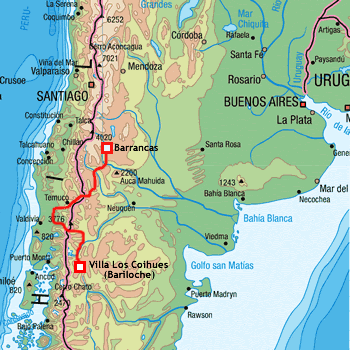
Our
cycling trip through Chile: click HERE to view larger
map and more details
Camping
Nonthue
is 10 kilometres from the Chilean post and marks the
beginning of some wicked climbing. Apart from one small
and another substantial downhill, where we are falsely
lead to believe we are home and hose, it is up all the
way. And unfortunately for our now very delicate bottoms,
it's a shaky and rattly pedal. Some of the switchback
gradients are severe, but nothing compared to the angle
of the road camber. Ali lets me know on a few occasions
and always from an "s-bend" a few metres above
that he is changing the website to tour.tk: pushing
the bike around the world.
From the campsite, we cycle 21 kilometres
and elevate 614 metres to the Quilanlahue turn-off.
The area is gorgeous, though the state of the roads
means we see little more than a tonne of rocks, matching
amount of potholes and a whole load of trees. The last
18 kilometre stretch, though predominantly flat in parts,
is so pebbly it really has its toll. We are both very
happy to squeeze our brakes against the handlebars on
the 16% drop into San Martin de los Andes
- Argentina 54km; 941m
Dinner with the Huttons
We find the street where John and Linda,
a couple we have met 3 times before - twice in Turkey
and once in Thailand -
are staying. The numbering is confusing and we go up
and down a few times before seeing someone in typical
backpacker attire: zip off trousers, sandals and mac
running down the street after us. It is of course John.
Who else would be running like mad after a couple of
lost loaded cyclists? It's great to see a familiar face
and his hasn't changed a bit in the last two years.
We opt to stay at the campground, though
the place is rather dank and dreary after all the rain
the region has received in the last four days. It doesn't
have tables and chairs of any suitable order either,
but it is easier for us to carry out repairs when everything
is out in the open. And the weather promises to be good
for a change. We arrange to meet at
La Colorada Hostel
for dinner and when we arrive, Linda has prepared a
delicious vegetable stew with rice. Dinner finishes
with fruit salad, chopped biscuits, chocolate scrapings
and yoghurt. The dessert proves to be such a success,
that we have it for three nights running. I believe
it is a staple treat of the Huttons.
San Martin de Los Andes is a big, fat
tourist town, as are many of the places around this
region in both Chile and Argentina. While not really
a spot where we would sit for a few days, it is on the
contrary lovely to relax with the Huttons and chat about
travelling adventures to date. Seeing people time and
time again on indefinite or lengthy travels is a good
way for us all to touch base and grab at a little bit
of constant in our transient lifestyle. John and Linda
have been on the road for seven years now and they still
love it. Just wandering around our planet seeing all
the interesting (and not so interesting) places it has
on offer. So, naturally we have lots of information
to compare and trade and of course laugh about. It was
sheer pleasure having a good ol' yarn over dinner with
the Huttons. We look forward to the next one.
Never look a perfect campsite
in the mouth
With most of our repair jobs out the way, we are ready
for the 3 day trek to Bariloche, where we will most
likely meet up with
James
for the record breaking ninth time. We are going to
cycle the Seven Lakes Route, quite a famous tourist
trail known mostly for its panoramic vantage points
over landscapes of snowcapped mountains and ultramarine
blue lakes. This section of Ruta 234 joins San Martín
de los Andes to Villa La Angostura. From here it should
be one more day to Bariloche where our plans are to
relax a while before bussing it to Buenos Aires. Our
cycling will then start again through Uruguay and up
to those Brazilian beaches that we keep referring to.
John and Linda see us off from the
campground with lots of warm hugs and best wishes. We
take to the main road leading to Lago Lácar and
begin tackling the first long ascent. More undulations
follow and just before the top climb [1169m]
of the day at 19 kilometres and 562 metres of elevation
into the trip, we meet Michael, another German cyclist
travelling north.
The sun is shining strong, we have
perfect blue skies and lake scenery around us and above
all we are firmly revolving our wheels on bitumen. Therefore,
it a little hard to relate to his horror journey yesterday
on dirt with Sunday sightseer traffic, but his little
head shakes and mumbles of "terrible, terrible,
terrible" ring home loud and clear. Seem to
remember hearing that before. Argentina can be soul
destroying cycling at times, but I guess we'll know
all about that tomorrow. We also learn that the suggested
20 kilometre unpaved section on Ali's map stretches
to more like 40 kilometres.
Even with this in mind and the wind
bending the flower heads of white marguerites and pink
everlastings directly towards us, it is a great ride
and when we stumble upon Camping Falkner, we decide
it is all way to good, not to stop for the day. Lago
Falkner (50km; 814m) is just stunning,
even more so than Lago Machonico down the road. Little
do we know, Lago Villarino is just a few hundred metres
up the road on the right and there they have a free
campground. Still the 25 pesos each is okay for our
spot and apart from one weirdo staying at the campground
who persistently walks through our designated spot,
we have a great afternoon watching wildlife and warming
in the sun.
Posh camping
It is just 3 kilometres and 78 metres of up to the start
of the unpaved road. The lake scenery is spectacular,
so the initial state of the roads doesn't sink in until
the ugliness of roadworks becomes more prominent and
the gradients get steeper. From the campsite the tendency
is on going up. We reach a high point after 20 kilometres
and 382 alti-metres, but undulations continue for the
rest of the day and every inch of the way to the end
of the 45 kilometres of dirt and the intersection with
Ruta 23. During this time we have not only passed Lagos
Escondido, Correntoso, and Espejo but plenty of backpackers,
half loaded cyclists with front shockers (which I'm
a little jealous of), caravans and campervans. It's
a bustling little metropolis of holidaymakers.
We finally see the last of the seven
lakes: Lago Nahuel Huapi as we near Villa
La Angostura (58km; 876m). A ciclovia
[cyclepath] takes us passed
Campsite
Unquechue
directly behind the conveniently placed Todos supermarket.
It is kinda posh and very organised and owners want
an outrageous 68 pesos for a plot without a plug. While
it looks like a nice place, we soon grow weary of all
the "do and don't" signage plastered over
the walls. And if you decline on the electricity, you
get dumped all together on slopey ground. It is almost
worth paying the extra 6 pesos to get a more secluded,
private spot with a flat pitch. Still it is only for
one night.
We meet Sofie and Kit, who have come
from Bariloche and they had headwind for most of the
way, at which I can't help secretly rubbing my hands
with glee; thinking about being blown down the bitumen
highway and into tomorrow's destination is pure joy.
There's a whole lotta shakin'
going on
Well, we wake and do all the usual sort of stuff to
get on the road. We glide along the bike path to the
town centre, which many may describe as quaint and we
hit the highway and the uncharacteristic easterly wind.
There'll be no tailwind escorting us today. Fourteen
and a half kilometres out of town there is a marvelous
national park campground set right on the lake for 15
pesos per person plus an additional 8 for the tent.
The highway riding is not particularly
pleasant, but we battle the 63 kilometres to the intersection
of Ruta 40 and then turn gradually in the other direction.
Twenty kilometres later and we are almost in the centre
of town. We have a map, picked up at the tourist information
a few kilometres back, which marks all the campgrounds.
The first two have such steep driveways running directly
onto the busy coastal road and they are a long way from
any supermarket, that we decide to head out of town
to a campground near Lago Gutierrez.
The ride along the narrow, no shoulder
coastal highway is horrendous. Fast cars; fast trucks
and fast buses with no concern for a loaded cyclist.
After the steep but short climb up at the the turn-off
to Villa Catedral its an easy 6 kilometres to Villa
Los Coihues - Bariloche (97km; 845m).
Camping
Los Coihues
is perfect as far as we are concerned. Grassy, clean,
with hot water and electricity (not at our site though),
wifi, chickens, ducks, horses, dogs, a kitten, black
necked ibises, other water birds and the crystal clear
water of Rio Negra running next to us all for
25 pesos each per person per day. Along with that we
get some brilliantly hot weather: enough to dip in the
icy river water and of course on February 27, a whole
lot of shakin' going on, when the earthquake hit Chile.
Shaken, not stirred
I awake in the tent at 3.34am as the ground begins
to move underneath me. I am not drunk. The tent
is swaying like it there's a storm outside. There
is no wind. Even lying on the ground, I placed
my hands on the floor to steady myself. Ali hasn't
stirred. I don't know what this is. In my half
slumbered daze, I shake Ali: "Quick Ali!
Get out! A horse is eating the tent".
I know, it is no rationalisation at all. But in
my defense, horses do roam wild here. Either the
fairground ride or my bizarre suggestion of equine
destruction were enough to wake him up and he
soon puts me straight. "We're having
an earthquake"
"Well, I think we should
get out of the tent then," I reply and
out we crawl. It lasts for what appears to be
two to three minutes and then we retreat back
into our sleeping bags having experienced one
of the most unnerving events in my life. I think
I said "Whoah!" at least twenty times.
"My God!" quite number more and a few
other words I won't mention here. And then it
dawned on me that, somewhere out there, others
must have felt it in a really bad way.
There's no psychological understanding
of an earthquake. "The earth moved under
my feet" is only a song you know and
when Mother Earth starts imitating some of those
wild salsa hip movements the Colombians have perfected,
your senses become quite insecure. They don't
know how to cope with it. I know mine didn't.
I became damned giddy. Besides the physical rolling,
which is really weird, the irrationality that
the ground, something that you have grown up understanding
is solid and rigid, starts acting like the ocean;
and suddenly you feel like you've had one too
many beers down the pub.
And I still do, even days after.
Mind you, Mother Earth hasn't stopped practising
her dance steps either. This now has me glued
to internet news to see what other destruction
she might have caused. And relish the thought
that living in a tent is probably one of the safest
abodes during such a crisis. What I have also
found out, is that earthquakes are happening all
the time. And, I do mean all the time. Thank goodness,
not in the severity of the one that hit Conception
in Chile recently, but just take a look at the
long list of
earthquakes
each day
on this website. It is really quite astounding. |
James
arrives on the last day of the month and it is super
to meet up with him again. Believe it or not, he slept
through the whole event last night, but he gets to feel
a couple of small tremors in the evening during a veggie
barbeque with good wine and lots of enjoyable tête-à-tête.
More next month about other degustatioins of pure relaxation
and merriment.
|
|