
on the road preparations tools country information links about us contact home
PUBLICATIONS: CYCLE TOURING TIPS


We have published several pages with video, us in the media, tip of the month's overview, distance charts and statistics pages.

page number 1: cyclists in the news
page number 2: video
page number 3: tip of the month (you are here)
page number 4: statistics
page number 5: distance chart [.xls]
page number 6: frontpage photos
page number 7: cycling towards a good cause


CYCLE TOURING TIPS

We pick up lots of cycle and travel tips as we pedal around the globe. Some purely out of common sense and some we learn from other travellers. In any case, each month we dedicate a space on our 'on the road' diary page to the 'Tip of the Month' and after a year of gathering this info, we thought it would also be good to show them as an entire overview. That way you can look through them easily, to see if you can use any yourself...
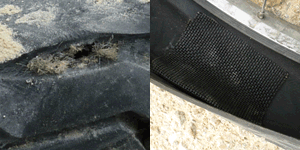
tip of the month August 2010

August 2010: split tyre?
So your tyres are wearing dangerously thin and you haven't managed to find any decent replacements yet.
Then the inevitable happens: your tyre splits.

No need to panic if you have a square of strong awning cloth (also known as canopy or shade-cloth) in your repair kit. Folded double and placed inside your tyre, it can get you a lot further on your trip. It is lightweight, cheap, doesn't take up much space and is available at most garden centres. It is also advisable to put this tyre on the front of your bike too, thus taking less weight strain from your luggage.
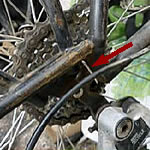
tip of the month July 2010

July 2010: stuck in the middle of nowhere with a snapped quick release skewer?

We never thought that this would happen, but it did. The quick release skewer snapped and we were stuck nearly ten kilometres from a decent sized town with a bike shop. We had to get to that bike shop, but how?

Well a spoke will do the job for the interim. It's strong enough to withstand the pressure and if you bend it (see arrow) close to the sides of the hub, the wobble is kept to a minimum. You may need to adjust the brake blocks if they are really in the way. We cycled ourselves, slowly but successfully, to the nearest repair shop.
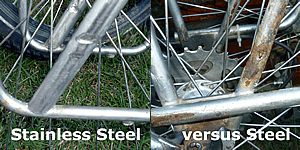
tio of the month: steel vs stainless

June 2010: Stainless steel versus steel racks
Tubus make some of the sturdiest touring racks available and their trusty performance during the last four years of our travels is proof enough of this. In 2004, I was faced with the decision of whether to purchase a 25CrM4 steel or a stainless steel front low rider. Besides the extra outlay for stainless steel, I had no idea what the difference would be then. Here's what I discovered.

All steel tubus racks come with a strong polyester-based coating. However, modern panniers have plastic hooks containing fiberglass. Combined with sand and dirt, the continual grind can wear down the metal, which can lead to erosion. Tubus's advice: "Always affix our Art. 79000 Anti-scratch set before using bags" and "If your carrier has already scratched areas, you can repair it with a common paint stick. Such a repair is not necessary for the fatigue of the carrier, it is only for a nicer visual impression."

The picture on the left is taken after four years of continual travel. It shows how extremely resistance the stainless steel version is compared with the 25CrM4 steel. The only disadvantages of the stainless steel carrier are that they are a bit heavier; have a slightly lower maximum load capacity; and if you are faced with having to weld it at some stage, the metal requires a different solder and depending on the set-up, quite possibly another gas source. Likelihood of a local garage having suitable equipment is not high.
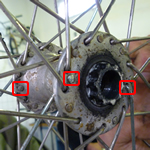
May 2010: How to lace a 32 spoke hub to a 36 spoke rim
When time is of the essence; the only parts are a 32-spoke hub and a 36-spoke rim; then a little bit of improvisation is in order. And here's a solution to get you successfully back on the road.

Drill four extra holes in your hub keeping in mind that they need to be as close to dead centre of the two existing holes as possible. Lace the wheel as per normal with four spokes being a fraction longer. While your wheel will not be perfectly true, you will be able to pedal. And sometimes that is crucial.
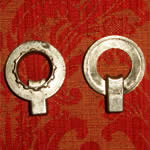
For a more detailed picture, click on the left image.

April 2010: Not only hot water, but a cooked breakfast as well

A water heating element is not only good for a pot noodle snack, a cup of tea, coffee or cuppa-soup, but it also boils eggs just the way you like them. Place the eggs in the pot, fill with water, add the element and let 'em boil.

Great if you are feeling like a cooked breakfast, but don't really feel like venturing from your hotel room.

March 2010: a little memento
Having business cards with your web and email information is definitely a growing trend among travellers and a nice memento for those you meet.

For a start, it is easier than writing your details, goodness knows how many times, on bits of paper that get forgotten in a trouser pocket. Additionally, apart from being impressive, there is little chance of handwriting misinterpretation. It is also not necessary to go to the trouble or expense of printing them off professionally. A simple layout on an A4 page, which can be easily printed off in an internet cafe will suffice. That way you only have to carry a few at a time with you.

February 2010: the perfect fire starter

With all the camping in the last months and the numerous chances to light an open fire, I thought back to this great fire-starting tip I heard about while cycling in the USA.

Soak cotton wool balls in petroleum jelly (commonly known as vaseline), and store in a sturdy ziploc bag. When it comes to starting a fire, pop one of the balls on a stick and place in an optimum position under the wood and light. It will burn long enough to get your firewood properly blazing.

January 2010: Propel water bottles beat any plastic bike cage bottle we've ever used!
These propel bottles were bought in the US at a local supermarket filled with flavoured water way back in the middle of October 2008. They cost just US$1.79 each. They also fitted perfectly in our bike cages and looked sturdy enough for the endurance of cycle touring.

And with Ali's getting the first hole just a little over one year, one month and one week later, that was proven correct. Besides their see-through nature, which means you can tell when they need a good clean, they have been tough and excellent value for money. Whether the company still produces the same bottle or not we don't know, but if you stumble upon them, then we suggest you purchase a couple. They are superb touring bidons!

December 2009: the best wet-weather gloves money can buy
Gloves that are so bulky its difficult to change gears; gloves that freeze your fingertips; and gloves that just simply aren't waterproof when they said they would be. We've tried them all until this tip passed down from Max to Kevin presented itself to us: So, here's the simple and affordable solution...

Any set of gloves; even your long fingered bike gloves will do for the inside layer and then cover them with a pair of industrial strength latex gloves. Stops the inside gloves from getting wet, so your hands stay warm and dry and gear changing is easy too.

November 2009: a more natural way of keeping the sandflies at bay
From Mexico and further on south through the Americas, sandflies can be an irritating problem. Ecuador and Peru especially have plague proportions in certain areas. One sure fire way of keeping these annoying little critters at bay is to purchase one of the local repellents.

Of course, these lotions contain plenty of chemicals and quite often high percentages of DEET, so if you want a more natural solution then why not try smearing a layer of baby oil on your unprotected skin. It really does work, though you will need to do this regularly throughout the day. Still, it can't harm you, and you end up with baby soft skin as well.

October 2009: I'd kill for a cuppa...
Before we bought our water heating element, there were many moments when I could have killed for a cup of coffee or tea. But let's face it, getting out the multi-fuel stove each time and firing it up, especially when you are not camping, is a real pain in the neck. Well, we no longer have that problem.

There are many makes and models of water heating elements and the cheapest on the market go for just a couple of dollars. You can find them in camping stores, travel departments or electrical stores. So, if there is electricity, then you can have boiled water at any time of the day or night. Not only handy for a well deserved cuppa or pot noodle snack, but you can treat the tap water you are not quite sure in a matter of minutes.

September 2009: What to do with the old Therm-a-rest matress?

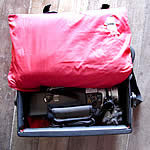
We love our Therm-a-rest mattresses, but we have had problems with de-lamination deeming them useless for sleeping on. But if you are into recycling, then here's a little tip... they make great insulation or padded bags.

Out of the last mattress, I designed a computer bag protector and a bike travel bag that not only fits snuggly on top of my back Ortlieb pannier, but is reasonably insulating too. The latter also doubles as a day pack and stuffed with a couple of clothes makes a great pillow. The fabric itself squashes up really small; is easily cleanable; and if it gets wet, it dries in a flash. So the possibilities are limitless... water bottle bag, hard drive protector, ipod holder...

August 2009: the benefit of enamel plates

Okay, metal plates are going to weigh a little more plastic ones, but they do have their advantages...

Not only are they cheap and robust, but they can keep your food warm too. Firstly, in combination with a tea towel-wrapped cooking pot, you can save from two thirds to half the cooking time of pasta and rice. Secondly, used as a base and lid, when making something elaborate like homemade chips or a pile of pancakes, the plates can keep one batch hot while cooking another: especially if you cover them with a tea towel. Furthermore, set next to an open fire they have similar benefits for keeping your tucker at the temperature you like it.

July 2009: in place of the paper coffee filter

Up until Mexico and Central America, we had no problems finding inexpensive unbleached paper filters for our ortlieb coffee holder. From then on in, it was not only difficult sourcing them, but when we did come across them they were bleached and we had to fork out an arm and a leg for a months supply. It was time to figure out an alternative.

With some no-see-um (sand-fly) netting left over from tent repairs and using the same measurements as a No 4 cup filter, I sewed together this little addition to our kitchen. As well as weighing and costing us next to nothing, it cleans easily with a good shake and a bit of water. Furthermore, it is way more environmentally friendly.

June 2009: teatowel pan caddy

We have mentioned this tip before, but with the rise in popularity of cooking-caddies, we would like to re-iterate one of the many uses of the common 100% cotton teatowel. Tea towels can act as an insulator too and we use ours as a cooking caddy. Pasta only needs to be cooked for a third of the cooking time and then wrapped up and left to continue soaking until the sauce is prepared. Rice takes a little longer but performs exactly the same.

When camping and staying in colder environments, we also place our enamel plates on the top and bottom for extra insulation. Added benefit here being, it also warms the plates up before serving the meal. So, not only can you use the teatowel for drying your dishes or a picnic cloth for preparing the sandwiches roadside, but it can save on your fuel consumption as well.

May 2009: hook-it good

One or two of these can pull you out of a fix, when left with a bare wall and nowhere to attach the clothes line or mosquito net.

Usually there is a spot somewhere in the room or cabin that is made of wood perfect to fasten this screw hook in.

April 2009: Handy velcrose straps

Whatever you call it: velcrose, rip-zip, or hook and loop, this haberdashery item is useful in many impromptu and permanent situations. We always have a supply of it in the sewing kit.

Most electrical cords come with a handy strap these days, but if they don't, it is easy enough to make your own. Not only this, but it can hold tins tight or be a temporary fastener if one of your bag buckles breaks. We have found that the latter works just as well as the clip and hence it is now a normal fixture on one of our Ortlieb back-rollers. Some even use these straps to tie their brake handles to the handle bar when parking their bike on a hill.

March 2009: The next best thing

The NBT2 lockring remover has assisted us in fixing many a broken spoke in the last 32 months of travel and will continue to do so for the rest of our travels no doubt. Honestly, don't leave home without one!

After the first broken spoke, it gets easier and easier to use this cassette removal tool and to find out more about how the NBT2 works take a look at the M-gineering site. Ordering can be organised by sending an e-mail directly to the company, who will ship almost everywhere and they conveniently have a Paypal account as well.
February 2009: the bag bucket

Doing the laundry piece by piece under the shower is okay for a few washes, but sometimes, clothes just need a good old soaking in soapy water. Most camping cyclists will have some sort of foldable kitchen sink or bucket with them for this purpose, but what if you haven't?

Basically, a couple of strong plastic shopping bags will suffice.
Only catch is you have to have somewhere to lean the bags up against. They do tend to be a bit unstable.

tour tips diva cup

January 2009: the perfect female travel mate
While there is no real remedy for the moody spells and uncomfortable disposition, there is the revolutionary Diva Cup to end those other hassles associated with that time of the month. A menstral cup is so clean, reliable and convenient: no more being caught off guard without that bulky supply of sanitary napkins or tampons, no more leakage problems and you can wear it safely for up to twelve hours at a time. All you need is a bit of water to wash it with and a few cycles to get used to using it in the beginning.

What you also shouldn't forget is you'll not only be saving yourself loads of money, but you'll be doing your bit for the environment as well. It has to be the perfect female travel mate, but whether you're on the road or not, I'd still recommend giving it a go: I'm pretty sure you won't ever want to go back!

tour tips ortlieb coffee filter

December 2008: for those that can't live without real coffee!

Everyday is a new day and we like to start it with a decent caffeine fix. Not being lovers of the instant varieties, we purchased an Ortlieb Coffee Filter Holder early on in our camping career.

It is really lightweight, folds completely flat and all you need are No 4 filter papers, a couple of chopsticks and real coffee of course. We can't fault the simplicity of this kitchen addition and we wouldn't be without it. Mmmmm...fresh coffee every morning: one of the little luxuries we just don't want to give up!

tour tips dog dazer

November 2008: Dash those damned dogs!!
For reasons unbeknown to me, dogs from all walks of life seem to have an objection to pedalling legs and will dash from far, far away to try and rid the roadside of their pet-hate. Hence, nearly every touring bike forum has a thread dedicated solely to advice of how to get out of this, sometimes very scary, situation.

Now, there are many ways of handling those dastardly canines when they come hurtling towards you, savagely bearing their dagger-like namesakes and looking as if they'll have you and your bike for dinner. The obvious one is to stop cycling, place your bike between you and the offender and try and walk away. If they continue to annoy you, then pick up a stone. Most will immediately cower from this gesture and give you enough time to get out of there fast, but if they still persist, throw it at them. You can also flag down a car and have them shepard you out of the situation.

In our experience, the above methods haven't always worked, especially when a pack of dogs has been involved, and that is why we purchased a dazer. It fits in the handlebar bag and can be used a lot quicker than bending down to find a suitable stone, or hope that a vehicle timely passes by. So far, it has worked on every occasion, except on a mother with newly born puppies (says something for motherly protection) and a couple of deaf dogs, which makes sense seeing as the dazer releases a sound signal that our canine friends don't find particularly appealing. It doesn't hurt the beast and is a much less aggressive way of ridding yourself of an annoying animal.

tour tips ergon grips

October 2008: when the ergon-grips wear out...
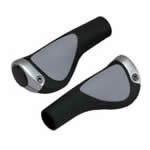
I think most people that use Ergon grips or similar brands have felt the benefits while touring. We both have fitted the GP-1 series on our bikes. After a little more than a year of cycling however, they were wearing pretty thin on the top side and although the manufacturers will surely dissuade you from doing this, we decided to turn them over and see if the grips had the same supportive effect on the reverse side.

Turns out they worked perfectly, however they did take a few days.to wear-in, but then again, so would a completely new set. We cycled happily with them up until last month, when we both decided it was definitely time to replace our well weathered grips. That was an extra years worth of riding and all in all we cycled with them for a total of 26 months.
toru tips hema towel

September 2008: the everyday cotton tea-towel for multiple uses
Okay, you are thinking, what do you need a tea-towel for with all that microfibre out there these days?
Well actually, some things are just good the old fashioned way and our cotton tea-towel, a seasoned 6 years old when we left, has remained strong throughout its further 2 year bashing on the road.

So, we use it roadside as a picnic cloth, for making sandwiches on or just plain sitting on. It hangs almost permanently from a bungi cord on the back of my bike so it's always accessible and this is how it usually dries as well. Also, when preparing pasta or rice, we cook it halfway through and then wrap the saucepan in the towel for the other half of the cooking (soaking) process and while we get the sauce ready. It keeps the pot piping hot. And then at the end of the day, it works well for drying your dishes as well.

tour tips bear proofing

August 2008: Bear-proofing
Camping in a spot with no food cache? Then, here's a tip, besides the tedious hanging your food bags between two trees solution:

If a rubbish bin is in close vicinity, then open up the back (you'll need two hands for this operation) and underneath where the rubbish bags hang is enough space to store your food overnight without it getting contaminated by the rubbish that comes in from the front.

toru tips tupperware flatout

July 2008: A FlatOut Tupperware Treat

The Tupperware FlatOut™ 3-Cup Container has come in so handy during our travels, that we thought we had better share the secret with everyone. They are expandable airtight containers that flatten to a disc for easy lightweight transport when not in use. There are different sizes but we found the 3-cup (700ml) variety to be the best for us. Being expandable, also means it has three different sizes for storing the left over rice dinner or salad that can be enjoyed the next day while on the road.

Just take a look at the storage section on the Tupperware site for more details. Shouldn't be too difficult finding a Tupperware supplier near you.

June 2008: Got a bike touring or camping tip you'd like to share with us?

Let's face it, this sort of info should be shared amongst the biking and camping enthousiast community.

So, if you have a great tip that you think is worthy of telling everyone about, then just send the nitty gritty details to info@tour.tk and we'll publish it in this spot as soon as possible.

tour tips valves

May 2008: Best travel value valve...
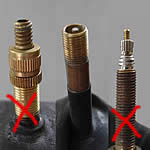
There are lots of debates about which valve type is better and we don't really want to enter into that, but as far as travelling in far off places and in not so westernised countries for extended periods of time, it is better to take the common car valve tube along for the ride. There are a couple of reasons why we recommend this:
1. You can purchase these tubes nearly everywhere in the world. Biggest bonus!
2. You can pump them up with air everywhere: at petrol stations, tyre establishments, bike and motorcycle repair shops. This valve is truly universal!
3. Once you have the car valve fitted, then the hole in your rim will accomodate all other tube types in an emergency. The other way around just doesn't work.
tour tips postcards

April 2008: decision by postcard

This tip is from John and Linda and although it may sound a bit strange, postcards can actually help you make your mind up as to which sights you visit and which ones you avoid.

The logic behind this is as follows: if you are in two minds about visiting a museum or a particular attraction, then go to the nearest postcard rack and check out what they show off as the main features. This way you can get an indication of what's in store and whether it's something for you to visit or not.

tour tips wet boots

March 2008: wet boots!
It's all a bit of a common sense thing really, but seeing as we had to use this antidote yet again, after the skies opened up on us in Malaysia, we thought we'd share it with you too:

Basically, if your shoes are wet, stuff them full, (and I do mean to the brim), with tightly screwed up balls of newspaper. The paper absorbs the moisture quite quickly, so be sure to check them after a few hours and see if you need to replace the wet with fresh paper. Furthermore, if they are not completely dry the next day and you have to wear them, then line them with a few pages of neatly folded newspaper. Much better than wet socks, I can tell you and helps dry them out as well.

tour tips handlebar bag pillow

February 2008: pillow equipment stabiliser
It was always a toss up whether we would take a pillow along or not on this trip. Comfort won out and amazingly enough, the super small and lightweight Yeti pillow gives just that little bit of angled support that it really does makes all the difference to your night's sleep.

And, as time went on we found a dual role for this little creature comfort...
After trying all sorts of foam padding, which works well, but does take up a lot of space, I now pack my camera in the pillow, which fits perfectly double folded around the equipment, in my handlebar bag.
tour tips cd reflector

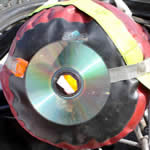
January 2008: recycled reflectors
Anyone who has travelled in Asia will have seen this numerous times before:

Old cd's used as bicycle reflectors. I only use one on the back of my Ortlieb dumpsack which I think is enough, but I've seen wheel spokes completely filled with discs. Another popular spot is to attach one behind the usual back red reflector for added visibility.

I made a custom ripzip (velcrose) strap so I can attach it to my ocky straps or anywhere else on my luggage.
tour tips thermarest chair

December 2007: Thermarest chair: not just a campers best friend!
Time to give Therm-a-rest a plug. Not only have we experienced some of the most curtious and quick remedy service, but their Lite Chair kit has become a faithful friend even away from the campsite. For long term camping phanatics, they are a must and the dilema of "which position to sit in next" is solved immediately. The chair, being filled with your thermarest matress is also insulated and will provide a warm comfortable seat in the most uncomfortable of places.

Outside the camping field, we have used them in hotel rooms without chairs or with chairs that we didn't dare put our bums on. But it truly outdid itself when I recently had back problems: it supplied me with a very supportive, back-relaxing seat.

tour tips shower cap

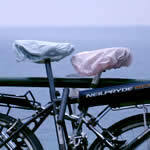
November 2007: multi purpose shower cap

And you always thought that a shower cap was nothing more than to keep grandma's hair dry
while she was under the shower. Well you are wrong...
Of course, grandma still uses hers, but cyclists can make use of them too.

Perfect for keeping your seat dry while you're not sitting on it.
For extra waterproof on your handlebar bag and even your day bag in a downpour.
Available world wide for almost nothing in an amazing assortment of colours.
tour tips spares India

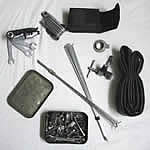
October 2007: Take your spares to India!
Although we only travelled in the north of India, we imagine that finding specific parts is difficult all over the subcontinent, even though there is a bike shop to be found in the smallest of villages. Any of the bike bazaars in the bigger towns had only kit bikes and everything was of a pretty poor quality or completely different sizing to our mountain bikes. No car tyre valves or French valves on their tubes either, so, if that's your fancy then bring them with you. There is a chain of Firefox Bike Stations throughout India, stocking Trek bikes and associated parts so this could be an option in the future.
toru tips smelly tevas

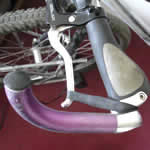
September 2007: Smelly Tevas?
Got this great tip from the Wereldfietser Forum.

Tevas are renowned for stinking. So if this happens to you, soak them overnight in a bucket of reasonably concentrated Dettol solution. Can't hurt to give them a bit of a scrub in the stuff as well.

Should stay pretty fresh for at least a month.

tour tips hand break bike stabiliser

August 2007: Inner tube bike stabilisers.
Miriam and Javier told us about this great tip for stabilising your bike in almost any parked situation. Just cut your old inner tube into rubber band like strips and put them around the ends of your handle bar. When resting the bike on a hill. slope or position likely to result in the cycle falling over or rolling away, use the bands to hold your front and/or back brakes in position.

The elastic bands also come in handy for setting your brake blocks in place.

Furthermore, if you cut the strips thin enough, you can use them as normal elastic bands.
They are super strong and don't deteriorate as quickly in the sun and heat like the normal variety do.
tour tips cleaning stove

July 2007: A primus cleaning tip
Trouble with a badly burning fuel stove and you have done everything to try and rectify it? Probably due to a built up residue in the lines and places that you can't really get into to clean. And, no matter how many times you prick the fuel hole, it just keeps on clogging up.
Dismantle the whole stove and immerse everything in Coca Cola (overnight preferably). Before putting back together, wipe clean with a rag and make sure all parts are bone dry. It is probably a good idea, at this stage, to renew your fuel source as well. The problem is often caused by dirty or old petrol. If that's impossible, then filter the fuel through a coffee filter to remove any unwanted bits.

Note: Coffee filters are also quite useful for putting on the end of your water filter's inlet hose in high sediment areas. So, it is handy to carry a few with you and they take up hardly any space in your bags at all.

tour tips ortlieb bag clips
June 2007: Tape and old tube to secure Ortlieb bags.
Just to annoy all Tubus rack owners, a few years ago, Ortlieb decided to change the size of their clips, so they could be used on a variety of bike racks. In order to fit Tubus models, you now need to insert a small black clip into the existing fastener. Problem with this is, they inevitably fall out even when you glue them in, which of course, leads to irritating search parties around campsites and in hotel rooms and corridors. Furthermore, this system does not stabilise the bag at all and they continually fly off on poor condition roads. Nigel, a cycling guru, who we met in Osh and on the road for over five years now, told us about this great idea. Wrap a few layers of old inner tube and secure them in place with gaffa or power tape. He swears his bags have never come off since he made this adjustment.
tour tips pristine bills

May 2007: Only pristine paper bills
In Central Asia especially, it is important that your American dollar bills and European Euros are in pristine condition. No unusual ink marks, pen scrawlings or even small tears because the banks and exchanges will not accept them. Beware though, as they'll have no problems dishing you out the shabbiest of currency and often on purpose. But of course, it works both ways: you have every right to refuse sub-standard bank notes from anyone and although they'll make a fuss at first, they will change it for you eventually.

tour tips sigg bottle clean
April 2007: Keeping the Sigg bottle fresh!
There's nothing worse than musty flavoured water and here's two ways to keep your Sigg bottles (or any other bottle for that matter) a little fresher. Sigg does sell "special" tablets to clean their bottles, but at a ridiculous price. They are little more than denture cleaning tablets, which you can usually obtain from either a well stocked supermarket or pharmacy. They are very inexpensive and do the trick just nicely. Fill the bottle almost to the top and pop a tablet in and allow to soak overnight. Empty and rinse a few times with fresh water the next day. You can also use the denture cleaning powder: it does exactly the same job.

Another way to keep your water tasting good is to squeeze just a little bit of fresh lemon juice into your bottle. You don't need much to get the desired taste and it is especially good for those of you who don't like drinking water. Adds a bit of an edge, while keeping the water bottle fresh.
tour tips wet ones
March 2007: for those times without a shower
After a sweaty days cycling, there's nothing like a hot shower. Unfortunately, water is not always available nor suitable for cleaning in and this little tip is the next best thing. The commonly known "wet ones" are available all over the world and these days come in the handiest sized packets. The example from a Dia store in Turkey on the left has fifteen sheets, which lasts us between four and five days. They really do make you feel and smell cleaner.
tour tips hassling salesmen
February 2007: how to handle the barrage of hassling salesmen!
Ali cleverly devised this one liner, that in most cases works and saves you a lot of annoying banter. The salesmen here quite often use the line: You come from Australia? (or whatever country they think of at the time), to start up a conversation with you. Turn around and say: No. You come from Turkey? Generally stops them dead for a few seconds and gives you enough time to walk out of hearing distance.
tour tips survival sheet
January 2007: survival sheet comes in handy in the cold
While huddled inside our tent at minus tempertures and sipping on an air-cooled beer, Simon and Pierre-Yves (the two French guys we joined up with at the end of the month) told about this great tip that is very close to my heart. To protect yourself from the cold: lay a survival sheet on the floor of your tent and if it gets well below zero, then place one over the top of the inner tent as well. They are light to carry and every cyclist should have at least one in their first aid kit anyway. Obviously, they are not indestructable, however replacing them at intervals is not really going to break the budget.
tour tips silnet silicon sealer
December 2006: SilNet - silicon seam sealer (McNett outdoor products. USA)
Every camper/ travelling biker should have a tube of this stuff. Made by the same people that make SeamGrip, we have used it successfully to reinforce stitching and seal leaks in our tent, fix holes in the Ortlieb bags, and even repair a resonable sized snare in a Goretex rain jacket.
tour tips bungie cords ockie straps
November 2006: Ockie Straps of a different type
In England about 12 years ago, we found the ockie straps that we are still using to this day. Also known as bungie cords, they are made with a plastic mould clip which is virtually indestructable. The advantage over the commom stretch cord with wirehooks is that it doesn't bend out of shape, rust or make unwelcome holes in your luggage. We made our own this time round and the separate components can be purchased from Bike4Travel should you want to try them out.

Other uses include:
Winding two together and stretch between posts to make a great washing line that doesn't need pegs. Another bonus is they don't damage trees.
Securing your bikes together and to railings on boats and trains.
toru tips feed the ants
October 2006: feed the ants don't kill them
Want to be sure that the ants don't raid your tent? Then give them something to eat too. A couple of sugar lumps (or anything sweet really) placed at a distance from the tent will keep the neighbourhood ants occupied for the length of your stay. Glad ziplock bags (the genuine ones not some copy brand!) are also pretty good for keeping pests out of your food supplies and are easy to wash and re-use.
tour tips carry toilet paper
September 2006: the only way to carry the loo-paper
An ozzie friend once told me about this and I'm sure that most backpackers already know the secret. At first I thought she was mad and it wouldn't make any difference to the "carrying easablity" by removing the inside carton roll. But there you go, I was wrong and for those of you that have never tried it, it's a great way to carry toilet paper. What's more, it makes a nifty little dispenser at the same time: Take the cardboard roll out of the middle (this can take a bit of work but persevere). Flatten the roll, making sure the middle piece of paper is sticking out and place it in a zip lock glad bag (or similar). This all fits really neatly and in the tiniest of spaces of any bag. Pull the paper from the middle each time and this creates the dispenser. You never need to get it out of the bag which makes for handy usage in the grottiest of loos and anyone who's camped or travelled on a budget will know exactly the benefit of that.
tour tips baby bottle
August 2006: for storing liquids, use a baby bottle!
If you don't mind clowns and happy faces on your storage bottles a good, very cheap, and 'super-safe for liquids' alternative is a baby bottle. In the past, I've always used Body Shop containers since the ones at camping stores are always so astronomically priced. But after no success finding an outlet in France I resorted to trying the baby bottle and it's really good. You can also cut the teat off and you have a rubber ring for extra sealing, however it works fine without it.

top