In remembrance of Mia
Pusch
On January 5, Mia Pusch was killed on
State Highway 3, just north of Bulls, in the central
region of New Zealand's North Island. A truck
with trailer, travelling in the same direction
collided with the 19 year old cycle-tourist, who
was a few weeks away from ending her tour of the
country.
Our sincerest condolences to
all the family and friends of Mia.
In the NZ Herald Article, journalists
translated extracts from Mia's blog entry just
6 days prior to her passing away. Her words speak
volumes about the attitude of truck drivers in
New Zealand: |
|
|
“When one is a cyclist on New Zealand
roads, one is not only torn from one’s daydreams
by dive-bombing magpies but is more often threatened
by a more nasty species that really requires more
attention: truck drivers. One usually finds this
species driving permanently at a phenomenal speed
in a race against time. These beasts seem oblivious
to the fact that their loud beeping can have no
effect in making the heavily laden, long-distance
cyclist go any faster. They swerve past the cyclists
who are struggling under their own steam at break-neck
speed mainly within only a half-metre to a metre
gap, all the while aggressively honking their
horn. The fact that this in no way improves the
situation, but in fact makes it worse, appears
not to enter the minds of these people.”
This is now the third touring
cyclist - that we know of - to be killed on New
Zealand roads since we started our journey in
2006. All were hit by trucks. I can't explain
how this makes me feel. I know only too well the
appalling attitude of many road users towards
cyclists all over the world, but for New Zealand
to have such a track record: there is just no
excuse for it. None! And until the country does
something radical about changing rules and regulations
and increasing the amount of cycle paths, I'm
wiping the place from my list of places to visit.
I don't care how beautiful it is, I'm not going
to increase the risk of ending my life anymore
than I have to. |
| |
Camping Los Coihues,
[website]
, Bariloche,
Argentina, 27-02-10
To a capital of friends
16 kilometres after La Cebada - Santiago de
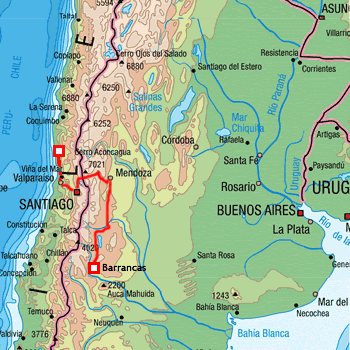
Chile (6 cycle days; 1 rest day; 384km; 4063m)
16 km. after La Cebada to 9 km. after
Huentalauquén Sur (70.00km; 828m)
9 km. after Huentalauquén Sur to Los Molles (66km;
697m)
Los Molles to 5 km. after La Laguna (73km; 952m)
5 km. after La Laguna to Valparaiso (63km; 358m)
Valparaiso to 6 km. after Curacaví (66km; 763m)
6 km. after Curacaví to Santiago (46km; 465m)
Against the force
After a sunset view through barbed wire and toasting
the New Year in somewhat early, January the first is
nothing special. Its the same occasional glimpse of
the coast, same boring scenery with the same fenced
off landscape of cacti and brown earth. Headwinds pick
up and the hills roll to the same intensity. We also
have the similar problem of finding a decent spot to
pitch the tent for the night. One could easily go insane
in these conditions, but you find ways around it: singing
or listening to music helps; designing the inside of
a bus for your next travelling adventures is definitely
therapeutic; or even pretending you are being interviewed
on prime-time television - my favourite time waster
has to be with Parkinson, but then I get to think up
all the questions. Lastly, you can make up a poem.
Cycling madness: travelling bliss
Another day of highway cycling; a landscape so hilly.
You certainly forget the time; battling along the
coast in Chile.
Another bout of headwind madness; howling throughout
the day.
Past barbed-off brown and pig-weed bluffs; not a
single place to stay.
Another night of roadside camping, listening to
the din;
Sipping on our Chilean wine; and toasting the New
Year in.
Another year. Yes,
another year; bit hard to comprehend.
Sat in the middle of nowhere; with a solitary
friend.
Another chance for contemplation; we have come
a long way.
Mexico's beach to Chile's seas; what more can
a person say?
Except another fit of figures; and so it neatly
rhymes
Twelve thousand, four hundred clicks; plus up
Everest 15 times.
Another thought for
those who wonder; how will I end this prose?
South America dishes up; as far as travel goes:
Another place to add to your list; of countries
to uncover;
Where people smile, wave and toot; and welcome
you with honour.
Another world like you've never seen; of Incan,
Mayan modes;
A world of mountains so high and vast; and humid
Amazon roads.
Another place in
our wide, wide world; where things are changing
fast
So, get there soon, get there quick; you're bound
to have a blast! |
An estacionamiento comes after 56 kilometres
in Huentelaquén Norte. We fill up with water
before confronting the headwinds again. Its an exhausting
ride and almost pointless trying to pedal against the
force. It seems like it won't end either as there is
absolutely nowhere suitable to camp. The first signs
of prohibited entry are also present along the highway.
A massive drop by the side of the road appears 9
km. after Huentalauquén Sur (70km; 828m).
It will have to do, though on a slope and barely enough
room to fit the tent.
A welcomed beach camp
In the heavenly quiet of lingering fog, we cycle off
this morning. Obviously there is no wind. Overcast skies
last as long as the early afternoon and cycling is easy.
We roll up and down the remaining hills on this coastal
route and enter Los Vilos. It is quite a decent sized
town and big enough to have a large supermarket. The
only hindrance to endeavouring down that path is the
climb leading into the centre of town. We stay on the
outskirts and shop at a mini-market. For two days worth
of supplies, we pay a small fortune. Water is free at
the last petrol station in the town, though we need
to ask the owner for a key to unlock the tap.
Only 19 kilometres up the road and
we restock with water at another estacionamiento, but
hardly necessary as we are pleasantly surprised with
the beautifully set-up of Camping El Chivato on the
beachfront at Los Molles (66km; 697m).
Being New Year weekend, it is the height of season and
totally packed. We are lucky to squeeze in on a not
so appealing spot, but it has a light, water and sink
and a shaded area for the tent. Normal cost is 12,000
peso, which is touching on European campsite prices,
but if you ask for a cyclist discount you can get it
for 10,000. After all the squashed up highway camping
in the past few days, this is a more agreeable way to
spend the night.
Posh highways
The highway riding is becoming awfully boring, but today
we have our fingers crossed, not literally of course,
for a change of pace and scenery after 31 kilometres,
when we turn off Ruta 5 and head towards Papudo on the
coast. There is a small general store close to the turn-off
and not knowing what the rest of the trip will offer
in the form of supply opportunities, we stock up. Though,
we could have waited until the more convenient supermercado
on the way out of La Laguna.
The only thing that really differs
from our previous route is the narrowness of the two
lane road and lack of shoulder. There is still plenty
of traffic to contend with and on the stretch from Papudo
to La Laguna, an extraordinarily high number of Mercedes;
Audi's and BMW's on the road. It's not surprising then,
that when you get to Zapalla, you are reminded of the
French Riviera, but then South American style. We also
pass several cyclists clad in colour coordinated gear
and pedalling flashy bikes. Even though we raise a hand
to say hello and they clearly see this: as they draw
near, their heads drop and they cycle on. Only one guy
acknowledges us. All a bit too posh for us: this surf,
water sports come polo and golf environment.
Luckily, the next town is a little
toned down from the aristocratic air of a few kilometres
back. This also means a couple of areas on the outskirts
that aren't barriered off. We find a perfect spot 5
kilometres after La Laguna (73km; 952m)
hidden amongst the trees in a network of motorcross
tracks. Several quad bikes and people come past, but
we go unnoticed. Relaxing in the dappled sunlight on
soft pine foliage are not enough to change Ali's mood.
He has had enough and is adamant that he wants to quit.
I plainly don't, but can see his point
of view. The riding has been incredibly uninspiring
after Peru and Bolivia. Open sociability doesn't jump
out at us anymore. The excitement of being in raw, untamed
places is over. Chile is modern and people are way more
isolated, insular. And then the cost of living enters
the equation as well. It is all definitely a shock.
Following much argument; discussion; plenty of accusations
and tears; shouting and giving up and giving in and
the realisation that maybe the tour really is over kicks
me in the guts. I'm prepared to compromise, but I'd
still really, really like to go on. From Ali's point
of view our bike journeying will cease in Santiago.
More highway stuff and
even more traffic
Any expectations of peaceful riding are completely dashed
as we take to a ridiculously narrow road today. It is
a crazy stream of vehicles. No time for looking around,
not that the views of industry and rubbish strewn streets
are anything to get delighted over. Just continual flinching
every time a bus or truck squeezes past us teetering
on the edge of a single, no-shoulder lane.
We have been told on more than one
occasion that Valparaiso is a special place; a gem of
a town to be exact. And so we have made this special
effort to get here. Entering Viña del Mar with
its succession of Starbucks; Burger Kings; Tele-Pizza
stores and well presented tourists, the traffic picks
up considerably. We can refuge from its psychotic whoosh
on the cycle path running the length of the boulevard,
but like most cycle paths, it ends inconveniently. The
pedalling then gets tough and it is a miracle we make
it unscathed into Valparaiso.
Signs stating we are not allowed to
ride on the footpath contrast with buses crushing us
into the sidewalk; honking in disgust as they bully
their way along the double and sometimes triple lane
highway. It is no wonder every cyclist we see has taken
to the footpath. After the road-raging torment you receive
from motorised traffic in this town, you are more than
prepared to disobey the rules. In the end, I too can
take it no more and demand that we cycle along the sidewalk.
Its an obstacle course of people, glass and lamp posts,
but I feel amply safer.
Ali had picked up a pamphlet in San
Pedro de Atacama regarding a place of stay downtown
and near the bus station. When we finally get to Hostal
S' Javiera on Pocuro 1052, it looks like a normal residence.
A local assures us it is a place of accommodation and
had he not been present, we probably would have moved
elsewhere. Turns out to be a real homely affair in one
very, very old building. Our room with balcony is fine
for two nights; the price of 7,000 peso's each reasonable
for this tourist haven; and the sweetly genuine approach
of the owners make our stay there pleasant.
Valparaiso (63km; 358m)
on the other hand is not as special as everyone makes
out. At least we didn't see any reason to get overly
keyed-up. While it has the potential to be something
way better, it all seemed a little run down and uncared
for in general. The tagging is so overwhelming for a
supposed UNESCO site. Once christened "the jewel
of the Pacific", the port is not as bustling as
it was before the Panama Canal opened. It does however
gets its fair share of trade a few days before and leading
up to New Year when the annual festival ends with the
biggest fireworks display in all of Latin America. It
is said that more than a million tourists attend the
spectacular every year.
Another interesting feature of Valparaiso
are the funiculars (cable cars) that take you up the
almost vertical slopes into the residential areas of
the city. Cerro Bellavista is one of the more recognised
spots for its brightly painted corrugated iron housing
and a series of 20 street murals. The rather eccentric
poet Pablo Neruda also took up residence here and has
quite a fascinating house for those who are interesting
in seeing a more personal side to the Chilean artist.
It is also home to many hostals, bars and boutique cafes
advertising expensive luncheon menus on ornate chalkboards.
Our budget takes us back down into
the hustle and bustle of the main town centre, which
we actually prefer to all the upmarket hype. Pizza is
about our only choice of fare on both evenings, since
the vegetarian restaurants are all closed after lunch.
Why they do that, we are still unable to fathom.
A lift in spirits
The trip out of Valpairso looks as daunting as the trip
in, as we pedal towards the skinny path leading its
way up and out of town. But when the shoulder materialises
it certainly lifts our spirits. Still the 10 kilometre,
350 alti-metre climb takes well over an hour. We roll
along for the rest of the way, with a few flat stretches
to pick up speed. After 43 kilometres another life saving
estacionamiento gives us the chance to fill up on water;
cool down and increase the energy levels.
The girl at the toll booth leading
to our first Chilean tunnel experience lets us through,
so we gather there will be no problem pedalling through
it. The no cyclist sign just before the entrance and
after traversing several kilometres mind you, does nothing
to our state of mind. No sooner have we stopped; ummed
and aahed; and finally decided we have little alternative
than to continue on; a roadworker's pick-up pulls over.
The bikes are strapped on the back and we are driven
through the tunnel. We'll soon learn that we are not
getting special treatment: this is the norm in Chile.
its a wonderful downhill run on the
other side: past wineries which display quite transparently
that there is money to be made from fermenting grapes.
We are on the boundary of Curacaví, where we
meet Carlos, sheltering from the heat of the day at
a road stop cafe. He invites us to join him for a drink
and a chat and then later asks if he can join us in
finding an overnight camp up the road. He was intending
on spending his evening sitting in an airport lounge,
waiting for his friend to arrive from Bilboa. Once we
are settled, sharing a glass of wine and dinner, he
agrees that the spot in the blue gum forest 6
km. after Curacaví (66km; 763m)
is a much better option. We are about 40 kilometres
from Santiago: only a short ride away tomorrow.
Meeting Point
The journey is straight forward enough: follow the highway;
climb 338 alti-metres in 23 kilometres; get another
tunnel escort; see Carlos off at the exit to the airport;
plan to meet up later that evening at
Hostal
Forestal
; and continue the cycle into the city. It gets progressively
busier as you would imagine for a 5 million plus population
city. The bus ways that entirely take up the three right
hand lanes are the worst. There is nothing merciful
about these drivers behind the wheel of bendy carriage
vehicles. It is no surprise to see some cyclists riding
on the left hand side of the road. On Av. Libertador
Bernardo O'Higgins, a cycle path begins. Exactly
where, I cannot tell you, I was too busy looking at
the traffic. I just noticed some other cyclists speeding
their way down the middle of the highway through a park-like
environment. You have to zigzag through a bit of a maze,
but the trail is clearly marked and stop lights guide
you safely through traffic. Now that's what I call good
city cycling.
We have about 10 kilometres of city
navigation along this prominent
street of Santiago (46km; 465m)
until we reach Park Forestal. The aptly named
Hostal Forestal
, on Coronel Santiago Bueras 122, only has
one double room left. We take it and get a 10% discount
for a long term stay. It normally costs 10,000 pesos
per person, which is steep, but it would have to be
one of the best set ups we have ever stayed at. Super
clean, great kitchen space, cosy sitting areas inside
and out, good wifi connection, relaxed and friendly
staff with an answer to everyone of your questions.
All speak great English as well. Some reviews on Trip
Advisor comment on the noise factor and sure, this is
not really the best choice of accommodation, if you
are looking to catch up on some shut-eye. Especially,
if a group of Brazilians has booked in at the same time
as you: these guys certainly know how to party and the
hostal doesn't really have a noise curfew. Nevertheless;
even with one sleepless night, we thoroughly enjoy our
week-long stay in the highly charged vibe of the place.
Besides taking full advantage of the
wifi connection and catching up on our website updates,
we find little more of interest to do in Santiago than
a quick wander round the town centre window shopping
and a couple of visits to various art museums. The way
too stressful bike journey out to the Patagonia store
at Mall Portal La Dehesa [Avenida La Dehesa 1445
Local 2074, Lo Barnechea] was not really worth
the hassle - the shop was miniscule and not at all well
stocked; but we did get to see the
Mall
Sport
[Avenida Las Condes, Las Condes, Santiago]
that everyone talks about. Here, you can purchase all
things sportive and camping should you need to replace
something in your kit. The website has every store with
tonnes of details about what products they stock.
Santiago becomes more of a meeting
point for friends than anything else for us: some planned
and some surprises as well. Carlos came back the very
first evening; quite a lot later than we expected with
his friend Karlos - no problems about getting their
names muddled up. Unfortunately, the airline had lost
his bike, which means an extra day in Santiago for the
boys and an excuse to go out on the town in the infamous
area of Barrio Bellavista. The main drag, Calle Pío
Nono, which begins with posh hobnob restaurants gradually
transforms into a street lined neck to neck with plastic
chairs and tables decorated with nothing else but 1
litre beers. As the night wears on the beer bottles
transforms into pisco flasks, so I'm kinda glad that
we didn't hang around that long.
And you'll be pushed to find a seat
anywhere, so be careful if there are tables and chairs
available: it probably means the drink prices are astronomically
expensive. As a foreigner, you'll more than likely be
confronted with a bill somewhat heftier than a local
would pay. Even though it's a little tacky, it definitely
has a big heart to it and as far as people watching
is concerned it scores a double whammy.
Didier
, a French cyclist we met three times in Central Asia,
unexpectedly arrives in Santiago the same day as we
do. He pops over two afternoons later for a reminiscent
chat. Hiro, a Japanese cyclist who we spent three days
cycling with on Baja California is also in town. He
spends three nights with us and it is great to see him
again. Even though his English is not that good, if
you take your time, there is room for plenty of communication.
And besides, he is such a sweet guy.
Benjamin
and Natalia
, a couple we met at Mavi Guesthouse in Istanbul live
in Santiago and we spend a couple of fire-charged nights
with them catching up on the three years in between
our rendezvous. Meeting them adds a whole new dimension
to our trip and our recent plans to go direct to Buenos
Aires are immediately reassessed when they invite us
to spend 5 days celebrating their wedding at Panguipulli
in the Lake District of Chile. An offer too good to
refuse and let's say by this stage Ali has forgotten
all about ending the tour here in Santiago.
What's more, we meet some other wonderful
people at the hostal as well and their encouraging words
and enthusiasm concerning what we are doing is enough
to get the sparkplugs firing again and the desire to
pedal on ito new horizons ablaze. Gustavo, who is in
awe of what we are doing and can't stop telling us so
and neither can Richard; an amazingly well-travelled,
well-versed Malaysian-Australian fellow. The truth of
it is, he's full of wit and diplomacy and just a really
nice guy.
Karsten
, who we cycled with in Ecuador and his wife Ingrid
don't answer our emails and we are beginning to think
that he doesn't want to see us. Turns out that they
had been elsewhere for the week and he finally rings
at 8pm on our last night in town. But, there's nothing
stopping Karsten when he has his mind set on celebrating
something and into the wee hours of the morning we all
go. The lack of sleep certainly has its toll the next
day.
The world of Malbec and
beyond 2009
Santiago de Chile to Barrancas (13 cycle days; 4 rest
days; 986km; 8097m)
Santiago to 12 km. before Los Andes
(66km; 574m)
12 km. before Los Andes to 11 km. after Rio Blanca (56km;
1205m
11 km. after Rio Blanca to 3 km. before Puente del Inca
(36km; 1275m
3 km. before Puenta del Inca to Uspallata (72km; 375m)
Uspallata to Mendoza (123km; 530m)
Mendoza to Capiz (98km; 372m)
Capiz to 33 km. after Pareditas (67km; 680m)
33 km. after Pareditas to 10 km. before Carretera 144
(69km; 484m)
10 km. before Carretera 144 to Malargüe (121km;
494m)
Malargüe to Bardas Blancas (70km; 720m)
Bardas Blancas to El Zampal (86km; 366m)
El Zampal to Barrancas (62km;1022m)
Follow your nose
The ride out of Santiago is more like following your
nose than considering any of the directions people have
given us. One way streets always foil that. We end up
on the autopista with its no cycling signs, but it is
not like any cyclist in Chile really takes any notice.
They are out in force. For a good part of the journey
we can stick to a service lane taking us along watermelon
fields and the sweet smell of blooming wattle trees.
Its hot today 45° Celcius in the
sun, which amounts to about 33° in the shade and
any climbing is difficult after such a long rest in
Santiago and little sleep the night before. Still, its
good to be on the road again and nearing our 41st country.
We get another lift through the 2 kilometre Túnel
Chacabuco (1065m) after a 40 minute climb to its
entrance. Again fenced off paddocks and farmland make
it difficult to find a spot to camp. There is one small
section of land without borders 12 km. before
Los Andes (66km; 574m) where we pitch
quite well concealed under a large tree for the night.
Sticky streets and steep
slopes
Los Andes is just 12 kilometres down the road and famous
among the cycle touring world for the
casas-de-ciclista
of Eric Savard. If you want to contact him to stay,
he works at the
Veterinaria Los Andes. We had mailed him from Santiago,
but received no reply. Apparently you can just turn
up at the Vetinary Clinic, but that also escaped our
observation. We pass through the town with its sticky
streets layered with crushed black berries and from
here on in the climbing basically starts. There are
a couple of drops and lots of steep slopes to slog up
in the hot afternoon sun. They get especially gruelling
after leaving Rio Blanco, the only town with decent
shopping facilities in the 34 kilometres after Los Andes.
Today is election day in Chile and
it is quite the contrast to our Bolivian experiences.
Everyone seems to have taken to the road today. The
last hours of our trip are not as productive as our
morning efforts. Inclines are plenty as are the roadwork
stops. There is also plenty of clapping and thumbs up
from those stuck in the traffic queues.
We find a great campspot
11 km. after Rio Blanca (56km; 1205m)
where locals normally hang out for a BBQ. When we arrive,
its quite busy with families doing just that, though
by the time we go to bed, the area is deserted. From
the other direction it is 20 kilometres after the tunnel
and at the end of an emergency truck stop, next to a
good sized stream of icy cold water gushing from the
mountains visible above.
Sweet switchbacks
As we expected, the steady trundle up the hill starts
immediately. First rock shed up the road has a gravel
path on the outside of it, allowing us to travel free
of traffic. I had pulled up a Google map a few days
before in Santiago of this section and seen the series
of switchbacks. Their squiggly representation on internet
is nothing like the real thing: it is a glorious piece
of road building engineering and the guy who came up
with the idea of switchbacks should be heralded a genius
as far as I'm concerned. The nineteen loops, all numbered,
weave us reasonably up hundreds of metres high. They
make life so much easier. Not that easy though, that
we are pleased to see another 8 more after negotiating
the first section. The google map also failed to show
this extra climb and so it comes as a complete surprise.
So do the two lengthy rock sheds with
no possible route except entering them. Besides forgetting
about keeping gradients to a comfortable angle, they
also skimped on the shoulder. It is some pretty scary
cycling getting through. Towards the end I have to walk
in the first tunnel and then the second one in its entirety.
Road deteriorates close to the Chilean
border but it still continues to climb all the way to
Túnel Cristo Redentor (3081m). We are thankful
we are not heading in the other direction, because the
immigration queues are ludicrous: vehicles waiting for
kilometres long to be checked for food products. Chile
really needs to get their act together on this front.
By the time we reach the top 22 kilometres
of pedalling up 1250 metres, it is 3 hours of cycling
later and close to the same amount in rest time. Weather
doesn't look good at all and the tunnel lift is the
best option, not that I think my legs could have dealt
with any more up today. But for those more powerful
than me, it is a further 600 metres of switchback climbing
to the real pass at the top of the mountain.
A piece of ordinary paper, ripped from
an ordinary pad, with an ordinary hand-written word:
"bicicleta" and a stamp is issued to both
of us at the police booth just outside the tunnel. Whatever
the reason is a complete mystery to us. A great descend
follows. A bit too much wind for my liking, though heading
in our general direction, sends us almost all the way
to the Argentinean Immigration Post. We first meet
Julian
Bloomer
from Ireland. Quite a long roadside chat later and the
rain looks like it will bucket down on us sooner than
we would like and we instantly depart: Julian slowly
up against the wind, and we quite hastily below. Our
campspot, 3 km. before Puente del Inca (36km;
1275m) and just out of view of Aconcagua
(6962m), the highest mountain outside of the Himalayas,
ends up being just a few 100 metres from
the Argentinean Adouane.
Where the trucks rule the
road
There are no problems crossing into Argentina. They
don't even check our food, of which there is none: we
have diminished all supplies especially for the occasion.
But they do want that mysterious piece of paper we received
yesterday. It gets a surprising amount of stamps and
signatures for its size and handed back to us. A few
kilometres further on and we loose it for good to the
military police at a roadblock. We are still baffled
as to the significance of this makeshift document.
The shoulder which I was extremely
happy about, soon disappears and though not too busy,
the truck and buses make it clear they aren't going
to give us any room. We opt to go off on the side on
several occasions. Lots of undulations with plenty of
downhills and a few steep but short inclines are about
the extent of the terrain today. Pink rock formations
line the sawdust coloured river flashing past us at
speeds we can only dream of towards the oasis township
of Uspallata (72km; 375m).
Poplar trees
line Camping Ranquil Luncay where we stay for 15 pesos
per person. Nicely set up area, but filthy bathrooms
and rubbish strewn everywhere. Only consolation is the
piping hot showers, which win me over every time.
Home of the Malbec
Back into the desert landscape with its searing heat
today. After the series of 18 short but "pedal
with all your might to get through to the other side"
tunnels along this stretch the road becomes long, straight
and - you guessed it - pretty boring. The truck and
bus traffic is incredibly dense. We are forced to pull
off to the side of the road so many times I lose count.
Mostly due to inconsiderate manoeuvring on the vehicles
behalf or simply no available space for traffic from
both sides and us.
No shoulder means no looking around
either. Total concentration goes on where you are pedalling.
If you ask me what the landscape further looks like,
I can't really tell you. All I remember is admiring
the mountain range to the right of me with its white
glacier caps in a series patchy glimpses. For the rest
it is a blank. If you ask me what the outskirts of Mendoza
look like, I couldn't tell you that either because I
spend the total "highway into town"
riding experience with my head down, focused on keeping
my wheel straight on the white line in front of me.
Any deviation to the left means potential crash with
traffic: and there was a constant supply of that; and
to the right a plunge down into the rubbled mess of
a shoulder that once existed. The strong afternoon headwinds
are just a small hindrance in comparison.
Mendoza (123km; 530m)
is a large city situated in the Cuyo desert region with
a population estimate of 1.7 million inhabitants. Better
still and certainly as far as my interests take me,
it's the centre of the fifth largest wine producing
industry in the world. While the southwest of France
is homeland to the Malbec variety, this grape receives
most of its repute in Argentina and I'm hoping the horrors
of today's cycling will mellow with age after a few
sips of this ruby colored, fruity, velvety wine. Intensely
inviting.
And I think everyone else had the same
idea too, because all the hostals we call at are full,
except for dorm beds and I don't do dorm beds anymore.
The information booths situated around the town have
detailed maps with a long list of accommodations, so
armed with our knowledge, we ride around from one area
to the other trying to find something suitable. Most
hostals cost between 40 and 50 per person for a dorm
room with shared bathroom and only a couple have something
available. In the end we ask at Hotel Nueso Castillo
and for 140 pesos we get a private room with air-conditioning
(quite needed in this heat struck region), tv, breakfast
and a very bad wifi connection, which of course we didn't
know about before. But wifi or not, its not a bad deal
and besides that Malbec is a beckoning.
As well as the obvious winery tours,
there is plenty to take in in Mendoza. The Museo Municipal
de Arte Moderno [Modern Art Museum] just off
Plaza Independencia and on the corner of Gutiérrez
and Avenida Mitre is free to enter and excellently set
up with several exhibitions. The
Mercado
Central
on General Paz 262 is disappointingly miniscule, but
the shop selling nougat, snackbars and alfajores (layered
biscuits filled with mousse, manjar or anything sweet
and covered in chocolate) is deliciously sweet and cheap.
There is a general market area on and around the streets
here and you can get just about anything and everything
you ever needed. Camping-fishing stores are abundant
on Av. Las Heras too. We pay a visit to
El
Puma
where the owner speaks great English.
Only advice is, don't leave your shopping
until the mid afternoon. Argentineans practice Siesta
with vigilant fervour and only large chain stores and
a few pharmacies remain open. During this daily custom,
it's time to high-tail it to Paseo Sarmiento jutting
off from Plaza Independencia where you either go to
be seen or go to watch others going there to be seen.
Pricey restaurants, compared to the no-frills gem of
a place we found: Automovil Club Argentino on San Martin
793 which has cut-price meals and nightly sets: a large
pizza and 1 litre of beer is just 25 pesos and if you're
not starving, perfect for two. The
temptation of the pool and billiards hall across the
road has us ambling a few steps after dinner for a game
or two in a beautiful old building with a downstairs
dungeon full of men gambling on cards and dominoes.
Gums and Vines - a perfect
route
I plead with Ali to find another route
out of town as I am dreading the thought of going back
onto
Avenida Gobernado Ricardo Videla known also as
Ruta 40. And he comes up with one of the best strategies
since the invention of bread : there's a smaller road
running almost alongside the main passageway out of
town and even more perfect it is simply the southern
continuation of Avenido San Martin and very close to
where we are staying. Getting out is painless with just
a slight deviation to a straight course when you reach
a weird looking roundabout where you have to turn sort
of leftish-/straight into Pueyrredon. This turns into
Peltier and then into del Valle. A right turn into Cervantes
will have you back on San Martin in no time. Keep following
until you see the sign posts for Tunuyan. Altogether
its 38 kilometres and so much more pleasant than the
main drag.
What makes this path even more special
is the ciclovia [bike lane] that appears after
the bridge outside Lujon de Cuys after 20 kilometres
or so. You'll pass the famous Norton winery and end
after 17 kilometres at Chandon winery on a beautiful
stretch of road lined with gums and vines. Just like
being in Australian wine territory. And like in Oz,
those big eucalyptus trees are a blessing when it comes
time to stop for a rest. Plenty of shade from the blistering
sun. And if you feel like a bit of a break, there;s
plenty of wine and food to be sampled in the wineries
along the way. Couldn't be a more perfect route.
We connect with Ruta 40: the well travelled
cyclist's path leading to the very most southern point
and the notoriously windy gravel route along the Carretera
Austral. The first section is a delight with its wide
shoulder, but just as I am thinking how wonderful it
is to ride free of the thought of traffic wiping you
from consciousness, it ends. It comes back to please
me every now and again along the rest of the journey
and luckily, traffic is is spits and spats. The further
south we go the quieter it becomes. Tunuyán
after 81 kilometres
is the biggest town we see along the way, but everything
is closed due to our arrival being smack bang in the
middle of siesta. There are two campsites on offer:
one a few kilometres before the town, which doesn't
look like much from the road and another just as you
enter Tunuyán. They want 20 pesos per person,
which we find a little steep for the facilities and
setting and decide to move on.
The road becomes absolutely perfect
for cycling and the long lines of poplar trees, sunflower
fields, bulrushes and pampas grass make a wonderful
change from the void we had earlier on the highway.
Our map suggests that San Carlos is a lot closer than
the 14 kilometre marker, so we decide to take the turnoff
down a dirt road to Camping Terrazas de Capiz
(98km; 372m). Great set up and nice atmosphere,
but really poor facilities for the 25 pesos per head
charge.
Should have known better
It is a fairly late start pedalling down the blissfully
wide shoulder with almond trees, pear groves; willows
and birches shading us from the intense morning sun.
San Carlos is actually off the main road and we take
a punt on there being shopping facilities in Pareditas
after
28 kilometres.
They have a fabulous little supermarket
on a road running parallel to the highway and I stock
up for a couple of days. We've decided to stick to the
Ruta 40 and head off down a dirt road that actually
looks very reasonable at the start. But by now, we really
should have known better. As we progress, the road disintegrates
badly. Wind and cars fling plenty of dust in our faces.
Adding to the intensity of "slog biking" on
sand and washboard throughout the 33 kilometres after
Pareditas, we also go up an odd 500 alti-metres as well.
Toughness is nowhere near as bad as in Bolivia, but
we hadn't counted on being slowed down so much. Mileage
today is consequently not as high as we would have liked.
The first river we spy is a true godsend. Not only do
we need more water for drinking, but Arroyo
Papagayo (67km; 680m) has a perfect pool
to bathe in as well. A wonderful treat after a hot and
dusty ride. A little tip should you camp here too: 150
metres up the road is a small stream of less silty water
to filter for drinking.
Ali's front rack and my
backside are broken
We are up at 5.30am eager to beat the usual early afternoon
blusters and get some headway on the bad condition terrain.
The initial 18 kilometres includes ascending 227 metres
and while the next 13 kilometres is basically down for
the best part of the way to Agua del Toro, the road
is not at all accommodating. At least not until a small
patch of bitumen near the lake where we stock up on
water for the rest of the day. In hot, dry places like
these where water sources are few and far between and
road conditions slow us down enormously, we carry between
10 and 12 litres at a time. This will get us through
approximately 36 hours. After a tunnel follows a decent
climb out and up from the massive expanse of water harbouring
one of Argentina's many
hydroelectric plants.
We try so hard to make the highway
today, which would mean we would still have 120 kilometres
of bitumen pedalling tomorrow to reach Malargüe,
but the sand, washboard, rocks and continual undulations
make it an almost impossible feat. The thin grey line
marking the smoother ride is vague in the distance when
Ali gets a flat tyre. I have already had one today and
when taking his wheel off we notice that the day's vibrations
have snapped the bolt off holding his front rack in
place. Certainly won't be reaching our preferred destination
tonight. Besides, the vibrations have had their toll
with my backside as well. Each bump is agonising painful
and I need to rest.
The squall brewing ahead, as we repair
the bike, also plays a major part in our decision to
dive roadside 10 km. before Carretera 144
(69km; 484m). The storm has been following
us for a while, but well to our west. It then retreated
backwards but is now looking like making a beeline for
our position. We opt for the best and only piece of
ground we can find. Everything is fenced off here, so
we are virtually on the road. Spectacular as the streaks
of lightning and booms of thunder are, they are practically
on top of us. Ali's makeshift garage repair shop at
the front of the tent is closed for the day and we sit
it out. Dinner is consequently late. Quite warm and
snug inside, we unwind as the action takes place outside.
A perfect campsite to rest
up
Only one hour and 10 kilometres of washboard to contend
with this morning before our wheels find themselves
rotating with a little less resistance. One hour later
however, and we have only done another 10 kilometres
due to the climbing involved. Luckily the undulations
mellow out somewhat, otherwise the 120 odd kilometres
into Malargüe may not have been obtainable.
The snow capped mountains to our right
remain until the roads bends to the south west. Past
oil fields with drills bobbin up and down and straight
roads with slight inclines. Hot sun and perpetual pedalling,
and El Sosneado just never seems to come. When it finally
does, it is little more than a minimarket; a bus stop
area; a hospital and a school, where we stop to filter
water for the last leg of the journey. Today we have
already consumed six litres on the road and we still
have 50 kilometres left to do. That's a daunting thought,
but seeing as the road declines slightly or remains
flat for much of the way, when my iPod finally stops
giving me music, I'm not so perturbed about the rest
of the journey. The tailwind blowing us in the direction
we want to go also adds to the ease of cycling into
Malargüe (121km; 494m).
The municipal campground is easy to find and its a great
arrangement for just 10 pesos per tent. You really can't
complain about paying less than 2 euros for two persons
including hot water, electricity, wifi (though it wasn't
working too well when we were there), and a lovely setting.
Put another cow on the barbie!
The best part about travelling
in Argentina is the widespread camping culture.
Not only families young and old, but plenty
of youth too. The atmosphere in all the campgrounds
we visit is trust-worthy, safe and friendly.
People sometimes come just for the day to picnic
by a river or lake and others for a week-long
stay. There are private campsites which charge
quite hefty prices and municipal grounds which
are usually cheaper. The best spots in the middle
of nature are often free, but then they lack
facilities. Still, the point is you feel extremely
secure in spending a night in your tent virtually
anywhere in Argentina.
With such an outdoor culture, it means that
camping stores are prevalent too. You can find
plenty of kit here.
One thing you will have to get used to is the
Argentinean daily routine. Generally, they are
not early risers. From 1pm to 5pm is Siesta
and there is little chance of achieving much
during this portion of the day. They just start
to think about dinner between 10 and 11 pm at
night, right when we are contemplating going
to, or already are, in bed. And then out comes
the cow and it's thrown on the barbie. They
love their meat in this country. They also love
their wine and the campground will echo with
sound of popping corks.
|
Sand beneath the wheels
and between my teeth
Putting food in the bags is hard this morning.
We have five days worth of supplies: 3 fresh and 2 dry
as there is uncertainty regarding the terrain and the
facilities along the way. Furthermore, crossing into
Chile will mean a thorough search of the bags resulting
in no fresh produce being allowed in. Our bicycles are
lead weights as we cycle through the main street and
stop to do our last bit of internetting for several
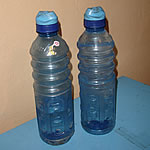
days and buy Ali a new water bottle for his cage, his
Propel isotonic drink bottle that we bought in the USA
on 14-10-08 for US$1.79 including fizzy drink, finally
got a hole in the bottom. That's a little more than
one year, one month and one week of constant use. Mine
is still going strong. See monthly tip above for
more information.
A curious onlooker at the campsite
had told us the territory will be tough and he wasn't
wrong. There's plenty of pedalling uphill to the top
climb (1993m) at the 43 kilometre mark of the day. By
this stage we have traversed 645 alti-metres. The next
22 kilometre stretch is on dirt. Though the condition
isn't too bad: only slightly washboard and intermittently
sandy, its hard going with a very fully loaded bike
and especially when the wind decides to pick up and
whip at our bodies. We also experienced the zondra
wind at the campsite. Dry, warm and often dusty, this
forceful movement of air starts predominantly in the
afternoon hours and can return for 2-3 days running.
It comes from the northeast and flows over the Andes.
The road returns to bitumen about 5 kilometres before
Bardas Blancas (70km; 720m),
which is a nothing little village. We camp below the
bridge where others before us have obviously spent the
night.
Praying to the asphalt
gods and receiving flies that bite like horses
Following the Rio Grande, which is not called "grande"
for nothing, is a leisurely cycle. Its a cool morning
and there are quite a number of suitable wild camping
spots along the way, though much of the land is still
fenced off. Water is abundant for the first half of
the day. The paved road continues until the next bridge
crossing over the Rio Grande, 58 kilometres into our
trip. It is hard to believe that such a mighty expanse
of water can course its way through such a narrow gorge.
It must be mighty deep down there.
From here on in the bitumen disappears.
Only remnants remain of the former road surface and
while it is possible to navigate the bike along the
good patches for 60% of the way the rest is extremely
rocky. There is also a considerable amount of traffic,
which adds quite a bit of dust to the journey as well.
Not helping that situation is the wind. It is an undulating
ride with the accent on going down and by the time the
early side winds have turned into headwinds in the mid
afternoon, I'm praying to the asphalt gods for a bit
of reprieve.
Washboard roads reflect in the sky
with cloud forms of corrugated waves. Though they do
look much softer than what I'm feeling beneath my wheel.
Our aim is to hit the river crossing at El
Zampal (86km; 366m)
today and when we see the bridge a few hundred metres
in the distance we turn off down a sand track towards
the river's edge. Its a great spot except for the plague
of horse flies that get Ali moving quite strangely.
The way he slaps his body parts while stomping about,
you could quite easily mistake his frustration for a
new form of
Argentinean
jig.
MInd you these horse flies are determined
little buggers, they even follow you on your bike. Luckily
enough they are slow and you can kill them quite easily.
It doesn't however stop the mosquito welt crossed with
a sand-fly itch that follows from their bite. And just
for once in my life, a nasty insect likes someone else
more than me. I think my prays somehow got a little
muddled up during the transmission.
The bitumen is back and
it really makes me happy: hey la hey la....
Horse flies are grazing in greener pastures this morning,
but the sand flies take over attack position. At least
you can use repellent against them. Unfortunately, there
is no repellent for unpaved roads. The next 21 kilometres
have some impressive red and pink rock dotted with pompom
shrubs, but its hard going again with 529 metres of
ascent. At road marker 2777 (kilometres still left to
reach Cabo Virgenes and the end of the Ruta 40), Ali's
hand goes up in triumph. I secretly hope it means we
are going down as well as the return of a solid surface.
Just having the bitumen back makes
me happy enough. At least traversing the further 111
alti-metres over 5 kilometres is much easier. A refreshing
drop down into Ranquil Norte follows with another 151
metre climb. The massive wind down to Rio Barrancas
is nothing short of spectacular as Volcán Tromen
(4114m) sits majestically in our path. A six kilometre
clammer in the hot afternoon sun is about my limit for
the day and when we arrive at the municipal campground
at Barrancas (62km;1022m)
with no toilet and no water tap, I'm just satisfied
enough with the flat patch of grass under the shade
of a tree to pitch the tent.
Three and a half years on
the road
Our night in Barrancas marked three and
half years on the road and time to send off our 6 monthly
newsletter. Life on the road in South America has taken
precedence to all the web-based activities we normally
do. Updates have been constantly late, like this one
is, as we have found ourselves more and more pushed
for time. Not only have we faced some of the most challenging
planning and cycling so far in our trip, but we have
met so many other cycle tourers and made an abundance
of new friends. Our time priorities changed somewhat.
So enough said, because I really think
newsletter
#10
declares it all...
If you would like to automatically
receive our 6 monthly newsletters then add yourself
to our
mailing
list
.
|