|
Wifi point Eden Atacameno,
San Pedro, Chile, 26-12-09
HOHOHO from
San Pedro!
This is where we would have liked to
put our latest update, but... Due to an untimely
breakdown of Son's computer (which needs to
be fixed in Santiago in a few weeks), we won't
be able to let you know all the beautiful, disasterous,
grotty, enduring and life changing details of
this months cycle trip from La Paz to here just
yet. But the photos are online (fantastic as
usual ;-) and all the gritty little details
like kilometres cycled, altimeters, punctures
etc. have been updated as well. So still tonnes
of info to read during the festive season.
So what happened?
Son's Acer Aspire One, bought in January 2009,
doesn't want to start up anymore... We got in
touch with Acer and they suggested flashing
the bios. This means we loose all info on the
hard drive... Since there is no-one here in
San Pedro de Atacama to get stuff off the hard
drive before we flash it, we have to wait untill
we get to Santiago (or any other big city).
And since we planned to take a bus from here
to Valparaiso and spend New Year there, we are
actually not that far from Santiago, two cycling
days to be precise. So, hopefully we can get
a backup of the hard drive in Santiago and update
the bios and get the computer working again.
Looks like a lot of people have had the same
problem with this type of Acer...
We will try and get a bus on
the 28th of December, which means we will be
arriving in Valparaiso on the 29th (it is a
24 hour bus ride). Spend a few days there and
then cycle to Santiago to meet up with Karsten
(who we cycled with in Ecuador) and Natalia
and Benjamin (who we met three years ago (!)
in Istanbul).
And to finish off
this short story:
|
Hostal Forestal,
[website]
Santiago de Chile,
12-01-10
From a metropolis to absolutely
nothing and on to tinsle town
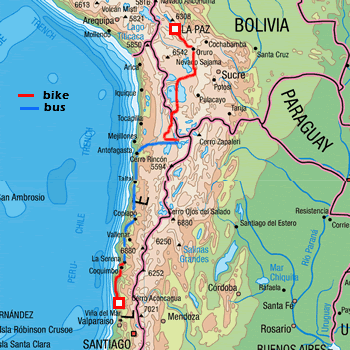
La Paz - Bolivia to San Pedro - Chile (14 cycle days;
2 rest days; 1018km; 5842m)
La Paz to Tholar (73km; 776m)
Tholar to Oruro (157km; 562m)
Oruro to 1 km before Huancane (92km; 251m)
1 km before Huancane to 4 km after Quillacas
(76km; 265m)
4 km after Quillacas to 31 km before Salinas (60km;
390m)
31 km before Salinas to 1 km after Irpani (49km; 286m)
1 km after Irpani to Isla Incahuasi (59km; 309m)
Isla Incahuasi to San Juan (87km; 355m)
San Juan to 18 km after Chiguana (49km; 189m)
18 km after Chiguana to 24 km after Ollagüe (44km;
244m)
24 km after Ollagüe to 1 km after Ascotán
(48km; 592m)
1 km after Ascotán to 1 km after Chiu Chiu (91km;
239m)
1 km after Chiu Chiu to Calama (33km; 50m)
Calama to San Pedro de Atacama (100m; 1334m)
In a whiz of electrical
cobwebs and colour
La Paz is a whizzing mix-master laboriously combining
two worlds: "the have" and "the have
nots". The partially blended, sway from one world
to the other, depending on what suits them best. We
are staying at Hotel Fuentes on Linares and close to
the corner of Sagárnaga, right in the middle
of tourist town; right at the hands of the money-makers;
right in the heart of "the haves". Amongst
the iridescent colour of woven fabric; the natural tones
of knitted alpaca products; and the stalls of glittery
silver and bizarre superstition, the occasional "have
not" staggers past, holding out his hand for anything
on offer.
Badly cobbled streets soar high into
the sky, but never far enough away from the cobwebs
of electrical wires to get a distinctive view of anything.
I wander aimlessly for hours trying to find something
clear to photograph. I end up buying two pieces of freshly
baked banana bread from a vibrantly dressed woman no
taller than my waist and snapping one decent shot of
the ice cream man who almost pushed me down the stairs
near the Iglesia de San Francisco. That too is surrounded
by billboards and people and stall owners and their
produce and its perfection cannot be captured in a single
picture.
Pepe's Café around the corner
on Jimenez 894 serves way better coffee than our hotel.
I meet his acquaintance at least twice a day and he
is always happy to see me. Our breakfast girl on the
other hand is not, but I won't venture there yet because,
at the moment I am heading towards the market area and
that is far more interesting. Past the good luck llama
fetuses and wacky medicines; up near the women sitting
on the street corner selling six yucca flat bread for
1 soles; well away from the camping shops with fake
North Face gear; and up even higher into the warren
of streets, each one designated to a particular shopping
theme. There are no tourists. Dawdling is easy, not
just because of the vibrant mingling of obscure and
normal products, but because of the traffic. Those on
foot move slowly at the best of times; vehicles block
lane ways and footpaths while others push, shove and
honk their course through the crowded streets. You will
undoubted get in the way at some stage.
I find everything we need for the next
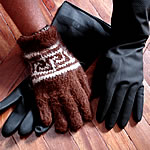
leg of our journey: industrial latex gloves; knitted
woolen gloves; gaffer tape; batteries; toiletries; a
small compass; sunglasses; dried fruit and nuts; biscuits;
chocolate bars; pasta; rice; sauces; jam; fresh fruit
and vegetables. Shopping is a success unlike some places
where you can search for hours and still not find what
you are looking for. I could have also filled my bags
with traditional costumes; cheap toys; electrical goods
and kitchenware too. I am charged local prices and everyone
is polite and friendly. Just like the owners of the
local vegetarian restaurant we visit on one occasion.
A set menu of tea, bread, salad, soup and main costs
12 Bolivians per person: (7 Bolivianos is equal to $US1).
The fact that we are welcomed so warmly makes up for
the incredibly bland meal.
Chuquiago
Café
has the same hospitable atmosphere, but much better
food. Upstairs on the corner of Sagárnaga and
Linares (entrance at No 903), Cristian and Luisa are
well in the thick of this buzzing metropolis, but still
incredibly down-to-earth in their approach. As well
as simple but tasty fare, there is the added bonus of
inexpensive internet or wifi service and a very reasonably
priced drinks list. It's a pleasure to spend time, other
than in the confines of your hotel room without having
to pay an arm and a leg for the privilege. We meet up
with Kevin a couple of times here and for a fine pizza
meal at Pizza la Mia on Calle Illampu 809 before we
eventually part ways. He generously lets me keep his
used
Schwalbe
Marathon XR that I still have on my bike. Thanks Kevin!
Ali and I both spend quite a bit of
time at the
Gravity Bolivia
bike shop, way over the other side of town via a bumpy
navigation of one-way streets. [Calle Victor Sanjinez
3050 B / Sopocachi / La Paz / Tel: 719 89239 / (ask
for Gustavo or Fernando / e-mail:
gravityalmacen@hotmail.com
]. First visit, we buy a new pump and then um
and ahh about the $US30 price tag of a used
Schwalbe
Marathon XR. Fernando apparently has some 7-speed shifters
with integrated brakes at his house, so we sleep on
the tyre issue.
The day after next, a ride to Gravity
Bolivia reveals a set of rapid fire shifters in practically
new condition. Another $US30 later and I am clicking
through the gears like I haven't been able to do for
at least a year. They no longer require the tapping
and pushing persuasion I've become accustomed to doing.
Labour costs 5 dollars a session in the workshop at
Gravity and they are pretty expert in their execution.
Ali also finds this out the next day when changing the
tyre on his front wheel and the axle breaks off in his
hands.
What the dickens?
Hotel Fuentes is a mid-range hotel by Bolivian price
standards, but their approach that of cheapskates. After
asking them to clean our room, following three nights
of sheet and towel use, they just pull the bed covers
up and pick our crumpled wet towels up off the floor
and hang them back over the rails again. When I ask
for fresh towels, I get the creepy feeling I have somehow
been transported to that immortal scene in Oliver Twist,
where I am Oliver asking "Please Sir, may I
have some more?" This sentiment runs over
into the breakfast room too, where you could have set
a camera up for a perfect shoot of the employee training
video. Title: "What NOT to do in the hospitality
industry."
The first morning we receive our complimentary
breakfast rations with three bed rolls. There are two
of us, so I'm wondering how the portion controlling
goes for someone who walks in on their own. Does the
grump behind the breakfast bar cut a roll in half? No,
she doesn't. She gives him two bread rolls. So, I see
no harm in asking for one extra roll. Within moments
of the words leaving my lips I am back in Dicken's play.
Apparently, I'll have to pay for it. I argue with the
logic that we are two and that three doesn't divide
easily between two without the use of a knife. Miss
Gloom is adamant: I have to pay 50 centavos extra.
Let's put this in perspective: one
bread roll in Bolivia costs 40 Centavos (4 euro cents)
and at Hotel Fuentes you pay 80 Bolivianos per person
(8 euros) per night. So that is a whopping 0.025% of
our daily room rate. Might I also add here that the
bread at this hotel is not fresh. The day after I complain
to the manager and we get an extra bread roll but from
then on in, the waitress doesn't acknowledge me and
just continues to issue us with our 3 roll basket. I
resort to doing something Oliver couldn't: I bring my
own bread in.
False advertising
As far as we are concerned, the best way out of town
with a loaded bike is using the main highway. There
is another road but gradients are steeper and there
are traffic lights and speed humps to navigate over.
And even though the 13 kilometre stretch of highway
comes with the obvious traffic, it is easy to get to
from Iglesia de San Francisco and there's a solid wide
shoulder for protection. The traffic leaves us alone
for most of the journey. It's 441 metres of solid climbing
to reach El Alto (4085m) and it does become a little
crazy as we near the peak. In the town itself, taxis
bank three deep on a four lane highway for hundreds
of metres: dodging them and the people wandering in
between is chaos, I loose Aaldrik for a few brief moments
all together. Eventually we end up on the notorious
La Paz to Oruro highway.
One guy in a tour shop had given me
a thorough low-down on all the possible ways I could
die in Bolivia. Quite a dark conversation to say the
least and cycling on this section of road was up there
on the list. So, I've been pre-warned and not only should
I expect my leather boots to crack into a million pieces
due to the salt covering they will get on the Salar
de Uyuni, but if dark clouds come rolling in I'll need
to immediately find a bus to get on. When I tell him
we are quite experienced at this sort of thing, he says:
that's what all the cyclists say that come here and
two froze to death last year on the salt flats. I had
to prompt him to tell me that this was in the middle
of blinkin' winter when temperatures can get lower than
-20° Celcius.
Anyway, back to the highway situation:
it is no wonder it is notoriously dangerous, when there
are only two lanes to carry the crazy driving antics
of impatient noggins behind the wheels of massive trucks
and 4-wheel drives. We have just a thin strip to balance
on and even if the coast on the other side of the road
is clear, they get pleasure out of coming way too close
for comfort. Total jackass behaviour! According to all
the billboards, Evo Morales (the soon to be new -and
old- president) has promised to build a dual carriage
along this section. I hope this isn't just false advertising
to get a few extra votes.
The rolling terrain takes us up 335
alti-metres and down a few hundred too. The weather
is perfect for cycling: not the slightest hint of rain
but as per normal, the wind picks up in the afternoon.
Calamarca comes after 60 kilometres and it is itsy bitsy,
as are all the other villages we've cycled through today.
We decide camping is our best option and move further
afield. After 12 kilometres we are surprised with the
town of Tholar (73km; 776m)
accommodating two decent sized hotels. For such an out-of-the-way
place, 100 Soles is a little steep. Still, we figure
we'll be camping enough in the next three weeks, so
why not spoil ourselves. Conveniently, they forget to
mention that the television on top of the cupboard,
connected to a cable line doesn't work. It never has.
A perfect example of false advertising.
How to vote five times
There are two reasons why we are awake and packed
before anyone has stirred in Hotel Gran Poder: its Sunday;
and its Election-day. Rather grumpily the gates are
opened for us and we glide out onto a car-free highway.
We have witnessed a few elections during our travels:
Malaysia; the US; and now Bolivia. All have been unique
moments and today is not exempt. Besides the fact that
cars are not allowed on the roads, alcohol has been
banned since midnight on Friday evening. Mind you, by
the amount of booze I've seen being consumed here, I
doubt they'll be able to control this one. The car thing
is easy though. Many towns and especially the provinces
have toll-control gates. The reason for this is it stops
someone from driving all over the country and voting
at each polling station.
From our perspective: it is the perfect
cycle day. Comes close to riding over the pass and out
of Yosemite National Park when the road was blocked
to traffic owing to recent snowfall. People seem very
happy and we are not quite sure if it because we are
well and truly in the country and away from the big
city or because its a special day. Adding to the absolute
bliss of it all is the amazing weather: the clear blue
skies only cloud over with sheep like blossoms towards
the end of the day.
Men and women are either cycling or
walking to election booths and due to the long distances
some of them have to travel, we are surprised to witness
so many making the effort. Especially seeing as it is
a forgone conclusion: Eva Morales will win.
We pass through Patacamaya (31 km);
Sica Sica (52 km); Kokani; (78 km); and then Caracollo
(119 km). All have accommodation, but due to the elections
the only place open in Caracollo is something akin to
a farmyard stable. Alright, it only costs 20 Soles,
but then again there are no bathroom facilities at all
and after inspecting the room with a saggy single bed,
Ali suggests we would be better sleeping on a roadside
curb. After a bit of deliberation, we decide to try
and make Oruro resulting in one of our longest cycling
days ever: only beaten by the 167 kilometre journey
in Delhi. Like the Indian expedition; the last stretch
is as flat as a pancake and the usual afternoon wind
doesn't push against us the entire way. It remains with
us, but keeps changing direction.
Just as we begin our entrance into
Oruro (157km; 562m) headwinds of dynamic
force try and prevent us from cycling through this very
big city. We first struggle past the toll gate, making
it easily five sectors we have cycled through today
and demonstrating that: if you were really dedicated,
by bike you could vote at least five times. We continue
to push hard past the big metal hat and the characters
lining the boulevard. Waldo, a local, befriends Ali
and leads us into the centre of town. Finding a decent
hotel proves a problem. The city might be full of people,
but everything is shut up: no shops; restaurants and
even hotels have their doors bolted. The residentials
Ali steps inside are dumps and the other options are
more than we usually pay. We settle for a 170 Bolivianos
room at Hotel Repostero including breakfast. It turns
out to be one the least enchanting places we have stayed
in.
Besides the luke warm to icy cold water
in our bathroom, breakfast wouldn't even qualify for
a light snack on a budget airline. I estimate it costs
the management no more than 1 Boliviano per person and
don't forget we are paying 170 Bolivianos for our room.
I wouldn't mind betting the wage cost is way below the
usual 30%, judging the slovenly approach of the staff
member in this department. Asking for another piece
of bread produces the same results as in Hotel Fuentes
in La Paz. We are told we will need to pay for it. Ali
flips, but hotel staff refuse to listen to his complaints.
He tries to address the "no hot water" issue
as well, but the receptionist keeps telling him he is
wrong and that there is hot water. Eventually someone
enters our room and tries for 10 minutes to get the
shower to produce a spurt of warmth. It doesn't: ah
duuuh!
With such a pathetic attitude, we decide
to go elsewhere. Upon booking out, Ali refuses to pay
the full amount and after a bit of a confrontation he
is asked what he wants to pay for the room: the suggested
100 Bolivians is eventually accepted and we leave. Ali
has already found a place down the road: Residential
Ideal which at 60 Bolivianos is a fraction of the price.
It is bare basics, but it is clean with share facilities.
Better than that, the family that run the place are
incredibly friendly.
Most of my time in Ocuro is spent roaming
around the markets for supplies. Normally, I enjoy this
activity immensely - the smells and colours of food
and culture: raw and in your face - but today, I would
have much preferred the "everything under one
roof" convenience of a large Hypermarket.
The market area is bustling and bubbling over with buyers
and sellers; diners and dawdlers; rural folk stocking
up their large mesh sacks with a month's supply of food;and
locals purchasing the necessary ingredients for the
evening meal. It takes me a number of hours wandering
the expanse of this shopping area and trying to find
everything we require for the big adventure in store
for us.
First taste
of salt
Leaving Oruro is not as difficult as we thought, though
our bikes are laden to the hilt with 5 days worth of
supplies and two days worth of water. The directions
given at the hostal are completely inaccurate, but streets
are bustling at 9.00am so there is no shortage of people
to ask. One local even wants to practice his English.
The road leading out through the dusty, ramshackle outskirts
is two lanes wide and no shoulder, though traffic isn't
hectic enough to cause any dilemmas. The highway reduces
to one lane and a very wide shoulder, while the landscape
morphs from its remnants of society to nothing much
more than salty puddles surrounding low lying shrubs.
The sun is cruel, but people become friendlier as we
encounter more abandonment. Truck drivers are notably
impressed with our efforts and the thumbs go up and
the hats come off in appreciation.
Besides a few gradual inclines, the
journey is relatively flat. Cows and clover fields dominate
the latter part of the day and water sources are plentiful:
a river trickles after the town of Poópo, whose
name has me chuckling for a little while; and a couple
of shops with basic supplies are available in the village
of Pazña. After topping up on bread, cookies
and other energy rich snacks we cycle out with the intent
on finding a camping spot. Something perfectly grassy
and well from the road on our right comes after about
13 kilometres and 1 km before Huancane (92km;
251m).
Abandoned lifestyles
Huancane, just up the road from our campsite, feels
abandoned until two young boys scoot past on their bikes.
They make their way towards the school where a teacher
is waiting outside and waving them hurriedly in. I presume
they are a little late. We are too today: its almost
9.00am. Ten kilometres from Huancane we hit our first
river. There’s enough of a trickle for us to feel
safe about filtering it. Even so, it comes out a little
green and quite earthy tasting. Another marginal flow
of water appears after a further 8 kilometres. Just
past it we make a a stop at Challapata which has plenty
of small stores and today (Wednesday) a bustling market
in the town’s plaza. Petrol is also obtainable
straight out of the 44 gallon drums situated inside
the convenience shops - so no smoking! We could have
waited until the 40 kilometre point in the trip to purchase
our supplies, though Huari doesn't have as diverse a
selection. Not only is this the last town with any real
selection of fresh supplies, but it marks the end of
the 144 kilometres of bitumen since Oruro.
The rocky and sandy nature of the first
section is quite a shock. While we expected bad road,
we weren't quite prepared for this. Arriving at a small
village the road forks in all directions and we choose
what looks like the firmest path: a decision we will
make on numerous occasions in the next few days. For
a while we make quite a bit of ground coverage. The
scenery is stunningly deserted with its salty flats
and pom-pom grasses sparse as puberties signs of facial
hair. Our only companions: hundreds of contently grazing
llamas and a sole herder who is more scared of us than
her flock are. She confirms that we are heading in the
right direction.
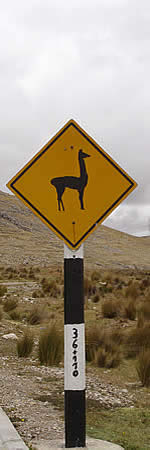
The llama is Bolivia's national animal
and belongs to the camelid family, which of course means
it is related to a camel, though it doesn't sport a
hump like they do. It is more closely related to the
alpaca, vicuña and guanaco all of which we see
in Bolivia, but in much lesser numbers.
The road continues to be patchy: washboard
and sand hold us up a bit as we near Quillacas and begin
with the 50 alti-metre climb into to town. The trip
from Huari to here is just 32 kilometres and took us
all afternoon. There are a few shops and an alojamiento,
but not much life. We end up moving on another 5 kilometres
and camp well off the road in the sand: 4
kilometres after Quillacas (76km; 265m).
Signs of things to come
Sleep is difficult for me due to a minor stomach upset
and frequent visits outside during the night. Today,
the roads are okay in parts, but horribly bad in others.
Bridges are out; gravel; rocks; clay; sand. Every obstacle
you can think of including impatient drivers and the
spattering of rain. Luckily, the road is really quiet
and the weather clears until late in the afternoon.
There is not much around: a few small villages, but
Vengalvinto (15 kilometres from Quillacas) is the only
one with a well that we could see. A kilometre before
Villa Esperanza there is also a small river that locals
are using to fill up their water containers and interestingly
enough everyone in the area travels with water containers
in the back of their vehicles. A sign of things to come.
From Vengalvinto to Tambillo, the
track climbs 390 alti-metres gradually. Coupled with
the washboard surface, there's not much chance to lift
your eyes from the road. By now though, we know pretty
well what Volcan Thunapa looks like. It has been in
constant view for the last couple of days and will remain
so for another couple more. Progress is slow in these
parts. Another sign of things to come.
Dark clouds have been hanging over
the crater for the last few hours and as we are finding
a spot to camp 31 kilometres before Salinas
de Garci Mendoza (60km; 390m), lightning
bolts through the sky. After pushing the bikes through
sand for ten minutes towards a small wind break, we
turn to see a dust storm brewing in the distance. It's
Ali's first experience, but I know that the front can
move faster than the recent flashes of light. All I
have time for is "get the tent up quick".
We both work fast, but not fast enough. As Ali is drumming
the pegs in and I am collecting rocks for securing the
snow flaps, it hits us. Like a sand blasting, it not
only rips the pegs from the ground but manages to work
its way into every crevice. Two mesh air vents are open
on the inner tent: sand pours inside. It squeezes through
zippers; builds up in the roll-tops on our
Ortlieb
bags; whips our faces; stings our eyes; and collects
in our ears. Huddled in the tent with our unopened bags,
we wait it out. A dirty black rain storm follows and
an hour passes before we emerge to astonishingly clear
sunny skies. Then the clean-up begins. You guessed it:
A definite sign of things to come.
Sod's law
The morning begins with clear, blue skies
and a very warm sun; the dirt path starts with road-blocks
and confusing side tracks, which lead us way out whoop-whoop
and along some of the worst washboard I have ever experienced.
Yesterday, we ignored a few of these blocks and came
to dead-ends, which meant doubling back on our path.
Today, we decide to follow the detour and end up wishing
we hadn't. Sod's law, I guess.
We weave our way back to the highway
- well, the word highway being used very loosely here-
actually, old riveted, stone speckled path, might be
more apt. The promise of Salinas de Garci Mendoza -
mentioned as being close on our map - doesn't come until
just before lunchtime and after climbing a few hills.
The town is actually a subdued, sleepy
village. The pleasantly shady plaza has a water tap
with supposed drinking water: we still filter to be
on the safe side. It also includes a hostal and a tourist
information booth, that was empty at the time and I
suspect remains that way since it would never really
get any patronage. I wander the narrow streets lined
with adobe huts in search of a decent shop. You can
tell the house that sells produce apart from the others
by the filled plastic bag hanging over door, or the
chair or wheelbarrow parked against the wall next to
it. I believe I visit every available store in the town
- five in total - and manage only to scrounge up the
last of the days bread; a few apples; and a handful
of chocolate bars and biscuits. It will not be the last
time I question what rural Bolivians eat in order to
get nutrients in their bodies. I mean if beer can be
shipped into these places - and it is in copious amounts
- then a bag of vegetables can too.
We trundle out of town along the road
leading to Tahua, but are stopped a kilometre on by
a local who tells us the road is closed. Ali and I disagree
about the next course of action, but he wins out. We
proceed to get ourselves deeper and deeper into mud.
Ali then decides we should cut across the mudflats,
but I'm not so certain that's a clever move. The stop-start
journey takes us roughly two hours of slipping and grunting
and groaning and heaving our loaded bikes through sticky,
compact mud. We stop regularly to clean it off during
what is probably only a couple of kilometres in total.
Sod's law, I guess.
The terrain we next face is unbelievably
rocky, but at least we can stay upright and cycle nearly
all of it. The turn-off to Tahua is unclear due to ambiguous
signposting. Ali gets out the Sharpie permanent pen
and draws the paths and town's names back in. A few
hundred metres passed the turnoff, we reach a flat and
grassy patch just beckoning us to camp at 1
kilometre after Irpani (49km; 286m). There's
no objection from either of us. Besides, the clean-up
job needs to begin: yesterday sand; today mud; and tomorrow
salt.
Well and truly worth its
salt
Ali becomes really ill during the course of the evening
and is so weak the next morning, he can barely move:
let alone eat breakfast. I make him digest finely sliced
apple with sprinkled sugar. Thank goodness we managed
to find them in Salinas yesterday. Apart from a few
carrots, onions and a small cabbage, they are our only
fresh produce left on board. I pack everything up, while
Ali tries to gain strength for the next leg of this
crazy journey: again washboard, rocks, boulders, sand,
gravel carpets the steep climbs and falls. And when
you are sick, that's no fun at all. Sod's Law, I guess.
I know I'm rolling yesterday's theme over into today.
We stray from the electrical lines
at one stage and realise we should have continued to
follow them. Using this strategy, you are more likely
to stay high. Even if the alternative road looks a little
better, it will more than likely turn into a bumpy plunge
followed by some 5 kilometre per hour strained pedalling
uphill or even slower pushing.
We pass through a couple of tiny villages,
the largest being Alianza about 10 kilometres from Irpani.
We climb a difficult 152 alti-metres over this section.
For such a big town, it is totally deserted: no life
at all. Absolutely no-one. If there were pastures of
any form around, I'd say they were all out in the fields
working, but there is nothing: just sand and rock and
even more sand.
Tahua never seems to come and our cursing
the hills turns quickly to sarcasm and then laughter.
It is ridiculous. These are not roads. They are not
fit of the title. Even 4-wheel drives are crawling along
this stretch. Upon reaching the peak of the final climb
where gradients reach 17%, the salt flats can be viewed
and Tahua is just below.
The town is quite undesirable and with
its locals staggering their way around the town square
sipping on something akin to methylated spirits in plastic
bottles, you'd hardly be tempted to stay in the hostal
on offer. Besides that, there are no shops open and
the plaza itself is a rundown disgrace. On the positive
side for cyclists, there are a couple of taps available
for those wanting water, but if you are intending to
stay on Isla Incahuasi then you can get your supplies
there. The only thing running through my head as we
pedal the 3 kilometre stretch to the nearest entrance
to the Salar de Uyuni is; "these salt flats
had better be good!"
And they do not disappoint. It is a
powerfully charged feeling to be forever surrounded
by blinding white honeycomb impressions; to hear the
crack and feel the crunch of salt beneath your wheel;
have the shavings fly up and hit you in the face as
you rocket along at unbelievable speeds on an imaginary
path. Well, it is a track of sorts, but not nearly as
clear as we had expected. Still it doesn't matter. The
37 kilometre course from the start of the salar to Isla
Incahuasi (59km; 309m) is obvious. The
tiny protrusion floating above the horizon in a clear
blue sky gets larger and less surreal as we near the
salty shoreline. Honestly, there is no other experience
like this one on earth.
And it is no wonder that this is Bolivia's
main tourist attraction. Salar de Uyuni, also known
as Salar de Tunupa is the world's largest salt flat
at 10,582 km². It is also remarkably horizontal:
almost staying at a constant elevation of 3,656 meters
above sea level give or take a metre. Somewhere between
50 and 70% of the world's lithium reserves lie in the
brine pool underneath the crusty salt surface. They
are not yet being extracted, but the geography of the
large area, the clear skies and level surface make it
a perfect spot for calibrating the altimeters of the
Earth observation satellites.
Since the salt flats are literally
bereft of fauna and flora, then it is kind of special
to see the giant cacti and rabbit-like viscachas that
cover Isla Incahuasi. And if you happen to be in the
area in November, its worth a visit to admire the three
species of South American flamingos that flock to this
area for breeding. Anyone wanting to stay over night,
Isla Incahuasi offers a hostal and restaurant. Though
for the more camping minded, the 15 Bolivianos entrance
fee per person will get you a free camping spot anywhere
on the island's perimetre. Anywhere else on the salt
flats is yours to explore without a price tag, though
remember getting the tent pegs into the salt could prove
a bit of a problem.
All the hills are brown
It is a slow, easy start to the day with a few cacti
pictures in between a couple of cups of coffee and then
a quick cycle round to the reception area to filter
our water for the next leg of the journey. If you are
expecting to pick up supplies here: don't. They have
little on offer, but rumour has it that the restaurant
serves up pretty good tucker. By the time we are sailing
at a rate of knots along the somewhat oilier path, it
is 10 am. We stop to take a couple of silly pictures
as you have to do on the Salar de Uyuni. The bizarre
perspectiveless nature of the white salty surface makes
for quite unique snapshots. Furthermore, it is probably
the easiest 80 kilometres in all of Bolivia and possibly
South America too. I so really don't want to leave when
we reach the dismal sandy tracks on the other side.
As if the journey hasn't been gruelling
enough, during the last 10 kilometres of today's grind
a headwind picks up and we make our snail trail against
a perpetual sand storm. Loosing the road has also been
frequent today, which from your point of view may sound
weird, but honestly, there is no true path. There is
limited signposting along this stretch and an insurmountable
series of tracks made solely by 4-wheel drive use. It
is obvious from the random placement of these corridors
and side roads that the drivers have become as frustrated
as us with the bad condition. Luckily for them, they
can simply press on the gas and move elsewhere in this
vast nothingness. We, on the other hand dismount: push
and pull our bicycle through deep sand. Consequently,
it takes forever to find San Juan and it is way further
than all our maps and kilometre references from other
cyclists' blogs say it is.
Getting nowhere
The last moments of the day are the strongest
in memory. I can see Ali's tyre tracks, though
he is nowhere to be seen. A dust storm blankets
us. Sometimes, I follow his etchings, but he makes
mistakes too and ends up with his wheel sinking
deep in the sand. I can see his footprints where
he pulled himself out. I veer off to the nearest
piece of limestone. The hard surface is such a
relief. Exhaustion has my mind wandering into
nowhere. I don't know how long I am at that place,
before I'm jolted back to the present situation.
I have hit a rock spinning my back wheel sideways.
I rectify the consequence of my concentration
lapse.
Now, I am awake again and feeling
happy that this day long muscle against winds
and bike dragging will soon be at an end. Another
half and hour; Maybe a bit more. A sudden thought
hits me as hard as the sand blasting my legs.
Jenny Craig should be notified. This would have
to be the perfect weight-loss programme. Upper
body and ab work-out from pushing a loaded rig;
thigh, calf and hamstring exercises from dirt
road pedalling; and fat loss through constant
corrugated vibrations. Six hours daily of these
exertive activities, coupled with the overall
lack of food in this region can only deliver the
kind of weight loss results such a company would
love to advertise. Its almost full proof; and
for minimum outlay. Big profits could be made.
Where am I? Fourty-five minutes
have passed since I last thought about the time.
I can dwell no longer on my business plan. A herd
of llamas has run away with my attention. Besides,
it was going nowhere anyway. They however, are
going home. I immediately relax. The day is finally
over. I actually did get somewhere. |
We arrive completely exhausted in San Juan
(87km; 355m),
as the sun is setting and welcome the warm shower and
comfortable bed at Hospedaje Max. Clean and a little
more refreshed, we ponder over maps and possible routes
out of here. There are just two logical choices. Continue
as planned through to Laguna Verde or head west and
cross into Chile. Our decision is based on the following
observations.
When the only part of the road that
is suitable for riding on, is the washboard, then its
time to seriously think about the route you have chosen.
The most daunting prospect of it all, is we know from
other blogs that this is not as bad as it will get.
That's still to come and furthermore at elevations reaching
close to 5000 metres. We are currently pedalling around
the 4000 alti-metre mark. And here we are dragging our
bikes through sand; jolting our bodies over bone rattling
grooves; vying for any hardened surface section we see.
This is no longer cycle touring. It is now an endurance
sport. And I'm not really travelling by bike to say
I've cycled a particular stretch of road notorious for
its hardship. I'm travelling to experience a country:
its landscape and its culture. If you lift your head
to peruse your surroundings for just a second here,
you are likely to hit a dust-hole or get your wheel
wedged between a couple of rocks. Our eyes had been
glued to the road all day today and all I can tell you
is... all the hills are brown and my mood is grey.
The belly rules the mind
~ [Spanish proverb]
It is clear during the course of our conversation
that Ali really has had enough. Although it takes a
while for me to come to terms with not fulfilling my
desire to get off the beaten track and experience the
colour change of Laguna Verde; the redness of Laguna
Colorado; the white misty geyser sprays; and the pinkest
flamingoes on earth, I have to agree that 10 plus days
top level endurance at 4500 plus metres above sea level,
with very little food available and the added pressure
of searching for water, is not a thought I relish.
Our proposed route will now take us
directly west towards the Chilean crossing at Avaroa
instead of south. The map we have promises tarmac as
soon as we hit the border and we estimate a couple of
days of cycling from here until Calama. Still, we are
going to require stocking up with food and water for
at least two days. To be on the safe side, I pack for
4 days as best I can in a town where there is no fresh
produce at all. The closest I get to fruit is tinned
peaches and juice crystals. Vegetables come in the form
of canned peas; instant mashed potato and tomato puree.
I end up begging a shop-owner to sell me five onions
from her private stash for 2.5 times the normal price
- after I have already spent a small fortune in her
store. At least now we have a bit of flavour to add
to our pasta dish.
The bread situation is also dire in
San Juan. Surely the Spanish influence must have spread
this far too and Bolivians are familiar with the age
old saying: "With bread and wine you can walk
your road”. I'm sure this extends to pedalling
as well. Now wine, I cannot afford in rural Bolivia
without an email to Mum and Dad for a bit of extra cash
and anyway that's impossible, because they don't have
internet anywhere here. Last cafe spied was in Huari.
Besides, I can wait until I reach Chile and Argentina
for the grape juice. But bread, please: "man
cannot live on crackers alone". I know, I've
tried it. There's little satisfaction in it at all.
So, in my four attempts to wander the lengths of San
Juan I came up with nothing each time. I tried different
times of day; different stores; got sent to different
houses - ones with white bricks (casa blanca) and ones
with red bricks (casa roja) - but alas none of that
delicious leavened product. And it was not Lent, I'm
sure about that.
Porridge with kilos of dried fruit
and nuts that I had thankfully stuffed into my
Ortlieb
panniers in La Paz has become our breakfast staple.
This is not a bad thing, but at lunch time it is hard
to get the satiety level up to anything close to midway.
I find my stomach screaming: where's the bread? I'd
do anything for a baguette. Crusty and golden on the
outside; warm, soft whiteness on the inside; melting
in my mouth... No wait, this is leading nowhere. Maybe
I should be thinking of a proverb to help me out of
this culinary dilemma. Talmud does believe: “A
quotation at the right moment is like bread to the famished”.
In deep salt
The path out of town is not as promising as our San
Juan host had suggested and exactly which track to choose
becomes quite confusing at times. We head in the general
direction of the large volcano in front of us: Volcán
Ollagüe. By crossing into Chile, we will ride along
the right side of it. After a decent stint of all the
usual Bolivian road obstacles, the road hardens and
cycling to the military base at Chiguana is easy. Headwinds
though, have already started to pick-up, which is not
particularly promising.
We cross over the train line and register
at the base. In hindsight, this was not really necessary
and probably would have saved us three hours of pushing,
had we not ventured through the mud crafted fort entrance.
The track we follow is that made by jeeps travelling
close to the railway line. After three kilometres we
pause at the turnoff to Laguna Colorado. Seeing the
long climb ahead for those that take that road convinces
me we are making the correct decision by veering right.
Though after a further 3 kilometres, when our path ceases
to exist, I begin to have my doubts.
Even though we didn't take the route
from San Juan to San Pedro via Laguna Colorado, we have
compiled an extensive map and up-to-date route description
on the area using our friend James' recent experiences.
Together with our route, this makes a really comprehensive
cycling report on the area. See the cycling section
on our
Bolivia
country information page
for details.
What seems like hardened dirt actually
breaks away beneath the bike sinking the wheel into
collapsing powder. Salt weeps from the soil and attaches
itself to the chain and cassette, deeming the thorough
bike clean-up in San Juan totally useless. This is one
time when sun, salt and sand is not a pleasurable experience.
By the time the road winds its way back close to the
railway track on the other side, its mid afternoon and
the headwinds are at their strongest. We heave the bikes
over the track and push through deep sand to reach the
highway, but it is pointless trying to continue any
further and we look for a place down a side track to
set up camp 18 kilometres after Chiguana
(49km; 189m). There is nowhere out of
the wind and all the guy ropes are tethered.
Ali has been suffering from a sinus
headache all day long, but I do believe he briefly refreshes
while eating our dinner of instant mashed potato jazzed
up with fried onions, garlic and mayonnaise and served
with tinned peas and brazil nuts in a sweet tomato sauce.
It is quite amazing what you can whip up out of a few
packets you know. The pain soon comes back and he has
an incredibly difficult night.
Our
cycling trip through Bolivia: click HERE to view larger
map and more details
Pushing frontiers
Today marks the entry into country number 40. Certainly
a surprise to us. We hadn't expected to add Chile to
the list so soon, but it is a great sensation to be
in control of where we travel and that we are not scared
to make deviations from our route. Also a comfort is
the delicious compensation of cycling on bitumen again.
The Bolivian border is 32 kilometres from the military
base we passed yesterday, so only 14 kilometres from
our overnight camp spot. It takes us all morning. The
road is of the same Bolivian standard, we have become
accustomed too: practically zilch!
The border post is absolutely in the
middle of nowhere. As of 2008, it costs 21 Bolivianos
for a foreigner to exit the country. Procedure for exiting
is simple enough and we cycle the next 5 kilometres
in no-man's land. The official crossing is somewhere
half way, denoted by a single column signpost with Bolivia
on one side and Chile on the other.
The next signage we see is the large
billboard letting us know that we can't take any animal
products into the country. I remember that we still
have an apple left and stop before the border to eat
it. Getting the stamps in the passport takes a while
since a bus load of travellers has pulled up just before
us. The organisation of this post is a little lacking.
No pens available; no information as to which form you
should fill in; the grouch behind the glass window allows
queue jumping and as far as we can tell, only capable
of grunting. Not off to a good start.
The next step is to wheel your bikes
over to the SAG hut and sign a declaration stating whether
or not you are carrying food products. Ali signs his
with a "No". I, on the other hand am carrying
quite a bit of food. And coming from Australia, I am
fully aware of the issues associated with fruit fly,
so I have no problem doing the right thing and answering
"Yes, I have food to declare". I expect them
to then ask: What food items? I could tell them. Could
you show them to me? I could open my bags and fish
out the products or I could give them the two back panniers
where I store my food. This approach would have been
by far the most simple and effective method.
Unfortunately, the actual situation
moves far from this scenario and we are both requested
to empty every single one of our bags for inspection.
Yes all 12 of them: sleeping bags, tent, clothes, the
lot. They have no idea what they are asking. Packing
everything back up again will take forever. Ali refuses,
stating that he has no food, which is true. He opens
the roll top of his bags and suggests they can unpack
his luggage themselves, but then they can pack it again
too. After all they open everyone else's suitcases and
close them again afterwards.
They refuse. Breaking the stalemate
is the colossally beefy: "Unpack your bags
NOW!" from the equally beefy chap behind his
desk. This doesn't go down well with Aaldrik and while
he starts to yell back and argue his case. I proceed
to unpack the bags that contain any food. Everything
is in order, except the honey, which all inspectors
come and hover over as excitedly as the little animals
that made it in the first place. One of them then proudly
fills the container with a blue poison and that's the
end of that. I'm more upset about loosing the squeezey
bottle. It was leak proof.
I then explain that I have no other
food in my bags: they've been fortunate to see it all.
This is not good enough and they want my clothing and
other bags emptied as well. So, I do just that. The
contents spill over the entire bench. Inspectors find
nothing of course. They are however well educated as
to what exactly a female cyclist stuffs into her front
bags. Strange how the men seemed to keep their distance
at this point. It takes about half an hour to put everything
back in place.
In the meantime, Ali's bags have been
inspected: totally against his will of course. They
uncover nothing of environmental harm or interest, though
one man finds a little box of our business cards intriguing
enough to open up and flip through. Not sure what he
thought he was going to find in there. And also by now,
I have received and signed the "discovery"
document concerning the honey and an "incident"
report has been complied in Spanish in connection with
Aaldrik's behaviour. Apparently he was extremely violent.
Funny how I was in the room the entire time and I missed
that bit. We both refuse to sign it of course.
Bikes fully loaded again, we push over
another frontier.
Chile is said to be the most developed
of any Latin American country, but our first observations
of this far flung corner of desert are far from this.
There are no money changers at the border for a start.
A local tells us to ride around and ask for Victoria
or Lola. We track down Victoria's son, who changes what
he can and at a more than fabulous exchange rate. So,
we enter the country with the impression that 1 Boliviano
is 100 Chilean Pesos: no wonder I think everything is
dirt cheap in the Hiper Lider Supermarket when we finally
make it to Calama. 1 Boliviano is actually 70 Pesos.
Our expectations of two days of steady
pedalling on the promised bitumen turn into 3 days of
unforgettably hard slog and even then we are still not
at our destination: the roads turn out to be fundamentally
similar to Bolivia and towns marked on our map do not
exist - lucky I stocked for a few extra days. Another
reason to throw the damned thing in the rubbish bin.
Salt flats resembling a monster dish
of frost covered cauliflower cheese lay for miles around
us. The roads are more sand than washboard, though we
are not exempt from that pleasure either. The hardest
part of the day comes when the southwesterly winds whip
past our bodies, stinging us with sand. At 4 pm we give
up and perch ourselves in a sand quarry 24
km after Ollagüe (44km; 244m)
next to a small ridge. It acts as a sort of windbreak
but all the ropes are still necessary again tonight.
Sandy, salty thoughts
The early rise compensates the hour long tent repairs.
Not only our lips, throats, sinuses and nasal passages
are having a hard time with the dry atmosphere, but
the tent material has shrunk in such proportions that
we can no longer get the poles in without a two-man
strong push-pull battle. During one of these grunt sessions
yesterday the stitching from one of the pole holders
straps completely broke free of the tent. While I do
the stitching, Ali removes a long pole in each set and
replaces it with a shorter one. It proves to be a successful
operation. No more problems since this alteration.
We start a small climb up and around
the last bend of Salar de Carcote. The road is ridable
but not brilliant to the top and then worsens on the
downhill. The town of Carcote never comes and it's a
little worrying considering our low water situation.
After 15 kilometres we hit bitumen and are lead into
the false security of thinking it is going to be like
this for the rest of the journey. For the first time
since the Salar though, we can travel at a decent speed.
Unfortunately, it stops just before the salt mining
camp of Cerbolla and doesn't return.
Headwinds begin at 2 pm today, making
progress really difficult. We pull into the Ascotán
Miners Camp (22 kilometres from Cerbolla) and stock
up on water. The following 4 kilometre and 230 alti-metre
climb takes nearly an hour as we fight against the gale.
Ali pedals slowly to the peak: Paso Fronterizo Ascotán
(3966m), but I have to push. The 9 to 14% gradients
get the better of me. One kilometre
after Ascotán (48km; 592m) we
find a large rock and a small, slightly slopey patch
that just fits the tent. After the last three days,
while we are pretty well sick of looking at sand and
salt, the idea of lying under a palm tree on the beach
is getting more and more inviting.
Absolutely nothing
Eager to miss the brunt of today's headwinds we
rise at 5.15am. It is freezing outside and doing the
dishes after breakfast reduces my fingers to a debilitating
cramps. Ali lets me warm them up on his belly. Sometimes
he is just so sweet!
There is nothing like a climb at 4000
metres above sea level, on corrugated track, in 6°
Celsius temperatures first thing in the morning. Certainly
wakes you and your lungs up. On top I get a flat tyre
and by 11.00am the westerlies have begun, so our plan
to avoid them by getting up with the flamingoes is foiled.
There is absolutely nothing around us except stones
and sand. No life: nothing grows here.
On a more positive note, the road is
better than it has been for many, many days and the
terrain, though slightly undulating, has a definite
downhill trend. We can scoot along some stretches, but
we are still not fast enough to make it further than
Chui Chui today. At the little store with the "bread
today" sign, we herald excitedly our faithful commitment
to bakery products and in between the celebratory dance
steps, I think a bit of drooling went on as well.
Besides our evening meal, we had eaten
ourselves out of house and tent and an assortment of
biscuits and chocolate bars are also added to the grocery
bag. Winds are so bad when we start off, we get as far
as 1 km after Chiu Chiu (91km; 239m)
before we pull-off in some dunes and pitch the tent.
Blowing the budget
The ride into Calama (33km;
50m) is in such contrast to the last couple
of weeks of cycling: it is dreamlike. Wind pushes us
along perfectly laid highway until we hit the outskirts
of town. Our hotel for 30,000 pesos is a little outlandish
for our budget, but it is invitingly extravagant and
because of the excellent exchange rate at the border,
we actually think it is 30 euros instead of 43 euros
per night. My visit to the Hiper Lider is also rather
expensive in hindsight and also adds another dimension
to the philosophy that you shouldn't go shopping on
an empty stomach: you shouldn't go shopping after deprivation
of luxury provisions for a long period of time either.
I come back with bags full of palate pleasure.
Tinsel town
Getting to San Pedro de Atacama is one of those
long irritating climbs of miniscule gradient. Sixty-two
kilometres and 1102 alti-metres of it to be precise.
We pass Saint Peter and Saint Paul and no I'm not having
a revelation. It's a couple of volcanoes that have been
hanging around our vista for the last couple of days.
Nothingness surrounds us all the way to the top: Paso
Barros Arana (3411m). The plunge against side winds
below is followed by another short climb before the
final drop into Valle Cordillera de la Sal where our
scenic-starved gazes witness some pretty stunning rock
formations. Red-pink tones against blue skies never
cease to please the eyes.
San Pedro de Atacama (100m;
1334m) is quite a shock: a yuppy
dessert town all tinselled up for the festive season.
But at the same time, its the perfect place for us to
rest after the last fortnight of bare minimum living
in extreme conditions. Due to this destinations popularity
with tourists, prices are steep and finding private
accommodation with share facilities for under 7000 pesos
per person is pretty well out of the question. A dorm
room will cost you 6,000.
We wander around trying to look up
a list of places Ali has researched, but without a map
of the place, it proves difficult. After four attempts
we decide to head back to Hostal Vilacoyo, the second
lodgings we checked out and as we turn into a side street,
who should come wandering towards us, but
James
. He is one of the main reasons we decided to come here
in the first place: prior to leaving La Paz we had arranged
to meet up for Christmas in San Pedro de Atacama.
The only way to describe seeing him
is "damned good". Pizza followed by a few
beers in the local pub give us enough time to chew over
all that we have experienced in the last days. Hats
off to James for completing the route south and from
his accounts we are glad we took the road we did. It
was still difficult, but much shorter and 1000 alti-metres
lower. He looks exhausted from his efforts.
Unfortunately our hostal doesn't have
wifi, so after two days we move to where James is staying.
Hostal Eden Atacameño has a great courtyard area
where you can swing in a hammock or sit quietly under
the giant pink pepper tree, doing anything that tickles
your fancy. And that's exactly what we do; everyday
for a week. We spend exuberant amounts of money on achieving
not too much at all. My computer crashes big time. There
are just a few days left on the warranty, which is the
only pleasing news about the whole situation, but it
also confirms that we need to get to a big city to get
it fixed. But which one?
Ali wants to head to Brazil and I want
to go south. I especially want to go to Santiago to
catch up with
Benjamin
and Natalia
who we met in Istanbul almost three years ago, and
Karsten
, who we more recently cycled with in Colombia and Ecuador.
I win this time, but our initial idea of heading to
Valparaiso on the coast for New Year are dashed when
we learn that a million people flock here and the price
triples for the festivity. A dorm bed can set you back
$US50: admittedly, you get beer all night for that and
Ali is tempted. But in all honesty, we'd rather have
a more low-key time.
In that week many, many guests come
and go; Christmas does too. We celebrate the occasion
in fine form with a grand dinner and with
Marcus
and Patricia
. They too eventually leave. We are next, followed by
James the day after us, but I'm sure tinsel town received
a new flow of visitors to fill our spaces. Even though
this tourist destination is in the middle of arid nothingness,
its is sparkling with life all year round.
Back to where we came
from and on into New Year
(3 cycle days; 0 rest days; 1101km by bus; 153km; 1832m)
San Pedro de Atacama to La Serena (1101km by
bus)
La Serena to Coquimbo (9km; 10m)
Coquimbo to 16 km. after Quebrada Seca (86km; 796m)
16 km. after Quebrada Seca to 16 km. after La Cebada
(58km; 1026m)
It is a long, slow ride to the top of the pass
and this time we are sitting in a bus. I almost need
a rest contemplating the energy necessary to get there
by bike. The headwinds are phenomenally strong and at
times this powered vehicle is only doing 25 kilometres
an hour. Better in this seat I reckon. The 17 hour,
1101 kilometre journey to La Serena costs 28,000 pesos
each plus 6000 for both bikes. Mind you the bicycle
thing is organised at the bus station with the driver.
We get a receipt for 2000 pesos - so take a quick guess
where the other 4,000 goes.
The trip is not the best bus journey
I have endured and I'm extremely grateful Ali got us
a spot at the front of the bus. The toilet at the back
stinks so bad; there's no toilet paper; the breakfast
they promised us is a little pack of cookies and 100ml
of juice; and the second-shift conductor spends all
his time snoring in the chair next to us. We are glad
to get off in La Serena
We are also glad that we didn't journey
this stretch ourselves. It is once again the same type
of nothingness that we have experienced for almost a
month now. And as well as undulating, the road is narrow
and extremely busy. After finding a supermarket for
supplies we head to Avenida de la Mar (coastal
road) in search of
Hipocampo
. We don't find it, but instead cycle along the promenade,
on the bike path when available, sniffing in the wonderful
smell of the salty sea until Coquimbo (9km;
10m). Camping Sole di Mar is a little
run down, but pleasant enough. It costs 12,000 pesos
normally, but if you don't ask for a receipt, you'll
get it for 10,000 pesos. A pleasant afternoon, relaxing
and snoozing in the shade is just what is needed after
an overnight bus trip.
The next two days of riding are so
similar, its hard to distinguish them apart. Besides
being completely zapped at the end of each day due to
constant head and side winds, the highway rises and
falls incessantly. Luckily there is a wide shoulder
to feel safe in. The landscape is mostly a dry red dirt
abyss filled with cacti and stone. Occasionally a patch
of civilisation miraculously springs out of the earth
in the form of olive groves. The goats cheese is delicious
around these parts by the way and little stalls along
the road selling this and processed papaya products
break the boredom of such isolation.
But the greatest asset to the highway
system has to be the Estacionamientos [parking
bays]. We stop at everyone on our side of the road.
They have amazing facilities: tables, benches and grass
umbrellas; toilets, showers with toilet paper, soap
and hot water; and of course we can fill up on that
life saving liquid as well. The tap water in Chile is
drinkable.
While it is a coastal route, we hardly
ever get to see the ocean. The road runs a good distance
inland and everything is fenced off with barbed wire,
making wild camping nearly impossible. An accessible
dirt track appears 16 kilometres after Quebrada
Seca (86km; 796m) where we set up camp
in a cactus garden and the next evening in desperation,
we resort to dropping our bikes and gear down a deep
enough slope near side-railing so we can't be seen from
the highway at 16 kilometres after La Cebada
(58km; 1026m).
It's in this exact spot that we commemorate
New Year. Well, we are awake for the Dutch New Year
at least. This is probably the most unpretentious calendar
celebration we have ever had, but we make the most of
it and raise a glass of Chilean red in toast, while
preparing a well deserved pasta meal. Being the party
animals we are, we are both asleep by 9.00pm.
II would have liked to have had a cascade
of profundities follow, but this update is already so
late you'll have to wait for another reflective moment
in our travels to receive these thoughts. Instead, we
both wish you a simple but heart-felt "Happy New
Year".
|