|
Blue
Backpackers [website],
Busan, Korea, 19-06-08
Another island another Japan
Hashimoto to Motoyama (4 cycling days; 2.5 hour ferry
trip; 228km; 2654m)
We rise to the sound of one particularly happy little
bird, chirping its head off and darting radically around
in the vicinity of our tent. Fly-fishermen are off in
the distance. It’s Sunday and the sun is stinking
hot, even at 7 in the morning. The 52 km cycle trip,
basically sticking in and around the No 24 highway,
is pretty straight forward and the ferry terminal, just
outside Wakayama, is clearly signposted the moment we
enter the city’s outskirts.
Being the last day of the weekend and
quite often the only day off for the Japanese, everyone
is out and about: busy absorbing themselves in their
extra curricular activities. I have to say, the Japanese
are pretty fanatical about anything and everything they
choose to do: none more so than their sport and relaxation.
Judging by the amount of shops we have passed since
arriving here and the number of dedicated men, up to
their thighs in chilly cold water while the skies are
desperately trying to rise the river levels, fishing
is a pretty popular past-time.
Likewise baseball, cycling, jogging,
the golden world of golfing and the quite humorous military
style march many embark on in the parks of a morning
or evening, rank high among their leisure pursuits as
well. They are all dressed accordingly. Even the motorcyclists:
with catchprases like sledgehammer and motorhead embroidered
on their leather jackets, I don’t have to explain
to you the extent of their devotion to their pristine
machines. This is the last image I had ever expected
to see in Japan, but surprisingly enough, hundreds of
Harley Davidsons and relatively fewer not so impressive
other makes, take to the country roads every weekend.
They are not of real concern to us: they generally make
more noise pollution than anything else and take a wide
birth as they overtake. Something about respect for
another person on two wheels, I guess.
Perform it to a bicycle
While we wait to board the ferry and for the ticket
office to open, the sun is shining fiercely. We find
a little patch of shade to sit and eat lunch. Just a
half hour before departure, Ali can pay the ¥5200
(¥2000 per person and ¥600 per bike) and receives
an instruction paper that has us in absolute fits of
laughter. It’s not that we want to make fun of
the misconstrued use of English, though the bit about
the bicycle bent me double. That happens everywhere
in the world and boy we have seen some real beauties
in our travels. I think, more to the point, it pretty
well sums up our very special experience, not only with
Nankai Ferry Co, but Japan in general.
| *
Explanation
If it is purchased a ticket,
please perform straight a signal in front.
Because there is a person in charger, please hand
a ticket.
If is gone on board by a ship; of stairs
overcharge, and please be in the ship.
I sit in the favorite place if in the
ship, and please make itself at home.
You cannot smoke in the inboard. When it is smoked,
I ask on a deck.
Because music plays at about 15:50 to
arrive at Tokushima,
I go down the stairs if I drift, and please perform
it to a bicycle.
Please obey the instructions of the person
in charge if I arrive at Tokushima.
Thank you for using Nankai
ferry today.
Nankai Ferry Co., Ltd. |
It takes just 2.5 hours to reach the
delta of the Yoshino river and the prefecture capital:
Tokushima. This city boasts that a total 138 rivers
run through its region and as we cycle along, it is
easy to see that this is most likely the case. The centre
itself is very relaxed and spread not so much upwards
as outwards. As we meander out of town along Highway
No 438 the road becomes smaller and the scenery greener.
We choose a spot under a bridge on a rocky river bank
near Sanagouchi
(66km; 192m). There’s a patch just
big enough to pitch our tent and it’s not too
inconveniently situated from the water’s edge.
Jingle bells...Jingle bells...
Japan has many sights of interest; just pick up any
guide book and it will tell you so. However, what most
of them fail to mention is the hotaru: the
firefly. Japan has at least 50 of the worlds known 2000
species and they are commonly referenced in poetry,
childrens’ ditties and Japanese proverbs. One
more recent addition to the Japanese language is hotaru-zoku,
which translates as firefly-tribe. It refers
to those, mostly husbands, who have been forced to go
outside to smoke. The cigarette glow in the dark from
apartment balconies obviously resembles that of the
glow of a firefly.
These attractive little creatures are
alarmingly on the decrease in Japan, since they only
live near clean streams. I therefore have to assume
that the water running next to us tonight is pretty
well close to pure because the “as far as we can
see” fairy-light performance was bigger and better
than any Christmas tree I have ever seen. It was so
spellbinding in fact, that after we had finished with
oohing and aahing, Ali began to sing Jingle Bells, which
does show how silly he can be at times.
The next day we continue following
route No 438. It’s hard to believe this is a major
road, as at times there is only enough room for one
vehicle to scrape through. Lucky, we encounter only
a small amount of local traffic and just a couple of
trucks, which, as far as I can see, double as roadside
greenery trimmers. We wind our way up along a quaint
country path, past a number of abandoned houses and
small villages. This type of environment is a cyclist’s
dream. Below us the gorge tunnels water at fervent speed
in the opposite direction to our climb. Everywhere you
look, there’s a new shade of green. My legs feel
strong today and I’m ready for what’s in
store.
Unfortunately, the weather has other
plans: well before lunchtime we are waylaid in the tank-up
spot of a local JA enterprise, while the clouds do some
pretty amazing things above us. It doesn’t look
good, but after two hours wait, the rain eases up enough
to leave. Completely drenched, we are forced to stop
a few kilometers further on. Unbeknown to us at the
time, we are just 2.5 kilometres from the tunnel. Nonetheless,
we discover a perfectly suitable spot, near
Koyadaira (38km; 70m), in a pine forest
to wait the rain out.
Cyclists in the mist
It continues raining solidly until 11.30am the next
day, which definitely gives new meaning to the word
rainfall. We surmise that the rainy season, which normally
hits halfway through June, has started a tad too early
this year. Still the current pattern seems to bring
sunshine after a bout of this sort of weather and sure
enough, although we leave in a bit of drizzle, by the
time we are eating our lunch, the sun is blasting down
upon us.
These conditions don’t last for
long and approximately 5.5 hours after setting off,
the second tunnel at the Minokoshi Pass (1406m) is in
sight. We have dragged ourselves along 33 kilometres
of mountain road and up 1216 altimetres at an average
climb of 5% in the constant rain. Maybe the figures
don’t mean much to you, but I can assure you it
is some of the most grueling work I have ever done.
With every push, my mind is active,
but I don’t always know what I’m thinking
about. Just looking at the road; trying to keep upright.
Now I’m thinking about what I’m thinking
about and that’s incredibly irritating. A crow
laughs “ha, ha, ha” and I think: shut-up
you sod. A Japanese bush warbler starts up and I try
to pedal to the beat of his song, but his tempo is too
fast for me. I try it half time. That works for a bit
and then I give that up too. I decide my next goal is
the second bend I come to: I’ll stop for a bit
to rest and have a drink. The second bend comes but
I continue on just a little bit further. Sometimes I
do that. Sometimes I don’t.
My raincoat drapes around me like a
useless, soggy, canary-yellow kleenex; my vision is
blurred from drizzle and sweat; and at the 2 kilometre
point, before the top, I’m so cold and clammy
and I just want to give up. According to Ali, I’m
a wimp, but I can barely push the pedals round anymore.
John Lennon exclaims on the Helter Skelter album that
he’s got blisters on his fingers; well I have
throbbing thighs, aching knees, burning calves and a
severely dwindling enthusiasm for what I’m doing.
The mist blocks out all sign of Ali
maybe a hundred metres in front of me and furthermore,
the promised scenic view of Mt Tsurugisan in our road
atlas is completely non-existent. It is pure white all
around me and I feel like I’ve been swallowed
up by something far greater than myself. To quote my
beloved Beatle one more time: when you're drowning,
you don't say “I would be incredibly pleased if
someone would have the foresight to notice me drowning
and come and help me,” you just scream. And that’s
what I did. Though, I really felt like crying.
Not really roped in
At the end of the day though, after the 8km downhill
tumble on the No 439 to Okuiya Kazurabashi
(41km; 1216m), a wash in icy cold Iyagawa
river water and a hot meal, sanity has almost returned.
Had it not been for the warning poster with bold red
Japanese characters and several exclamation marks under
a photograph of a brown bear, I would have also had
a peaceful night’s sleep. You don’t have
to be a genius to work out what the message was.
The famous double vine rope bridges,
that in truth are steel cable bridges wrapped in vines
for aesthetics, is a total rip-off at ¥500 a pop
just to walk across it. The Japanese have this incessant
desire to try and either reconstruct or tame nature
and the whole place is more like a low-key theme park
than anything else. Though I must confess, the poster
of Mt Tsurugisan does do the mountain justice. Pity
we never actually got to see it.
The campsite on the other side, which
is mentioned as being free in the LP costs ¥350
per tent and ¥150 per person. Under normal circumstances
this isn’t too much to pay for a well equipped
camping area, but the lights are out, the toilets are
cordoned off and don’t forget you need to fork
out ¥500 to get to it. Basically there’s nothing
on offer here but a cleared gravel patch.
Someone must be watching over us though,
as not a soul is in sight when we arrive, I don’t
fall through to gaps on the wobbly bridge and very luckily,
no bears attack us during the night. Gosh, you get to
learn about two of my phobias in one sentence! During
our muscle enhancing, 30 minute workout, carrying our
loaded bikes up the steep walkway, the cleaner comes
into view. She is very curious as to where we have come
from, but speaks no English. Our Japanese is just as
inadequate and so we end up passing one another with
pleasantry nods and an exchange of language that neither
party understands. No-one present in the booth at the
top this morning either, so we just cycle away with
no obligations to pay.
No true discourse with
nature
Sailing down the Iyagawa river towards Oboke, we pass
monster dams, electrical works, pine forrestries: lopped
and not lopped, and we get a clear insight into the
Japanese way of preventing nature from doing its normal
thing. Apart from the stickle brick-like cement blocks
that they stack in and around the rivers, they have
taken to spraying concrete on the sides of cliffs and
then painting it a sort of sand brown colour. The problem
is there is nothing natural about the way it looks at
all and feels as if we are on some sort of Disney theme
park bike ride. The life-sized rag dolls propped up
in the fields and used to frighten away crows only heighten
the funfair atmosphere. Admittedly, these animated scarecrows
in everyday pose, do at least reveal a sense of humour.
If we thought Okuiya Kazurabashi was
bad, then it was obvious that we hadn’t yet visited
Nishi Iya with its own kazurabashi (vine bridge) and
the biwa no taki (a 50m waterfall). Some concrete and
steel girder freak has built a massively repulsive construction
on the side of the cliff and in all their wisdom a fake
waterfall on the other side. A highway has been built
for the sole purpose of visiting the waterfall. Yet
still, the Japanese are out in their troops visiting
this place. I just don’t get it! The area has
so many signs of promise but human intervention has
ruined any chance for a true discourse with nature.
In search of the perfect
camp-spot
We continue on as we have hopes of camping somewhere
along the Ananai river tonight, but every spare patch
of land is filled with rice paddies or vegetable crops.
Any prospective camping pitch we see is either too close
to the river for comfort or unreachable. The first decent
place in kilometers turns out to be a helicopter pad.
We decide that we would rather waiver the chance of
sudden gale forced winds in the middle of the night
and move on, though it’s becoming dangerously
late.
It appears desperately futile at close
to 6pm at night and with little daylight left, the abandoned
construction site looks like our only option. But just
as we are rounding the bend, and it is funny how this
always happens, we simultaneously spot a perfect stretch
of river bank. The excitement is dampened a little as
it is on the other side but reignited when we spy a
bridge a bit further on. Following the river and our
noses, we easily land in Kizenzan Park,
near Motoyama (82km; 545m), complete with
a specially designated camping area.
This windfall even has toilets with
toilet paper, hand soap, magazines and a little vase
of flowers. Additionally, a modern washing-up hut perches
on the side of the bank under the forest and one very
dear person, obviously with experience in these matters,
saw the need to connect a couple of shower rosettes
to the back wall of the wash-up area. I am forever indebted
to this person: bless their little cotton tabi-socks.
It’s perfect and it costs nothing. The 12 hours
of rain that follows and only stops at 1pm the next
day diminishes the spirits somewhat, but by the late
afternoon the wind is blowing our washing dry, hawks
are circling their territory above and I am happy as
Larry watching Ali skim stones across the river. He’s
pretty good at it, by the way.
Eye for detail
Motoyama to Miyajima (3 cycling days; 66km ferry trip;
169km; 1776m)
Today’s temperature rises something like this:
at 9am, 11am and 1pm, it is 20º, 23º and 25º
celcius respectively. I can tell because the overhead
electronic highway boards are detailing this for me.
We are still on Route No 439 and it is a glorious day.
The climbing starts almost as soon as we get out of
Motoyama city, which turns out to be quite a decent
sized place with ample shopping facilities. One that
catches my eye, for its rather strange combination of
merchandise, is the local “Sports and Liquor Store”.
Leaving the Yoshino River behind at
the monster Sameurara Dam, I stop to take a photo of
one of the manhole covers. They are just incredibly
amazing in Japan and shows, as far as I’m concerned,
a certain eye for detail. Every town, city, province
and prefecture has their own design, often depicting
a landmark, flora or fauna specific to the region. Many
are the usual cast metal but some are so brightly adorned
in colour that I just have to pause a while; to contemplate
the intricacy of the patterns. They remind me of woodblocks
used for printing. Needless to say, my fascination for
these roadside features causes me to stop frequently
and Ali to get pissed off regularly. This pool of manhole
cover photos shows that others are as deeply captivated
as I am.
Seeing the light at the
end
From here on in, it’s just under 20 kilometres
of relatively easy uphill push until the tunnel. This
time, I could almost say I enjoy venturing inside, even
though it is the longest we have experienced to date.
There’s a wonderfully wide and raised cycle path
on the side and it is so straight and flat for the entire
length that you can actually see the light at the end
of this, almost 3 kilometre, long construction.
After a tunnel, it normally means an
effortless descent. And this time is no exception. No
less than 18 kilometres of impeccable downhill highway
all to ourselves: perfect opportunity for Ali to practice
his ballerina biking stunts and me to laugh at him.
Highway No 439 is interrupted by No
194 for a short distance and we need to ascend once
again. A beautiful winding country road bordered with
expansive views of green paddies, bamboo and pine trees
and blue flowering hydrangeas entertains us before we
stumble upon another public campsite with toilet facilities
just outside the village of Ikegawa (53km;
576m). It’s only 2pm, but we are
not about to look a gift horse in the mouth.
Tobe or not Tobe
The next day smells of honeysuckle and pine wood. The
riverways are untampered with and punctuated with small
farmyards. We are on Highway No 494 now, but it resembles
more of a mountain trail than a main throroughfare.
The first hour is painless, but the second a bit more
of a sweaty affair. We traverse 479 altimetres in just
17 kilometres, but are once again compensated with a
tunnel at the top and a plummet down to the turnoff,
just before Shinagawa, on to Route No 12. It’s
another 12 kilometre (200m) uphill push that follows
and then we go down again into Kuma. The rollercoaster
ride continues with a further 8 kilometre (220m) climb
before we reach the Misaka Pass (720m). The climax of
our joyride is the 700m nose dive over 14 kilometres
into the flat-land outskirts of Matsuyama
(68km; 997m).
We choose a spot in a park close to
Tobe, but not exactly in the centre. Unfortunately for
us though, it is a well used area by locals and we feel
well out on display. Not one of our better choices of
campsites.
Oh deer, oh deer, oh deer...
Straight forward ride into and out of Matsuyama, though
every bank we see is either not a branch we can use,
out of order or closed. This is not unusual for a Sunday
in Japan, but quite a strange phenomenon for the world’s
leader in technology, I think. Some ATM’s operate
within particular hours and will not allow you to withdraw
cash before 9am and are similarly closed after 9pm.
Consequently, we arrive with no money
and annoyingly so, cannot pay by credit card. All the
cash machines in this area are closed as well except
the ATM at the terminal which doesn’t accept our
card. Therefore, Ali needs to ride off to the next town
to source the ¥6560 (¥2900 each + ¥380 for
a bike). We miss the 9.30am ferry, but are not perturbed
about catching the next one at 10.55am. The trip to
Hiroshima is 66 kilometres and takes just over 2.5 hours.
Back on the road again, Route No 2
this time, it is just like cycling into any one of Japan’s
concrete jungles: not very pretty, insurmountable amount
of infuriating stop lights, traffic and discarded rubbish
all punctuated by pachinko slot parlours. We are headed
for our second ferry trip of the day out to Miyajima
Island. The port is only 23 kilometres further on and
we break the journey by shopping at a supermarket on
the highway. Ferries leave every 15 minutes, cost ¥270
with the bike and take only 10 minutes to get across
to the other side.
The amply photographed Shinto Shrine
Gate (torii) leading to the Itsukushima Shrine is only
just visible through the haze on our right. There’s
a short promotional film about the island playing on
one of the two video screens on the boat, it is the
first time that we have heard announcements in English
since Tokyo and we wonder if coming here is such a good
move.
As soon as we leave the boat, a friendly
man also on a bike overhears us questioning one another
about where we need to go, and points us in the direction
of Tsutsumigaura Park. Supposedly a campground exists
here. We round one corner and get all snap happy at
the couple of unusually tame deer on the side of the
road. We needn’t have bothered with photographs
here though because it soon becomes apparent that the
whole island is virtually overrun by bambi’s.
And there were plenty of other opportunities to be had.
They are all tame!
The campsite is 2.8 kilometres from
the terminal and we are relieved to find a quiet area
away from anything that remotely resembles tourism.
(Miyajima: 48km; 203m). After
we have set up and are relaxing at the picnic table
near our tent, a local man comes by in a white pick-up
truck with the necessary paperwork. We pay him ¥600
each for a two night stay. This gets drawn out to three
nights when we discover an electrical point at the back
of the closed canteen after the first day. Yet another
peculiar trait of Japanese campsites: apart from never
offering electricity to their guests they quite often
don’t have any showers available either. I don’t
know how the hoards of students cope in the summer holidays
when they flock in their thousands to this place for
a few weeks. Either they hire in portable showers or
everyone walks around smelling of sea salt or ponging
to high heaven. Maybe it keeps the wild animals at bay.
And there are plenty of those in this
campsite. A crow tries to take off with a packet of
fried broad beans lying on the table when I have my
back turned, a tanuki (racoon like dog) is
caught frolicking around in our tent and the deer keep
creeping, ever so slightly, closer and closer to the
food source, while I’m preparing the dinner. Though,
I have to say that there is something kind of special
about having lots of long lashed, big eyed bambi’s
curious about what you are doing.
Finally, a city with a
heart
Hiroshima is the first big city we have seen in Japan
that possesses a heart. You’ll find it at Peace
Memorial Park. Also, well worth a visit, is the Museum
of the same name. It goes into great detail, sometimes
a little repetitive, about the infamous bombing on August
6, at 8.15am, in 1945. Except for the wax figurines
depicting a scene of burnt children, which more aptly
belong in a horror train set at Disneyland, it is all
very well presented with informative displays: including
interesting artifacts, models, photos, letters and video
presentations. I, personally found the whole experience
very moving, but you probably need to know that I still
cry at the end of a Sunday matinee movie, even when
I’ve seen it before.
Running out of sushi
Miyajima to Busan (4 cycling days; 10.5
hour ferry trip; 250km; 1999m)
After three days we say goodbye to all the bambi’s
as the sun tries to break through the clouds and we
push through the obstacle course known as Route No 2.
Steer clear of this road, if at all possible. It is
a proper nightmare. The crumpled bike frame and smashed
glasses still under the car tyre that we see a few kilometers
down the road are proof enough of a cyclist’s
fate with these drivers. We are itching to get on the
No 187 road and soon enough we are sitting admiring
the Kintaikyo Bridge in Nishi Iwakuni. The dark clouds
in the direction of where we need to go however, are
not appreciated. It begins to rain and we shelter for
an hour or so before braving the elements.
This is another one of those journeys
that I would rather forget. Even singing Ella Fitzgerald
and Rickie Lee Jones songs doesn’t take my mind
off the fact that I am beginning to resemble a drowned
rat. It’s such a shame, because this area is so
beautiful, but there is no chance of taking in the scenery.
At Sukane, we take Route 69 and go as far as we can
before our waterlogged disposition gets the better of
us both and we opt to set the tent up on a cement platform
next to a dam wall, near Sugano Dam (71km;
353m). Tempers are frayed and we yell
and scream at ourselves, one and other, the tent, the
bikes and anything else that we come in contact with
until we are in the tent, comfortable but above all
dry. Everything looks so completely different from this
perspective. Wet season has definitely started and so
it is time to say goodbye to Japan and hello to Korea.
Next morning you wouldn’t believe
it was the same country, same time of year, same river,
same place. It had rained for 16 hours continually and
now the sun is beating down like it has never shone
before in its life, the surroundings are luscious green
and it is tranquil. Butterflies rest on our gear as
it lies in the sun to dry. Doesn’t take too long
before our complete kit can be packed up and we can
move on.
The plan is to cycle through to Yamaguchi
and up to the Odao Pass and towards a campsite in green
pastures, but somewhere along the line, we take the
wrong turn and end up back at Route No 2, which is quite
depressing as it is bigger and busier than before. We
use the cycle paths as much as possible but they persistently
swap sides which is extremely frustrating. We pull off
the main path near Ogori (74km; 647m)
and find a relatively quiet area under a bridge that
carries the Shinkansen (bullet train).
We are just a day away from Shimonoseki
if we use the main highway, but neither of us want to
leave Japan with our last thoughts of somehow being
tangled up in traffic; stressed out by arrogant truck
drivers; having endless visions of rows of Pachinko
Slot Parlours; and congested urban mazes. This is not
the Japan that we have come to enjoy so much. The decision
is unanimous: we take two days and a slightly roundabout
route. Tomorrow we can arrive a little earlier, do all
the washing resulting from the last few days of bad
weather and pack the bags ready for the ferry trip before
hitting Shimonoseki the next day.
The journey doesn't quite go to plan.
It is a lot of hard work traversing the countryside,
though very stunning to look at and the weather is just
brilliant. At ten to six in the evening though we are
just getting the tent set up at the beach front
near Kawatanaonsen (79km; 894m). You probably
have all sorts of wonderful images in mind. Well you
shouldn't, because it is one of the less appealing places
we have camped in Japan. The view across the bay is
barricaded with those same cement stickle brick blocks
that they try and tame the rivers with. The area around
us quite derelict and unkempt. The public toilets aren't
open, which is the first time we have encountered that
in Japan. Ali has to walk quite a distance to find a
tap with running water, which makes cleaning ourselves
and doing the washing a little more difficult than usual.
Nevertheless, our spirits are high as we have another
destination in mind. Tomorrow we will arrive in Shimonoseki
(26km; 105m) around lunchtime, pay for our tickets on
Kampu
Ferry Lines: ¥9000 second class ticket; ¥600
port departure tax; ¥500 fuel surcharge fee; and
¥1000 for each of the bikes and hang around in a
grassy green park until 6pm, when we may board the boat
for Korea.
Sitting there, we both reminisce about
our time in Japan. Without a doubt, we would recommend
it as one of the best cycle terrains we have encountered.
In parts, it is incredibly challenging, pristinely stunning
and encompassing a nature of such immense magnitude
that you feel quite privileged to have witnessed it.
Of course, not everywhere is as beautiful, but the best
thing of all is, you really feel free in Japan to do
it your way. You can camp virtually anywhere you choose.
We prefer the more out of the way places, but if you
have to rest for the night in the middle of the city
then that option is also available. It doesn't have
to be expensive either. Self catering is the same cost
as in Europe. So all in all, a great country to load
up the bike and get exploring.
Our
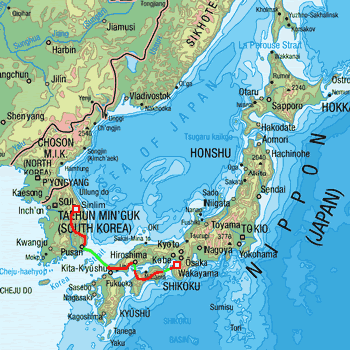
cycling trip through Japan: Click HERE to view larger
map and more details
Kim's
Guesthouse [website],
Seoul, Korea, 14-07-08
An animated welcome
Busan to Near Sinlim (6 cycle days; 3+2
rest days; 507km; 4836m)
We have no idea what to expect of Korea:
can we camp wild; what are the roads like; the food;
the people? It will also be the first country that we
venture into without a guide book of some description.
We soon find out that in some ways Korea is similar
to Japan and in others it is so far removed that the
first couple of hours on the ferry boat from Shimonoseki
to Busan are almost a culture shock of the third degree.
The animated and vibrant characters we chat with certainly
authenticate one of the most obvious differences: the
people of Korea are very spontaneous and they are just
dying to talk to you. We did kind of miss this aspect
in Japan and it doesn't take us long to adjust to the
raucous downing of soju shots and cheering every time
someone says something silly or profound. Before the
boat has left the harbour, we are shouted our first
Korean beer from Duk: Hite is the brand name and if
you would add an "s" to the beginning of the
word, you'll get an indication of how it actually tastes.
Similarly the other beer on the market in Korea is Cass
just needs an "r" in the second place and
I'll say no more. Even though Korean beer is not that
great, on a humid day, after a few steep gradients,
a cold one relaxing by the tent really does hit the
spot.
After circumnavigating the ferry and
checking out all the services on board, we spend most
of our time in the lounge area. Unlike any other ferry
I've been on before, where you have to make a dash to
the cash machine for more money when buying 2 cups of
coffee, everything is surprisingly cheap on board: restaurant
included. Our room is equipped with 12 sleeping areas
on tatami mats and apart from two older Japanese ladies,
who have settled themselves in one corner and are asleep
almost before the ferry has departed, we have the room
to ourselves. A pretty rough night at sea follows and
I vaguely remember the ship docking in the wee hours
of the morning. It must have been blown across the ocean
at records speeds. Still, we are not allowed to disembark
until 8.30am. At immigration, I'm given a thorough third
degree and it starts instantaneously; no hello; no nothing...
Good Morning (as I hand over
my passport)
When were you in Korea before?
This is my first visit.
How long will you be staying in Korea?
45 days.
Why do you need 45 days in Korea?
Because I'm cycling to Seoul from Busan and it will
take about 45 days.
What will you do in Korea?
I'm cycling through Korea to Seoul
Where will you be leaving from?
Seoul.
Where will you be going next?
Canada
Can I see your air tickets?
No, I don't have them yet.
Why not?
Because I'm not exactly sure when I'll get to Seoul.
I'm on a bicycle
Do you have friends in Seoul?
No, no-one.
Do you know anyone in Korea?
No, no-one
Who will you be visiting in Korea?
No-one
Where will you be staying in Busan?
I don't know yet. I'll find the name of a hostel at
the tourist information.
At this point he stamps the open page
in front of him, scribbles in a date that I can't read
and throws my passport at me without any further acknowledgement
what so ever. Mmmm...welcome to Korea! Ali is let through
interrogation-free. Our bikes are waiting for us in
baggage collection area, but the bags need to go through
the x-ray machine, so while we unpack, a very enthusiastic
and apologetic airport worker runs them to the conveyor
belt and then back to us as each one is cleared. Customs
ask us the same type of questions I was cross-examined
with, but not quite as many and without further ado
we are in the Busan arrivals lounge.
Reaching Blue
Backpackers is much easier than getting information
out of the girl at the tourist information desk, but
they only have dormitory beds available. This is not
my favourite way of spending the night, but it'll have
to do as we both can't be bothered searching any further.
As it turns out, the guesthouse is quite an okay place.
The genuinely helpful owner is a lovely, no frills,
down to earth person and the place is full with lots
of friendly and interesting travellers. Also to it's
credit, it is almost immaculately clean and the kitchen
spacious and well equipped. There's wifi which means
we can do quite a bit of research on internet over the
length of our stay and Ali maps out a rough route taking
us through the National
Parks in our newly purchased road atlas. Since it
is entirely in Korean, he also embarks on learning the
Korean
alphabet (Hangeul). To his credit and our advantage,
as we later find ourselves having to decipher roads
signs in Korean, he has mastered it in just a couple
of days.
Everything has a used-by-date
Big cities are good for a few days of wandering around
and the chance to do the things that you can't do when
out in the sticks. Busan is a bit of life saver in that
respect. Besides enjoying the hustle, bustle of colourful
street life, a lot of our gear, has come to the end
of it's life after a two year long proud service and
needs to be replaced. Both cameras have dust bunnies,
the solar panel connection is no longer working, the
computer keyboard has lost it's "n", the inner
tent zippers are completely stuffed, as is the one on
Ali's handlebar bag, my day pants have developed a large
rip from the knee to the crutch and Ali's need major
repair, both our shirts collections have holes, our
bike shorts are not far from tatters, our shoes beyond
repair, we both need new socks and the trusty campart
aluminum cook set of twenty (!) years has definitely
seen better days.
Just goes to show that everything really
does have a use-by-date. Another one of those strange
little phenomena that you really become aware of when
on the road and on a fairly tight budget. Somehow, you
learn to squeeze every bit of life out of all your equipment;
whereas in the average consumers' world, we toss things
well before that, sometimes, we even purchase items
that never ever get used at all. Just think: how many
times have you actually used a pen right to its last
drop of ink before buying another? In two years, we
have gone through 7 pens and 2 pencils. There's simply
no room for clutter, on a bike or not on a bike. Everything
needs to have at least one essential purpose. Multi-functional
articles are a traveller's best friend and believe it
or not, you actually develop a sort of relationship
with the items you use on such a regular basis. It's
sad to say goodbye to them and their substitute had
better watch out because it will be under your watchful
scrutiny for the first few weeks of use. At least our
new set of pots and pans was. I actually carry the old
set around for a few days, just incase the replacement
isn't up to scratch.
Luckily for us, Korea is a camper's
paradise with outdoor stores galore in Busan just near
Nampo-Dong
Station on Line 1 and there's a massive fabric and
accessories market just down the road from the guesthouse.
The latter causing major goosebumps of excitement in
myself when I step foot inside the maze of colour, texture,
frills, diamontes, buttons, buckles, attachments and
embellishments in gold, silver, glass, metal plastic
and in every colour under the sun. Ali finds it all
pretty well boring and I guess only avid seamstresses,
tailors and my sister P will know exactly what I'm talking
about. Its just delightful to look at, but I'm only
there for new mosquito netting and zips. At the end
of our Korean trip I also learn that Seoul has an area
that rivals Busan. It along with every other conceivable
market and wholesale area can be found in the vicinity
of Dongdaemun
Station also on Line 1.
Odour de jour
Five nights in Busan is enough and though we leave town
in rather dubious weather, by the time afternoon hits
the skies have cleared and it's actually a pretty nice
day. Well, it would have been perfect except for the
heavy duty traffic and the petrochemical industry that
spans nearly 30kms of coastline. And as if the exhaust
and petroleum smells are not enough we are also assaulted
with the damp pungent odour rising from seaweed drying
along the roadside. The plan of pleasantly totting up
the coast towards Gyeongju becomes a bit of a nightmare:
we also miss a turn-off which increases our kilometres
and adding to this frustration the trip proves much
harder than we expected with undulating surfaces that
give us just a small taste of things to come in Korea.
About 40 kilometres before Gyeongju (125km;
818m) my back pannier snaps off the frame,
but this time lady luck is on our side. Only ten metres
from where this occurs Hoam Chul Lee and his welding
apparatus are waiting. It's a five minute job and there's
no charge either. He even throws in a bottle of aloe-mineral
water for good measures.
Hanjin Guesthouse is not too difficult
to find but very grotty and in hindsight it would have
been much better value to stay at a motel. They are
friendly enough though and as we rock up for the night,
Ali gets interviewed for local television. I'm too knackered
to even grunt, so stay well in the background. The heavens
open up and stay that way for literally the whole of
the next day, so a visit to the temples and tombs resembling
oversized grass covered mole hills is out of the question.
Ali uses the time to reassess the route. We have to
find smaller roads if our sanity is to remain with us
in Korea. While the following day doesn't start off
brilliantly either, we decide it's now or never: neither
of us have the inclination to stay any longer in our
rather dingy and musty smelling environment.
Korea is much like Japan as far as
it's rural element is concerned, though poorer and quite
often shabbier. They grow just about every conceivable
crop known to man: corn, potatoes of every variety,
tomatoes, courgette, aubergines, garlic, onions of all
shapes and sizes, cabbage, green leafy stuff, melons,
pumpkins, soyabeans and so much rice that it makes you
wonder exactly how the world can have a current shortage
of this food item. And in the 3rd most densely populated
country of the world (not including tiny sovereign states
like Monaco or Singapore and self-governing dependent
territories) that means every single inch of earth is
farmed. In the cities, you'll see spring onions ready
for harvest bending over the sidewalk, soyabean crops
in the front garden of advertising companies and sadder
still, green paddies butting onto chemical factories.
Of course this has consequences for us too and finding
a camp spot on our second day of cycling is nigh on
impossible. The farmers fields either inundate the river
beds or the terrain is too rocky to pitch a tent.
Near Gunwi (100km; 838m)
and after an exhausting day of cycling, we end up settling
for the tiniest piece of ground along a tractor track
leading to the river. The grass is a little high for
my liking, but we are sealed in our tent before it is
pitch black and sleep undisturbed until Farmer Joe and
his tractor are at the foot of our tent making an awful
racket and wanting to pass at 6.15am. He diverts, as
there is obviously enough grass to cut in other parts
of this river and we wake with a start that immediately
begins our 2 hour morning ritual of eating, packing
and setting off.
During the next week we quickly learn
that Korea is not for the unfit, nor the faint hearted:
it is one mass of mountains. They might not be that
high but boy, oh boy, they are steep. Everyday is a
relentless series of sweaty grunts and groans up hill
followed by silent but a well-earned relief, coasting
down again. One day it's stinking hot with a sun fit
for whipping up a stir-fry on pavement and the next
it is hammering down with rain. Other times, it's overcast
while still maintaining 31° Celsius. Pig odour wafts
through the air on Monday; Tuesday, the freshly harvested
cabbage fields remind me of a mix of simmering sauerkraut
and sweaty socks. The following journey blows cow manure
in our direction and by the time Sunday comes around
we've had a full nostril assault. We have ventured in
and out of so many towns and cities with names ending
in yeong, yeouk, cheong and cheok that I have no bearing
on where I really am anymore. Each pass seems to be
too far away and the downhill runs all begin to look
alike. We stick as much as possible to the three digit
highways as more often than not, these are quieter,
more rural. More often than not, it's a very challenging
route.
We enter Hwabuk (109km;
1117m) and decide to ask the local police
where the Songnisan National Park campsite is. Since
most travellers have accounts of dealing with unhelpful
and arrogant police with little or no understanding
of the English language, we are a little hesitant at
first. Now admittedly, these two constables did have
very limited English, but contrary to the other stories,
they are quite obviously excited that a couple of foreigners
have paid them a visit. "Tea, tea" one guy
shouts. We really have to decline, as it will be dark
soon. and there's bad news too. There is no official
campsite in the vicinity, but the good news is they
have nicely pointed out a spot on the river a few kilometres
down the road, where we can stop overnight. All sorts
of hand and foot actions along with ummmms and aaaahs
are used for giving us the directions. During these
charades, I begin to think there is no way we'll find
this spot, but it's easy enough. Although it doesn't
register tonight, a few days down the track it becomes
apparent that like Japan, wild camping is also tolerated
in Korea. Only problem here is, there is not as much
free space available. It also dawns on us that the police
are our one resource we can count on when outside cities.
They let us use their telephone, internet and only once
did they disappoint us with no information on where
we could camp in the area. On that occasion though it
didn't matter because there was a perfect spot up the
road anyway.
Spontaneous actions
and mixed feelings
The next day, we find the campsite Hwayangdong
(25km; 258m) just a few kilometres further
on, but not before climbing a torture hill. We are stopped
just after we reach the top by an enthusiastic couple
who shove a can of beer in Ali's hand, pour us both
a cup of ice cold water and donate two small melons
from their coolbox supplies, while babbling away in
Korean to us. It's one of those moments when you realise
that the world is full of good natured, kind and thoughtful
people. Pity a little more thought didn't go into the
tending of the campsite and it's vicinity. Firstly,
it's not a particularly well equipped place and the
waft of well-seasoned rubbish filters through the warm
air. In fact, this is not what I'd expect from a National
Park anywhere in the world and it is quite disappointing.
With facilities lacking, we decide to venture on the
following day. Doldonjae (59km; 965m)
in the Songgye Valley in Woraksan National Park is a
much better example of camping environment, but the
electricity is out in any of the amenity areas that
we camp in. There are no rubbish bins except for a small
container in the toilets, so it's not hard to imagine
what happens with everyone's refuse. A pile of rubbish
sits before the wash-up on the day we leave. We have
no alternative, but to add to it. I feel kind of bad
but at some time in the week, someone will come and
collect what is standing here. It's as though the officials
here can't be bothered or something because, similarly
no-one comes around to ask for the campsite fees for
our entire three night stay either.
Cycling out of the park, cuckoos calls
are telling me that it's no particular time of day,
beautifully ornate butterflies flutter around the side
of the bike, but I still have mixed feelings about the
place: there is some gorgeous nature to be appreciated
here, but there is still too much of a "human presence"
for me to believe that this is truly a National Park.
The whole area is full of farms, the military still
have their flight paths directly overhead, there are
way too many karaoke places for partying and the rubbish
disposal system is nonexistent, which means it is everywhere.
Naturally, with all this intrusion, there is little
wildlife to be seen; at least when I compare the same
areas in Japan. Korea might have plenty of chipmunks
but other than that, the only other fauna has been in
farming pens.
Police to the rescue
While our next stop, near Sinlim (90km;
840m), is not an official Chiaksan National
Park campground, it is used by all the locals and perfectly
clarifies my earlier observations. The rubbish left
behind by its visitors is simply sad and the porta-loo
facilities so disgusting I refuse to step foot inside
them. And yet the spot is totally beautiful with a fast
moving stream before you on a stone river bed, a peaceful
grassed area with trees, private podiums and benched
areas and a badminton court. We pull a picnic table
closer to our tent and we are set for two nights. Normally,
we wouldn't stay an extra day, but we are having problems
confirming our tickets to Canada. The booking company's
system and the girl in the office, has kept Ali in search
of telephones and internet cafes constantly since our
departure from Busan. We'll be heading into quite rural
areas over the next couple of days, so with a town so
close at hand, it's better to sort it out now.
Well, he at least attempts to get
things sorted, but what eventuates over the next few
days becomes one of those ludicrous waiting games. Initially,
Ali was booked and I was on a waiting list. My flight
is finally confirmed, only to find out that we can't
pay for both flights on Ali's credit card. I don't have
a credit card with me so, after much debate, several
telephone calls and emails we can eventually pay with
one card. However, they process our two tickets separately
and as you would expect, the credit card company blocks
the second transaction. So now I'm flying to Canada
on the 16th and Ali isn't. It's the weekend by this
stage, we are in the middle of no-where, it's 8 days
after getting the okay for my seat on the plane and
if the ticket isn't paid by Tuesday we incur and extra
US$45 in fuel surcharges. We can do little else, except
wait until Monday for them to try the credit card again.
I mean to say how hard can it be to pay a few hundred
euros with credit card over the phone? It all works
out in the long run: "long" being the operative
word here.
A nice thought to end the month on
though: the police come to our rescue in all the villages
that we pass through. Not only pointing out places where
we can camp on their local area maps but offering Ali
full use of their internet and telephone services for
absolutely nothing. Without their kindness, we really
wouldn't have been able to book, confirm and pay for
our flights. Sheds a totally different light on the
Korean Police force compared with what you are lead
to believe in guidebooks and other published matter.
|
|