|
Internet
Cafe , Kyoto, Japan, 29-05-08
A quick sorry...
This update is certainly a little late in coming. Sorry
about that. We thought that we would have plenty of
opportunities for wifi connections while travelling
through Japan, but the fact of the matter is that outside
the big cities, it is far more rural than you can imagine
and an internet cafe far from the thoughts of the folk
that live there. Secondly, we have been camping wild
nearly every day and the only access to electricity
is the small amount we generate from our solar panel
and not really enough for me to sit and hog the computer,
writing for hours. But at last, in between Kyoto and
Nara, we find a campsite, where we can settle for a
few days and get everything up to date. Enjoy!
Living it up in the City of Angels
It
is the beginning of the month and we are still enjoying
Bangkok. You can eat out reasonably cheaply, especially
if you steer clear of Khao San Road. Though it is still
full of low budget travellers, it's a far cry from it's
former sleazy backpacker's hangout. Actually, everyone
seems to have a lot more cash on them these days and
the whole area could be likened to a cross between the
cosmopolitan shopping convenience of Oxford Street in
London and the chaos of Paraganj in Delhi. The Vegetarian
quarters runs perpendicular and behind the Burger King
and has free wifi from almost every restaurant. After
trying several places in this area, we discover the
best spot in town is No 1 Vegetarian Restaurant: one
of the more authentic Thai looking places. You can't
miss it.
Cycling around and you will realise
pretty quickly that pollution is still a major issue
here, but the streets on the surface, appear to be remarkably
clean. We wander through the well known Lumpini Park
on our way to find a bike shop and we could be in Regents-,
Central-, or Vondel Park, except for the tropical flora
and unusual fauna in the form of giant iguana like lizards
in the lake. Noticeably, even the Thai people are scared
by them. There is a little bit of Venice Beach here
too with an outdoor workout area: though the equipment
has seen the better part of a monsoon or two. Families
are milling about, snoozing through the lunchtime hours
on woven mats or just relaxing the afternoon away and
the scene couldn't be further from the poverty stricken
streets we saw just ten years ago. Poverty still exists
though not quite as transparent as it was then. Newspaper's
quote a minimum wage of just 194 baht per day; that's
not much money at all and the old man who builds his
umbrella house around him every evening outside the
condo where we are staying is testimony to its survival.
We do some of those boring things that
need to be done, when we get to a big city: Sony Cybershot
camera needs it's lens cleaned again: Yep, again and
the fourth time in nearly two years! My teeth get a
thoroughly good cleaning from a periodontist's hygienist
at www.silomdental.com.
As well as having one of the back teeth pulled, just
one week short of my 44th birthday, my very first cavity
reveals itself. Though a little more pleasurable than
someone sticking there fingers in your mouth, finding
a decent bike shop is also one of those must do tasks.
We opt to go to Probike shop, however, in hindsight
we should have gone elsewhere. The outrageous prices
and total lack of customer service get the big thumbs
down from us.
If you have been wincing as much as
we have at every breakdown of Ali's back wheel, then
you'll know that he needs to have it respoked. Probike
do a shoddy job and then treat Ali with an arrogant
defensive air when he complains. And of course spin
a rubbish story as to why the spokes were not tightened
properly. They reluctantly fix the problem, only after
Aaldrik demands that it be done, like NOW, and not before
removing his wheel and dropping the bike full on its
derailler on the floor. Honestly, we should have known
better. There are tell tale signs to watch out for:
like a workplace the size of a postcard and a shop full
of smooth handed sales people.
Just a day later we meet up with Christian
again, who we met on the road in Malaysia and Franz,
another perpetual cyclists and they give us the following
invaluable bike shop tip: Sang Phet Bike shop / Charan
Sanit Wong Road / Soi 132/7 Bangkok Noi 10700. They
couldn't praise the service, pricing and friendliness
enough, so if there is a next time round, we will make
the effort to head on out of town.
To the land of the rising
sun and beyond
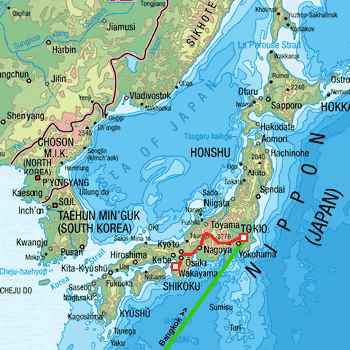
Our flights are booked for Japan and we
are getting pretty excited about another complete change
in culture. Initially, we wanted to start the tour in
the last week of April, but on the advice of several
acquaintances, we postpone the trip until after Golden
Week, which falls in the first week of May. Japan in
general, is totally going to break the budget, but we
both are adamant about going there, so what harm can
a month or so do. To keep the costs down, we intend
to camp at every possible moment and use couchsurfing
and a small list of contacts as much as possible. Following
this adventure, we will ferry across to Korea from Shimonoseki,
where we are not quite sure how the rest of our trip
will pan out. Intentions were to try and get a 3 month
visa for China in Seoul and then after using a bit of
public transport, use the time to cycle through Tibet.
However, due to Chinas latest hard line policy on travel
permits after the turmoil in Tibet and the ever-so conveniently
coinciding Olympic Games, our plans have been quashed
completely.
Rumour has it that Chinese Embassies
around the globe are even going as far as to refuse
entry to foreigners: saying that those wanting a visa
should return to their homeland and apply there. Now
apart from tickling my Mother every single shade of
pink, this would prove a rather costly exercise and
not one we are about to embark on. Besides, even then
you only get a 30 day pass with absolutely no chance
of an extension: so totally useless for anyone about
to commence a cycling journey in China. Once again,
we reach another point in our tour, where our plans
have to be trashed and reassessed on the account of
bureaucratic or political mumbo jumbo. And to be honest,
we are not sure how this one will pan out. We both really
do have our hearts set on cycling in Tibet, but it might
just have to wait until another time.
Many happy returns of the
day
After a ceremonial giving of newspaper wrapped presents,
a celebratory Birthday drink and just 3 hours sleep,
we leave our little Bangkok oasis at 5.30am on May 8.
Ali gives me the wallet he bought for himself yesterday,
but then finds out is not suitable. At this point of
unwrapping my presents, I figure that the rest are just
empty boxes but he proves me wrong by adding a new set
of headphones in their own case and a suduko book to
the list. We have hired a pick-up utility for the journey
to the airport, which costs 1000 baht, but worth the
peace of mind. Shooting past the highrised cityscape,
a not so spectacular sunrise is well on it's way before
I notice that we are using the expressway. Now if this
were India, we'd be having a right proper row with the
driver at this point in time over the toll fees. But
this is Thailand and we have paid the 1000 baht fee
up front and we can just sit back for the little over
half an hour journey to the New Bangkok International
Airport.
We have a total of 41kg of check in
luggage and at least 7kg each carry on baggage without
even weighing the bikes, which with a little help from
Ali holding on to the rack while weighing them, come
in at 28kgs in total: that's probably 4kgs lighter than
normal. Oh, and not to forget quite a number of kilograms
in electronic and camera equipment that I have hanging
around my neck and stuffed into any available pocket
space causing my trousers to hang precariously low and
the reason for my cumbersome toddle. The girl at the
desk is very friendly and she automatically offers us
3 kg extra each. This still leaves us with 22kg over
the limit and at a whopping rate of 585 baht/kg it converts
to a wallet lightening fee of 244 euros in excess charges.
It's my birthday, so why not use this as an opportunity
to round up a bit of preferential treatment. Unfortunately,
the check in girl can't do anymore for us but calls
over her supervisor, who immediately cuts another 10kg
off. Just like that! Wow, this is the easiest it has
ever been: no disappointed looks and grimaces, no pleading
that later turns into threats or even crying tantrums.
Everything runs so smoothly and the
China Airlines staff are courteous and super pleasant.
When they find out we don't have an onward ticket from
Japan, we must sign forms relinquishing them from any
responsibility: stating we are aware that we have insufficient
documentation on us. As I expected, the equipment I'm
carrying in my handlebar bag causes a bit of a fuss
at the x-ray machine and needs several scans before
they are satisfied that the Beachtek DSX-2A I'm carrying
is a XLR video adapter and not a weird looking detonating
device. My steel capped boots have to come off as well,
but I'm used to that by now.
Our flight is split in two, with a
stop over in Taipei but only for 40 odd minutes. Just
enough time to get off, walk through the transit area
and on to the next boarding gate. We arrive at Tokyo's
Narita airport at 6.30pm. Although we are a little apprehensive
about being let in, mostly owing to the concern from
the China Airlines officials back in Bangkok, it is
the simplest procedure and we breeze through immigration
without a question asked: though the latest thing is
to fingerprint and photograph all foreigners entering
Japan. A Customs officer asks us how long we intend
to stay, is satisfied with our 35 day answer and waves
us on. We find a suitable place in the arrivals hall
to put the bikes back together and repack the bags.
It's too dark to get any real riding done, but we have
to leave the airport grounds because strangely enough
it actually shuts up shop for the night.
We cycle out in the right direction,
after a bit of disorientation and only have to go 5kms
up the road before we find a perfect patch of grass
under a tree and far enough from the road for comfort.
My slight headache that developed on the second flight
has now turned into a fully fledged migraine and although
our campground is right under the flight path, I'm too
sick and Ali too tired for the ground-tremoring rumble
to really bother us. There's a petrol station conveniently
down the road where we purchase fuel to cook a meal
for the first time since China. Unfortunately, I am
in no state for eating as everything that goes in seems
to want to come out again very quickly. All I can say
is: "damn that aeroplane food!" At least that's
what I think it is...
Culture Shock of a very
nice kind
Next morning we need to travel for at least 10kms before
spotting a convenience store and somewhere to grab a
bite to eat. It's yet another 7-Eleven. That confirms
it. They've definitely got the world sewn up. A bit
shocked at the prices initially but it's roughly the
same as Spain or Portugal, so not that expensive really,
just considerably more than we have been used to for
a while. For you information, 1 euro is equivalent to
about ¥160.
Our route is along the No 295 from
Narita Airport to Narita City: there's a backpacker's
on the main drag for ¥2700 per dorm bed per night,
which is dirt cheap by Japanese standards. Boy, are
we glad we have a tent! We then use the No 51 to get
us into Chiba. From here, we basically intend to stay
on the No 14 until we hit Tokyo's JR
Central Station, (73kms 427m):
This is easier said than done and we do stray just a
couple of times, but considering we don't have a map,
it's quite an achievement when we finally reach our
destination. With all the traffic lights though, it
does take us a full day of riding and the stop-start
routine tries much of our patience.
As soon as we are in Tokyo we invest
¥3000 (18.50 euro) in a really good atlas: published
by Shobunsha Publications, Road Atlas Japan covers the
whole country at a scale of 1:250.000 (Hokkaido 1:600.00).
It has cities and towns in both Roman and Japanese script.
We later find out that the road representation is almost
identical in actuality, which is pretty impressive.
Only downfall of the book is that, even though it indicates
mountain passes, there are no elevations and anyone
that has cycled in Japan will know, that can turn an
expected day trip into a couple of days of hard slog.
Still, the main issue for us is a map with details of
the smaller roads. Unfortunately, these are also not
numbered, but with Ali's great sense of direction and
power of deduction we manage quite successfully to get
off the highways and into less populated areas in order
to camp wild.
Japan also has an amazing network of
cycle paths, but beware they are not signposted and
taking one of them could lead you literally, right up
the garden path as we find out on numerous occasions.
And there is nothing worse than having to turn around
and go back! Furthermore, the gradients that they consider
cycle path friendly are little over the top for a loaded
bike. It's often better to stick to the main road. At
least you can see where you are going. On first impressions,
streets are clean in and around Tokyo and although there
is little sign of pollution, people strangely enough,
still insist on wearing face masks: even when driving
in their own car with windows wound up. Does seem a
little over-paranoid.
Only making plans at Nigel's
Anyway the plan is to ring Nigel,
once we have arrived at JR Train Station. Gerry, in
Singapore, put us in contact with him and being another
cycle touring fanatic, he welcomes us big time to Tokyo.
Within 10 minutes of our phone call, Nigel is at the
station and we are cycling back to his and Maki's apartment.
Both have no qualms about putting us up for as long
as we intend to stay in Tokyo. Initially we thought
we'd be out of there in a couple of days, but what with
their generous offer of accommodation, the use of the
multi-media empire Nigel has built around himself, the
uninviting weather and not to mention the exchange of
cycle tales from far and wide, we are kept well and
truly entertained for 5 days.
When it is not raining, we venture
around Tokyo, on foot mostly. Subway and trains cost
about a euro per short trip and each exit gate means
one trip, so it mounts up over the day. Besides, walking
gives a better orientation of the area around you and
we are situated just a 25 minute walk east of Central
Station. The electronic hub known as Akihabara is a
whirl of flashing lights and a barrage of noise way
beyond sensory overload. Things are cheap here in most
respects, but not always so it definitely pays to shop
around. And that is something you can definitely do
here. One of the most amazing department stores I have
ever seen before in my life and with absolutely everything
ranging from suntan cream to the MacBook Air, is just
to the east of the railway line. If this place doesn't
have it, then I reckon you'll be hard pressed to find
it anywhere else. We purchase a few goodies, which doesn't
help the budgeting but suppresses the shopping urge
for an indefinite period of time: a new mouse; extra
512MB ram for the laptop; burnable dvd's; a lead-acid
battery (somewhat larger than we had in mind) for the
solar panel; and a voltmetre.
As well as strolling down the main
strip of the notoriously snobby Ginza area: where they
say shopping is an ultimate experience, we also venture
to the Imperial Palace and investigate the adjoining
gardens before struggling no end to find the Patagonia
shop in the Ogawamachi district. After the feet have
just about given in and we have circumnavigated the
entire district inch by inch, we finally discover the
shop, tucked away in a side street. The only reason
we are here is because Ali's latest Patagonia shirts
(a little over a year old) have developed so many holes
over them, that they are close to disintegrating completely.
We gear ourselves up for the pleading but are welcomingly
surprised with an immediate: "we change over".
No questions asked and no receipts necessary: the best
sort of customer service. The shop assistant clearly
states that if there is any trouble then these can also
be changed again! It's what you would expect from 45
euro a pop shirts, but the simple truth is you don't
often get this sort of customer service these days.
So hats off to you
Patagonia and the staff at the Ogawamachi store.
(2-3-18 Ogawamachi - Kanda - Chiyoda - Tokyo 101-0052
/ tel: 03-3518-0571)
Good weather comes to those
who wait
Disappointingly, the weather hasn't been the best while
in Tokyo, so it's been great refuge to hang out in the
apartment researching our trip further and catching
up with news. We go out to dinner a couple of times
with Nigel and Maki, once to Nawab, a very good Indian
restaurant with an amazingly decorative toilet just
down the road from where they live. But even more memorable,
on our first night in Tokyo, they take us to a Monjya
restaurant. Now, this food sort is not mentioned in
any Japanese food or guide book I've ever read, but
apparently it is famous in this area. To describe it
in Nigel's words is to say it's a pancake in a blender,
cooked on a griddle and as it turns out, that's basically
what it is: an eggy batter with a variety of chopped
ingredients, depending on your choice, cooked on a iron
plate until the outside forms an almost caramelised
crispy crust. The inside remains a little soft and doughy
and it's absolutely fabulously delicious.
Eating out can be quite expensive in
Japan. Both the restaurants we frequented are relatively
cheap in comparison but still, a meal here will set
you back between ¥1300 and 2000 per plate. That
said they were all generous servings and the cost really
only mounts up if you want to drink with your meal.
You won't get much for under ¥500 a glass and that
includes soft drinks and juices. Consequently, we eat
in a couple of times as well, which is also great because
I get to use a modern kitchen again: something, which
most of my dinner party friends will know, I love to
do. It's also a bit of a lesson in the ins and outs
of Japanese food products, life and customs as well
as long conversations about travel and contemplating
the pros and cons of various cycling and camping equipment,
linux versus windows which Nigel is passionate about
and the cost and politics of weddings since Maki and
Nigel are about to get married and before we know it,
the sunshine is on it's way. We plan to pedal off on
Friday and true to the weatherman's word, it is a gloriously
sun-shiney morning.
Tomorrow is another day
Tokyo to Kamikochi (5 cycling days; 343km; 4437m)
It's warm in the sun and cool in the shade
and a nice combination of both to keep you happily cycling
along. All except the traffic lights that is. Within
the first half an hour I count 60 odd sets and then
I have to give up, but it remains poignantly irritating
that the first two thirds of our journey today are incessantly
punctuated by them. Ever so slowly the cityscape turns
into a semi-decent landscape and the traffic thins a
little. Not half enough to make it a pleasant journey
and it must be said that the trucks are a cyclists worst
nightmare in Japan. Mainly because they barely have
enough room for themselves in the lane provided, let
alone trying to pass a loaded bike as well. We try the
footpath, or so-called "shared cycle path",
but it is so uneven, often too narrow for us to pass
through, and so totally unpredictable, hence the road
is the only option. Most of the journey (56kms) is pretty
flat until we reach the Shiroyama Dam where we have
to climb and fall dramatically over the next 15 kilometre
stretch. Not too difficult but the roads are narrow
and Ali is almost wiped out on two occasions, that I
count.
Our route goes something like this
No:20-18-41 and further No:20-16-413/412 and then we
find ourselves outside Sagamiko Picnic Land, which sadly
advertises itself as a Paddington Bear Campers Paradise,
or something to that effect. Anyway, we optimistically
go and investigate what they have on offer, but step
no further than the gate, when they suggest that we
should pay ¥5400 for the night. That's a massive
34 euros and then you have to pay for hot water and
any other facilities you wish to use. It's not a hard
decision to make and we are promptly back on the road
in search of a decent wild-camping spot. We had already
seen a few possibilities along the way, but turning
back is not really an option. Later that evening, we
study the folder the "la-la-land" camping
ground had on offer and discover that they had tried
to extort the Golden Week prices out of us. I only mention
this now because it will not be the last time the Japanese
Tourism Industry will blatantly charge us more because
we are foreigners and something I'll get on the bandwagon
about at a later date in the blog. Just warning you
now.
Upon reaching the the town of Sagamiko
(72km; 473m) we discover the local park
but decide it's covered in a little too much concrete
for our liking and opt to return back over the bridge
to a camp area marked on an outdated local map a few
hundred metres further up the road. It turns out to
be a gem of a place. An abandoned camp site directly
on the river. Only snag is, to reach it we need to navigate
a steep winding path that gives up on the bitumen half
way down. Tomorrow will be a killer beginning, that's
for sure.
A little rusty round the
edges
Doesn't matter, because camping is just so fine. Ali
and I are at our best together when out in the elements
and the weather doesn't decide to play too many tricks
on us. It is obvious while pitching the tent and getting
all the gear out for the first time since China that
we need to get back into the rhythm of things: we are
a little rusty. Still the peaceful and independent sensation
of listening to bird song, while looking out over a
surging river, fueled by a waterfall, framed by wild
flowers, sprouting from the very grassed land that you
have pitched your tent on nulls and voids anything else
you have experienced during the day. It is now and it
is beautiful and you really do enjoy taking it all in.
We purchased our food stocks quite
earlier on in the day, not being accustomed to Japanese
shopping etiquette and consequently, had to carry quite
a load up and down the hills. The supermarket was called
"OK Everyday Low Price", which with our budget,
seemed the perfect place to shop. It definitely was
and we are now stocked quite nicely on goodies and essentials
for our future camping existence in Japan. We later
discover that there are major supermarkets dotted all
over the country and we don't get to enter the same
one twice in two weeks of cycling. In one town, I entered
a shop called "Halloland" and just down the
raod was another monster-store entitled "Shopland".
Jeepers, the marketing teams must have been racking
their brains all night coming up with these names. To
be honest though, you can get by with just the larger
convenience stores. It does cost you about 20- 30 %
more, but a Yamazuki or Pulses store has enough fresh
produce for, as varied a diet as you should desire.
As we thought the previous evening,
the climb up from our serene campsite is treacherous.
We have to help one another continually. At the top,
Ali sets the computer back on nought as he says it wouldn't
be fair to include these figures in our distance measurements.
And that's why I'm mentioning them now: A maximum gradient
of 31% with a full 100 metre stretch of 25%. That's
a morning's workout if ever a trainer could think of
one.
It takes us 30 minutes to get to the
roadside. We are in fine spirits and the sun is shining
again as we start off on our journey taking us along
the No 412-20-76 and finally the No 413. By lunchtime
however, the sun has disappeared along with my enthousiasm
a little later on in the day. My left knee hurts, my
legs ache and all I want to do is get to the top. We
have been climbing all day and the on the last stretch,
following the Doshigawa River upstream to the fifth
and final tunnel of the day. The only way I make it
to the 1099m peak is to push the bike for the last kilometre.
So, where's Mount Fuji
then?
Thank goodness, it's downhill from then
on and sooner or later, we should be able to see the
famous Mount Fuji. For such a massive mountain it certainly
keeps itself well hidden, because even as we pull up
towards the Mitsu Campsite at Yamanakako
Lake (54km; 1264m), there's still no sign
of it. The owner doesn't speak any English, tries to
overcharge us for a gravelled plot and we hike out of
there as quickly as we pedalled in. We follow the sandy
shore line of the lake far enough away from it all and
we stop in our tracks because, there she is before us:
a breathtaking 3776m emergence of snow capped volcano
shrouded in mist. You just have to admire the intensity
of this massive rock. It's a unanimous decision to set
up camp right here: in perfect view of Japan's iconic
cone shaped mountain. When the clouds finally disappear,
an overwhelming beauty descends over the lake. Yep,
another ideal camping spot.
It is absolutely true, what they say
about no-one really bothering you while camping wild
in Japan. In fact, I'd even say, they go out of their
way to totally ignore what you are doing, which does
feel a little strange at first, but hey you get used
to it. There are plenty of fisherman on Lake Yamanakako
who go about their business as if we are invisible.
No-one says hello or good morning as they pass, except
an old fellow, who speaks a few words of English. And
I'm sure that is probably part of the problem. As we
have quickly found out, not a lot of people can speak
English and since the Japanese are pretty well-known
for their reserved nature when it comes to using a language
they haven't mastered, it is possibly easier for them
to look the other way and walk on. You'll have no problems
though, if you approach them. So far, we have found
everyone to be friendly and helpful.
Ali "Udon" Mulder
The following morning, we leave Mount Fuji behind us
but her cloud cloaked presence remains until late afternoon
when we turn off onto highway No 358. We initially trundle
along highways 138 and 139, which are packed with traffic,
very narrow and have a half decent shoulder for us some
of the way. We pass over a section of road that is actually
heated: Talk about opulence! Apparently, it freezes
here due to it always being in the shade and in close
proximity to ice-caves. I must admit, it was pretty
cold riding through here, but for the rest of the day
the weather is mild and pleasant.
We pass through a 1.5km long tunnel,
which is well lit but still no fun at all. The coast
down into Kofu was though. Here we shop and plan to
travel to Chiyodako Lake for an overnight stay. We end
up cycling all over the place, through backyard paddys,
along windy sidestreets and including up a massive hill
to an elderly people's home before realising that the
lake is over a mountain pass and it's too late to start
tackling that. We just cycle out of the city and find
a wild-flowered spot near Nirasaka (81km;
532m) on the river.
Up until now, nearly every day we have
had udon noodles for dinner. I ask each time I shop,
what Ali feels like for dinner, but the answer is always
the same. He even jokes about changing his name to Ali
Udon, which does have a certain ring to it, I must say.
But seriously, they are delicious and very cheap. You
can pick up a packet for as little as ¥20. A couple
of packs, some vegetables, bean curd and flavouring
and you've got yourself a pretty nutritious meal for
extremely little cost. So, from a cyclists point of
view, Japan doesn't have to be that expensive at all.
You can camp everywhere for free, filter your water
from the copious supply of fresh running rivers and
streams and cook your own meals.
Obviously it depends on where you shop,
but here's an indication of the prices of some products
in Japan:
water |
2 litre |
¥100-200 |
bento lunch box |
per box |
¥500-1000 |
vending machine
soft drink: |
350ml
500ml |
¥120 ¥150 |
soba noodle box
udon noodle meal |
tray (supermarket)
meal (restaurant) |
¥300-500 ¥500-1000 |
| coffee hot/cold |
200ml can |
¥100-120 |
processed cheese |
200g |
¥300-450 |
| beer |
350ml
500ml |
¥205+ ¥265+ |
udon noodles (fresh)
soba noodles (dry) |
220g packet
400g packet |
¥20-80 ¥170-250 |
| wine |
750ml |
¥500+ |
mushrooms |
200-250 gm pack |
¥80-200 |
| apples / oranges |
per kg
big (each) |
¥400 ¥100 |
rice crackers
custard cream buns |
130-150g packet
5 piece per packet |
¥100-150 ¥100-150 |
| bananas |
4-6 piece |
¥100-300 |
bread (white) |
half loaf |
¥160-200 |
* (at the time of writing 100 Japanese Yen = 0,62
Euro cents)
Doing your noodle in over
a lack of rubbish bins
The supermarkets are something else. Firstly, they are
massive and without a doubt, you'll get lost trying
to find what you want. Secondly, the produce is very
good, very fresh and most things are reasonably cheap.
Mushrooms that you would have to earn a full day's wages
for in Europe, cost absolutely nothing, as does the
tofu of every delicious description and variety. Beansprouts
and green leafy products are also inexpensive. Tomatoes
on the other hand cost a small fortune. So does cooking
oil and cheese is pretty much out of the question as
an everyday commodity. Thirdly, bread only comes in
a half loaf size and it is more commonly cut either
in 6, 5 or 4 slices. Imagine a half loaf of bread in
just 4 slices! The traditional sandwich is impossible
to get your mouth around. Gives totally a new meaning
to the word "jawbreaker." Every now and again,
I manage to find an 8-slice pack, which is a little
thicker than a the western idea of thick sliced bread.
Lastly, the packaging will blow your mind. Everything
is in a tray, which is covered twice or even thrice
with further plastic. Dry products have an oxygen absorber
sachet inside and then when you get to the cash register,
they'll shove all these items into even more plastic.
Nigel taught me the phrase "sore name de",
which means "as it is". It has certainly come
in handy!
This over abundance of supermarket
plastic all seems a little strange, when there are signs
everywhere about the environment, littering and their
obsessive concern about dropping cigarette butts on
the ground. Not that any of this signage is very effective.
Part of the problem is trying to find a rubbish bin
in the first place. Very, very infuriatingly, there
just aren't any! Vending machines and convenience stores
are your best bet, but quite often it will only be for
glass and pet bottles, cans and if you are super lucky,
burnable rubbish. There's nowhere to get rid of the
real rubbish, which I can tell you amounts up pretty
quickly with all the packaging.
Consequently, the roadsides are covered
with cans, bottles (mostly in the form of broken glass),
used chopsticks, plastic bento boxes and snack packets.
Furthermore, just like everywhere else in the world,
wild dumping is a big problem. This in mind, we were
both a little offended at the older gentleman, who especially
goes out of his way to drive his car up to us while
we are eating our lunch roadside and beckons in crude
hand signals that we must not dump our rubbish on the
ground. Obviously, this person is adamant that foreigners
are the cause of the Japanese litter problem. Well,
I can tell him that visitors to his country don't normally
carry speaker boxes, televisions and refrigerators,
along with soiled babies' nappies and other similar
refuse to ditch on the side of the road. Maybe he should
look in his own backyard first, if he really wants to
do something about solving the problem and leave a couple
of environmentally aware cyclists in peace to eat their
lunch.
Sakura, sakura...cherry
blossom pink and white...
While we may have missed the cherry blossom season by
a few weeks, the landscape nevertheless dishes up a
beautiful array of wild flowers and scents: admiring
the cornflowers, primroses, irises of every colour,
azaleas, daisies and of course the rice paddied farmlands
helps keep your mind off the 1-2% incline that we traverse
for the full first half of the day in the Yamanashi
Prefecture. HIghway No 20, which we literally follow
the whole day, rewards us with a dramatic descend around
1pm. Most of the villages that we pass are not particularly
pretty. Like the consumers'choice of car colour in Japan,
which is more than often white, white, grey, silver
or white, the housing is also quite drab: brown and
off white and there's a lot of debris cluttering up
the yards.
As soon as you are through each township,
the countryside is quite magnificent: blankets of green
trees cover the volcanic mountain formation and shoot
vertically up to touch blue skies. The whole setting
is in such a colossal proportion, that the trees, from
a distance, look like mere shrubs. Only as you sidle
up next to the mountain, do you realise the massiveness
of each individual plant itself. The nature in this
country is spectacularly immense and equally intense.
Today, we plan to reach Suwako Lake
but as soon as it comes into view, it's obvious that
this area is so overly populated that we need to cycle
a little further a field. Other cyclists have all mentioned
camping in the parks in the cities, which is quite plausible,
given the nonchalant attitude of the Japanese towards
foreigners camping wild in their country. But the city
parks are used extensively by joggers, evening strollers,
dog walkers, families and sporting groups that you will
be permanently on display. Personally, we like to cycle
out of the city preferably on a side road and camp on
the river bank, often near a bridge. There are so many
rivers and streams in Japan that you can take your pick.
Our spot tonight near Shiojiri (84km; 993m)
is one of those perfect places.
It is certainly a well deserved rest
tonight as the 14km climb out of Suwa was a killer,
but once again the 8km tumble down into Shiojiri was
superb. We shop at another large supermarket near Hirooka
station, fill the petrol bottle up which causes a bit
of a stir and witness a young boy walking over a pedestrian
crossing and then turning around and bowing subserviently
low to the car that stopped to allow him to cross. People
bowing at you might seem a little strange, but you'll
soon find yourself doing it too. In Japan, it's respectful
and similar to our nod of the head or wave.
Tunnel Vision
Today is a little overcast, but we have
been really lucky with the weather so far, considering
the forecast was for rain about now. The sun peaks out
every now and again as we follow the Azura River upstream
towards Mt Hotahadake. Again impressive countryside.
As I look around me, this could be anywhere in France
except the vineyards, lavender and wheat fields have
been replaced with rice paddies, azaleas and wheat fields.
It's definitely farming country.
The last real shopping facilities are
at Shinshimashima, where I get my second flat tyre for
the day. After here, you are only left with the option
of paying through the nose for anything you purchase
at Kamikochi Park. They don't have real groceries either,
just snacks, pot noodles and few other items like face
masks. Why on earth would you go hiking up in the fresh
mountain air with a blinking face mask on? Beats me.
One place I would certainly recommend
wearing a mask is in tunnels. I hate tunnels, let this
be known right now. You feel trapped: they are dangerous,
scary, noisy, stinking, claustrophobic, light blinding
spaces that cyclists shouldn't have to use, but do because
it saves them from thigh burning pain. We go through
a marathon of exactly 21 of the forsaken things today.
The last one being the king of all tunnels. I thought
the general idea was that they were supposed to be flat,
but no, this one defies all other definitions and is
quite an engineering feat as far as that side of things
goes: 1350m and at a 11% gradient. We have to push our
bikes through the entire length along a narrow ledge
with magnetic reflectors on the road side that make
the passage just that bit too small for a panniered
bike. It was not a nice half an hour experience, but
we made it and as we pedal round the peak and look out
across at the Kamikochi mountain range, the trip was
worth every aching inch.
Kamikochi (53km; 1175m)
is definitely a place to put on your itinerary. It's
peaceful, beautifully relaxed when you are not hanging
around the gourmet shops selling all sorts of bizarre
food products, and you can camp. For the ¥700 per
person, you don't get much, just toilet facilities and
running water, but that's enough. Unfortunately you
have to pay for a Japanese bath and they dictate the
time of service. At ¥400 a pop, we heat up water
ourselves and do what we've been doing everyday since
camping wild. The Sea
to Summit kitchen sink has certainly been one of
the most invaluable items we've taken along with us
on this trip.
Airing your laundry in
public
Day two in Kamikochi starts off miserably. The rain
had started yesterday evening around 9pm and it doesn't
stop until around 12 midday. About 2am, I woke to find
my side of the tent swimming in a 5 cm deep puddle of
icy cold water. Ali reluctantly gets out and tries his
dam building skills to no avail and we end up having
to move the tent in the pouring rain, with everything
inside it. This is one of those dreaded tasks you wished
you'd never embarked on and after the first attempt
only succeeds in moving the tent into another pool of
water, we are finally high and dryish after our second
effort.
We desperately need to do some washing
and decide it could quite possibly dry with the wind
the way it is. Beautifully though, the sun comes out
around 1pm and remains with us for the rest of our stay
in the park. Our washing is stretched out between two
trees next to the tent and seems to pull more of a crowd
that the stunning mountain view across the river. Our
clothes have never had so many photographs taken before
in their lives.
Ali says the best part about Japan
is the birdsong and he's right in that it is almost
operatic. There's one particular song that starts off
as a series of uplifting chirps that rise to a symphonic
crescendo and then the articulated splendor gradually
slows in pace and abruptly ends. It goes on for quite
a while and the first time Ali heard it, he stopped
cycling to listen and then clapped at the end of the
performance. It was pretty deserving of the attention,
I must say.
Going absolutely wild camping
in Japan
Kamikochi to Nagaike (6 cycle days: 379km;
2958m)
We leave after two nights and our next goal is to reach
the campsite in Nagaike in between Kyoto and Nara. OUr
replacement Schwalbe tyres are waiting to be picked
up in Nagoya, but further to that, there's no time limits
or definite plans. By now we figure, we'll need to extend
the travel insurance by a couple of extra weeks. Japan
is proving to be a wonderful adventure, really challenging
cycling, stunning nature, enough modern facilities to
keep travellers of our means happy and plenty of opportunities
to camp wild and have fresh water everyday. What more
could you ask for?
The local short tailed, long haired Macaques monkey
population is out in force to see us off the next morning.
They just lol around enjoying the sunshine as we venture
back out of the park, past the bus station and gourmet
shops with hoards of Japanese tourists hovering over
rice crackers that cost more than a euro each and soba
noodles for about the same price as a new release cd:
honestly, just how much are you prepared to pay for
a pot of noodles? The winding road leading to the tunnel
that had been so difficult coming up, is busy with buses
transporting tourists to and from the park. As we exit
and take the turn off towards the Abo Pass, we find
ourselves at a crossroad. In front of us is a toll tunnel
and cyclists aren't allowed in due to road works. To
our right is the steep road leading to the pass which
is surprisingly closed due to recent snowfall.
After a bit of oohing and aahing with
the traffic controllers, they come up with a solution
for us. Our bikes are thrown on the back of a bright
yellow road works truck and we get a comfortable ride
through the tunnel and all the way to the side which
saves oodles of kilometres and leg power as well. The
rest of the trip is relatively easy apart from the intermittent
road works with overly bureaurocratic pensioners in
charge, the usual truck traffic and the unpredictable
cycle paths that just come to a dead end, swap sides
of the road without warning, or become so overgrown
that you can't pass through.
In love with Hida
Our route takes us along Highway No 158
until Takayama, which is a pleasant little town with
old wooden houses and quite a long shopping strip in
the centre. Shopping seems to be a favourite pasttime
of the Japanese and it appears they take it very seriously:
even supermarket shopping. It is fairly obvious, when
I venture into these massive establishments after a
day's riding, in my steel capped boots and bike shorts,
that I'm not entirely dressed for the occassion. Women,
more so the older generation, look me up and down in
utter disgust as though I'm from an undignified part
of outerspace and got coodies to boot. They tend to
steer very clear of me in the ailses and one mother
even went as far as to draw her young girl closer to
her when I walked near them in the miso soup section.
The Satoh Merca in Takayama, though was completely different.
I had been bowed at twenty times before I had got halfway
down the row of packaged seaweed.
We now follow
the No 41 which runs along side the magnificent Hida
River. She is ever changing: sandy banks become smooth
white stone formations. Impenetrable on foot. Smooth,
peaceful ponds become turbulent pools that later turn
into dangerous torrents. The water is so clear you can
see the bottom. Birds are plentiful and butterflies
cling to bright coloured wild flowers. At 5.30 pm, we
perch ourselves on her grassy banks just near Gero at
Hagiwara (85km; 611m).
Getting to our next port
of call is an easy run following the Hida the whole
way downstream. There's a few tunnels to navigate, but
I don't think anything will ever beat our trip to Kamikochi.
Much the same village life to be seen as well: lots
of rice paddies in amazingly green countryside. The
manicured curves of the tea plantations sculpt the lanscape
in perfect waves. We take the side route No 64 to Kani-Shi,
where we pick up some fresh supplies before following
the railway line in the direction of Tajimi
(93km; 399m)
Our campground tonight is a little
different as we are actually in a town. It takes us
half an hour of looking around though before we decide
on this spot. There are two other choices, a park on
a major intersection; or further downstream on a fairly
exposed bank. The third option which we choose is still
very close to the main drag but quite a way down beside
a small river in an overgrown garden at the back of
a couple of businesses. Blue irises, golden daises and
green grass are everywhere so it's incredibly picturesque.
I convince Ali not to put the tent on the irises so
we use stones on the snowflaps of the tent and sleep
on the marble surface instead. It is surprisingly comfortable
for stone. We are not bothered by anyone and sleep like
logs.
Getting the bikes up the steps the
next day is a bit of a hard work, but it was a perfect
overnight spot. We leave the irises behind, intact,
and head for Highway No 248 out of town in the firection
of Seto. It's quite a difficult ride today. The road
is really narrow and every truck in Japan seems to be
on the same route as us. Adding to our maneuverability
problems we go up nearly the entire journeys 427m in
the first couple of hours. The cycle paths are totally
unusable overgrown and thwart with litter. After Seto,
we follow the No 363 and as we close in on Nagoya, the
road flattens out. We almost fly into the city outskirts
to pick up our replacement tyres around lunchtime. Thanks
again to Masao from G-style
distributors and Bettina from Schwalbe
for arranging this for us. The replacements went on
the bikes immediately and we are pretty certain our
rate of flat tyres will go down dramatically over the
next months.
To the bridge over the
rivers Kisogawa and Ibigawa
All we really want to do is get out of the city and
find somewhere to camp, but not without a stop off at
Kato
Cycle shop for a few extra necessities. The sprawling
metropolis just goes on and on and on and by the time
we are on the massive red bridge construction (HIghway
No 23) heading towards Kuwana, it's well into the afternoon.
We literally keep going the Mie Perfecture, which is
an absolute disgrace, rubbish wise, until we find a
suitable place to camp. We do, just outside Kuwana
(78km; 427m). Travelling in the cities
is hard work and not our favourite form of cycling.
Tonight, we decide to steer clear of them at all costs.
An overcast morning turns into a streaming
wet day and we are climbing our way up to the Suzuka
Sky Line, whatever that is: it just sounded good on
the map and so we decided on taking Route 477. Besides
it takes us away from major towns and into the mountains
again. But the weather has other plans and we have no
choice but to stop outside of Komono (27km;
318m). Luck is however, on our side because
just as the heavens open and the rain gets really bad,
we stumble upon a wooden hut. It has open windows and
frontage but it is warm and dry and there's a perfect
platform for the tent, should we get stuck here. This
of course happens as the rain continues for a solid
20 hours and we spend a great afternoon and evening,
counting our lucky stars at the perfect overnight accommodation,
while the countryside gets a thorough soaking.
Early morning workout
When we venture off the next morning the rain has stopped
for just over an hour. It starts almost immediately
when we are back in the saddle and doesn't let up for
the complete climb to the top of the Suzuka Sky Line.
Nothing like a grinding uphill pedal first thing in
the morning to get your heart rate pumping. I stop after
2.8 kilometres and Ali informs me that we have risen
230m. That's tough going. I teeter between being hot
from the exercise and cold from the sweat and rain.
Not a pleasant feeling. It takes us two hours to reach
the tunnel at the top, just 6.1 kms from our set off
point, but 500m up at an average of 8% all the way.
These hills are definitely wicked.
A new set of clothes to replace the
sopping wet ones, long pants and raincoat are needed
for the downhill plunge into mist and drizzle. It keeps
promising to clear up but never really does and we soon
realise that the climbing isn't over for the day either.
We are stopped by our first car and receive our first
gift, in the form of chocolate, from a very enthousiastic
young couple. In this sort of weather, chocolate definitely
comes in handy and just a few kilometres down the road
by a hot coffee vending machine, one block is fevorishly
devoured.
At Hino we turn onto the No 307. It's
a bit up and down all the way to our stopping point:
10 kms out of Koka (52km; 910m).
Yet another perfect patch of ground, near a supposed
temple and golf course. Though there's a bit of car
activity, we are left to our own devices once again.
The birdsong is beautiful again tonight and it looks
like the storm has finally blown over. Blue skies turn
into night skies, we eat and sleep contently after a
challenging journey.
We only have a couple of hours journey
today, which will mean we can arrive at the campsite
and do all the chores before the afternoon has set in.
Well that is the plan. The road is treacherously busy
and drives me insane. We pass the Chinese ceramic area,
with all their kooky looking animals on display. There's
one particular character, the tanuki, that has been
replicated enough times, you could perch one on every
doorstep in Japan. It sort of looks something like a
cross between a raccoon and a badger with tits and a
large scrotum. Weird what some people find attractive.
The last physical feature, according
to folklore, can be stretched to the size of eight tatami
mats and in one fable was used as a parachute and in
another as a drum. Taking all this into account, you
would aptly expect the tanuki to have mischievous tendencies.
And you are right, because he never pays his bills,
loves his sake and is forever playing tricks on people
with his magical power of transformation.
Apart from this mythical ceramic version,
the animal also exists in the wild in Japan. It is an
atypical dog species with characteristic black stripes
under its eyes. It doesn’t possess any of the
fore mentioned physical or supernatural attributes,
but he’ll find a way to get into your tent if
you are not careful. So, don’t leave any food
lying around.
Nagaike (45km; 293m)
is easy enough to find and after a couple of stops to
ask where the campsite is, we find ourselves in a closed
park. The general-chores man though, is kind enough
to let us pitch our tent. Apparently the place closes
one day a week and that being a Monday, though this
is not mentioned in the camping in Japan chart (pdf
file 428k), Ali found on internet. Doesn't matter and
two days later, we are still here. Although not the
perfect camping grounds we've ever been in and incredibly
expensive at ¥2100 for what we get, it is great
to have running water and more importantly, electricty.
Otherwise this update just wouldn't have made it online
yet.
After being rained in for a couple
of extra days than planned, we finally make the ride
into Kyoto. It is not at all relaxing nor pretty cycling
through the sprawling grey concrete mass. We open the
computer up near Central Station to find that not one
unsecured wireless connection exists. Down a side street,
a business offers internet for ¥1000 per hour: Now
they really have got to be joking somewhat disappointing
for the world's leading country in technology. The tourist
information on the ninth floor of the apparently beautiful
Central Station Building has a better deal at ¥400
per hour. Ali flies through the updating and we glance
at our mails before trekking off to the National Museum.
There's some interesting scrolls and wooden statues
from the Heian and Kamakura periods but the display
techniques are old hat, repetitious, with inadequate
English translations and Ali is a little disappointed.
We fly back to the campsite and prepare for our departure
the next day.
It's raining again...
Yep, it's raining again as we awake and we dawdle through
the packing up routine. Finally dries up enough for
us to hit the road, but doesn't stay that way for long.
An hour and a half later, we wind up in a 7-Eleven drinking
hot coffee ad eating chocolate chip cakes while sheltering
from the rain. Though we meet a lot of friendly people
today, the trip into Hashimoto (80km; 489m)
is not a particularly pleasant one: apart from the weather,
the cycle paths are crap, there is one concrete jungle
after the next and the bits in between, that you would
expect to be green, are filled with neon clad Pachinko
Parlours and unfinished highway dreams. Remarkably we
find a patch by the riverside, just outside of town.
Peaceful until the local lads decide to use the riverbed
as a place to hoon up and down in their four-wheel drives.
Doesn't last too long and by 10pm we are about to nod
off. Tomorrow, the beginning of June and a ferry journey
to Shikoku: the island of the 88 Temple Pilgrimage.
| |
When in Japan, you will have
a few options of getting your money out of your
bank account. Most banks will only accept Japanese
cards, but there is an exception: Japanese Post.
And a very good one, because they have offices
all over Japan, even in the tiniest of places.
But beware: ATM's are not open all day every day...
that may sound strange, but it is no fun when
you are about to catch a ferry, to find out the
ATM doesn't work on Sundays...(!) Usually they
open at 9AM and close at 9PM, but the operating
hours on Sunday entirely depends on the size of
the branch.
More info? Check out out country
info pages! |
| |
|
|
|