|
Ideal
Travellers' House, Kota Bharu, Malaysia, 11-03-08
Kota Tinggi to Pantai Cherating: 4 cycling days; 1 rest
day; 346 km; 1159 m
The
Mini Ardennes
Just one of those lack lustre days, I guess: we both
haven't had much sleep and we can blame the television
programmers for putting Gordon Ramsey's 'Hell's
Kitchen' on from 12 to 1am for that. Furthermore,
the weather is not looking too good. Consequently, after
10 kilometres or so, we find ourselves sheltering under
a dilapidated vegetable stand for the best part of an
hour, wishing that we had just stayed in bed. It's already
11am before we get back on the road and there's still
a considerable amount of kilometres to make before the
day is over.
From here on in, the rain never really
stops spitting at us and the undulating road conditions
quickly wear our legs and our patience out. It's not
that the hills are particularly steep (6%) or long (200-400m),
it's just that this 'Mini Ardennes' ride doesn't let
up until we are a few kilometres from our destination.
Moreover, it almost drives you mad having to continually
change gears over such short distances. So much so,
that at times, I just coast down the decline in my smallest
gear and wait until the gradient is steep enough on
the uphill stretch to start pedalling again. And so
it goes on.
And so do the palm oil plantations:
there is not much natural rain forest left in this region
at all. I try to attune my mind to counting the different
types of wild flower species along the road side and
that keeps me entertained for a while. There is definitely
an assortment of the usual yellow and pink varieties
but I hit the jackpot when I spot my first wild orchid,
majestically sticking its white and mauve head high
above the man tamed undergrowth. I count six in total
before entering the port of Mersing (94
km; 575m).
The town itself is a little smaller
than we had expected seeing as this is the main ferry
terminal for trips to Pulau Tioman. From here, you can
also catch a bus to almost anywhere in Malaysia. Typical
with such a travel hub, there are quite a number of
westerners in town. Omar's Backpackers, where we stay,
is truly a backpacker's place: lights out at midnight
and all that, but it's clean, has a share kitchen and
costs a meagre 20 ringgit for a spacious double room.
Besides, we will be asleep well before the light curfew
on the account of one physically, knackering day.
Despite slight head winds, we zoom
out of Mersing in fine form. The road is much more inviting
and kilometres of rain forest are really something to
enjoy from the bike saddle. A jittering melange of cooing,
whooping, chirping and clicking form a enticing hum
from behind the luscious green backdrop. Birds and butterflies,
the colours rainbows are made of, flaunt themselves
in full view. Monkeys are also in plentiful numbers
and are a little cheekier than their winged friends:
quite often attempting to chase after us as we pedal
by. A quick, loud hiss is normally all it takes to stop
them in their tracks. We breeze into the tiny township
of Kuala Rompin (63 km; 231m)
and settle at the first hotel we see: seems a waste
of time to search any further than the brightly painted
Kencana Hotel on the left and at the beginning of town.
The room is light and cheery and only 35RM.
Scenery-wise, the following day is
pretty non-eventful. The only parts worth mentioning
are, yet again, the rain forest bits and there aren't
enough of them as far as I am concerned. The greenest
of green fern barricades the road from unconventionally
collaborated trees and the wildlife that lays beyond.
Only the vibrating hum lets you know there's a whole
different world inside. Man's contribution of row after
row of palm oil palms is so contrived in comparison
with the natural beauty of the rich thick scrub sweeping
it's organic form way up into the tree tops.
We pass some pretty small villages.
Everyone is incredibly friendly. In the warm, humid
and wet weather, we have both taken to riding in shorts,
mine baggy and Ali's the lycra bike pants type and so
far no untoward attention at all. You can generally
get a feel for what's okay and what's not by taking
a good look around you. There is a large Chinese population
in the areas we have cycled through up till now, which
means that a strict dress code is not exclusively adhered
to. In fact, the Chinese just seem to get on with what
they do best, in the way they see fit, while the Muslim
community does pretty much the same. All very amicable
actually.
We make Pekan (88 km; 52
m) around 4pm and opt for the budget choice
in town: 1) because the black clouds above us are promising
to dump bucket loads of rain any minute; and 2) the
'a little more up market' hotel next door is fully booked.
The owner of Hotel Pekan is a bit embarrassed as he
takes me upstairs to show me one of the rooms. He explains
the state of his premises by saying 'Hotel very
old'. It's actually not that bad, I've slept in
worse, but he is right about it being very old. All
that matters at the moment though is that it's a roof
over our heads while the heavens have just decided to
open up. Furthermore, a basic room with share bathroom
and toilet for 18 RM is dirt cheap for Malaysia.
A couple of large vegetable fried rice
(presently our staple diet) and a deserved beer (not
part of the staple diet due to the cost factor) top
the day off perfectly. A bit of reading, writing and
relaxing and we are soon asleep, only to be awoken in
the wee hours to the sound of more rain than we would
like to hear. It continues all morning as we wait in
our hotel room knowing full well that there's no use
leaving in this sort of weather. On the other hand,
our choice of hotel room's is somewhat different to
this one should we choose to hang out in it all day.
Nine o'clock comes around and the downpour dies down
to a weak patter. With black skies in front of us and
wind in our faces, we leave somewhat apprehensively.
Maddening Monsoons
Forgive me if I'm wrong, but I really
thought that the monsoon season was over. However, by
the pressure in the air and the sweat dripping down
my nose, I'd say we're right in the middle of it. It
is now 12 pm and we have only accomplished 15 kilometres
due to repeatedly seeking refuge under what ever we
can find along the way. Our expectation is that today's
journey should be somewhere around the 80 kilometre
mark. We push our way along miles of roadworks on busy
roads, highway networks and very, very uninspiring urban
landscape. The sign post 9kms before Kuantan validates
that Cherating Beach is just 35km further on. Our map
confirms another distance, but it's only 1.30pm, so
we figure it will be a cinch. You think we would have
learned by now: firstly, never ever trust a map maker;
secondly, do not believe Malaysian road signs and thirdly,
never underestimate the weather.
The skies open up once again and just
before we are violently swept back to Singapore, we
pull over, half drenched, at a disused vegetable stall.
At this stage, we still believe we are just over an
hour away from our destination, so we wait the rainstorm
out for 75 minutes. As soon as it hits 5pm and it appears
as though the rain isn't going to stop anytime this
century, we decide that there is no other option than
to don the raincoat and helmet and go hell for leather.
Nice plan, except for the fact that
Cherating Beach is actually 20 kilometres further than
we estimated and the road starts to climb and fall and
we are in one nightmare of a rainstorm. The traffic
is also unforgiving, splashing us with their spray,
not that we can get any wetter. Oh yeah, and did I forget
to mention that when the rain backs off we are cycling
into a headwind. Boy, if there is ever a time when you
would want to pack the whole thing in it's right about
now.
What is most worrying is we seem to
be so far inland and there are no official signposts
to gauge from, not that you could trust them anyway.
We stop to ask a truck driver, who says it's about 9
kilometres away. Now, tired and wet I may be, but this
I can do. However, just as we have both mustered up
a bit of speed, 3 kilometres down the track, we spot
a giant board stating the Cherating Sailing Club is
17 kilometres further on. Does this guy drive around
with his eyes closed? After the turnoff at Sungai Ulan,
a load of lousy resorts who haven't got a clue how far
they are from anywhere, begin to taunt us: one says
12km, the next 5km and another 10km. How can they all
be so wrong? Just for the record guys: Cherating Beach
is 50kms from Kuantan City Centre and 15 kilometres
from Sungai Ulan.
Shoulders are flooded completely along
the coast and we weave the best path possible through
the puddles. Houses are entirely cut-off from the road
and one restaurant I see has shut up shop for the night.
Not much chance of clientele dropping in for a quick
bite to eat when they can't see their feet, let alone
the restaurant floor. We just keep on cycling, leaving
these great photo opportunities behind us. Believe it
or not, the rain actually gets worse. I scream some
futile and unrepeatable words at the heavens and then
we see the sign we've been looking for: Pantai
Cherating (100km; 301m), on our right.
There is only one resort sign at this entrance and so
we are still doubtful as to whether this is the correct
road, but take it anyway. The first place we hit that
looks half-way decent and open is Ranting Resort and
a chalet, not on the beach, is 50 RM with a fan. Soaking,
frazzled and so very pissed off, we just accept without
looking any further. Anything resembling comfort is
of paramount importance at this point in time. Our room
is okay and the surroundings pleasant, though there
could possibly be better deals around.
Can't remember much of the night, we
showered, ate and fell asleep in that order and that's
about it. Next day and it's a difficult job finding
something for breakfast. The usual Malaysian style buffet
is available in a couple of places, but the dishes are
either seafood or meat based. I find it rather unusual
that you can't get the traditional roti canai or roti
telur anywhere in this village. This is Malaysia after
all! A westernised restaurant up the road, Cherating
Cottage, does it's own version of roti canai which is
really quite good. A quick walk on the beach and the
rest of the day is taken up with a few necessary chores.
There's washing to be done and while Ali patches the
numerous holes in our Ortlieb
bags, I sew up the gapes in the clothing. Ali's bags
are really quite bad and need quite a bit of attention.
The late afternoon is set aside for a wander up the
beach.
Cherating Beach boasts being one of
the three main tourist attractions on the Malaysian
east coast. The beach itself is quite alright, though
swimming is monopolised by males, which of course I
find a shame. The water is a little churned at present
too, but there's still a nice sandy frontage to walk
along. The rest of the area looks a bit like a building
site though and there are very few tourists around.
We can only gather that it's not the start of season
yet. Still, the amount of shack like buildings that
are still being operated out of, but have definitely
seen better days, is quite surprising for this so-called
holiday destination. Two nights is enough for Ali, though
I could stay at least one more. It's the beach that
wins me over every time. Growing up, almost on top of
the ocean in Australia is what's done it, I suspect.
When I'm not near it, I do so miss it. I'm not quite
sure what it is: the sound of the waves pounding on
the shore; the foam tickling my feet as it curls around
them; squeaking white sand; salty lips; or just sitting
on a dune mesmerised by the surf meticulously moving
in and out for hours. Anyway the next day I get my wish:
it's bucketing down in the morning and we stay an extra
day. The afternoon pans out to be great weather. Lucky
me, I guess.
Wi-fi
point , Thongsala, Ko Phangan, Thailand, 23-03-08
Up to the distance
( Pantai Cherating to Ko Phangan: 11 cycling days; 1
rest day; 907km; 1112 m)
March 8: International
Women's' Day, a dear friend, who I've lost contact with
but still think about 's birthday and election day in
Malaysia. Almost everything is shuttered close except
for the polling booths, which are abundantly represented
along our route. Interestingly enough, fully-scarved
women are also out in full force and in keeping with
the day's spirit, energetically cheer us on with waves
and the big thumbs up as we pass them by. Quite a foreign
combination but definitely an uplifting sight after
India and Pakistan. On a completely different note,
necessity calls Ali to buy a new tyre to replace the,
now almost through to the tube, Indian Hindustan make
we bought at the border of Nepal for € 1.60. That's
a total of 2764 kilometres for those of you who are
interested. We will try and get the replacement Schwalbe
tyres owing to us in Bangkok, but until then he
sincerely hopes the € 2.20 Malaysian version will
stand up to the heat and the distance.
Everything
is relative
Today is an easy ride. Goes to show that
everything is relative and had we not had such difficult
cycling conditions a few days ago, I would probably
be whinging about today's incessant headwinds. But in
reality, all they really do is make us push a tad harder
and slow us up a bit, detrimenting a record time making
trip. We skirt massive oil refineries, which are despicably
unattractive and give the olfactory senses the impression
the person in front has let off one gigantic fart. Considering
this view and smell, there's not much inclination to
camp here, though the rest of the trip so far in Malaysia
has offered many appealing opportunities for setting
up the tent.
The rain barely gets past a spatter
and doesn't really interrupt our journey, so it's a
relatively easy haul into what we believe to be Dungun
(87km; 140m). In hindsight, we consider
it to be more of an outskirt township than the centre
itself, but the Sri Gate Hotel is comfortable, clean
and conveniently positioned, as is the semi-fashionable
Pantai Café with excellent coffee, spicy fried
rice and one commendably brilliant English-speaking
waitress across the road.
In search of the perfect
breakfast
Election is over and as expected Barisan
National, the ruling party for the last 50 years, won
majority votes again. Not surprising, seeing as they
have a twelve party coalition which pledges enormous
support. Opposition parties are few and far between
though a couple of them have recently joined ranks to
win a victoriously democratic five states. Now, the
clean-up job begins on the eye-sore chaos of flags,
string, poles, cabins and booths, water bottles, posters
and evidential rubbish associated with mass-human congregation.
it's another straight forward day and
we hit the coast for a substantial duration for the
first time while cycling the east coast of Malaysia.
While Pantai Cherating was okay, I would suggest staying
on the stretch between Dungun and Kuala Terrengguna,
especially around Tanjung Jara and Rantau Abang. Here,
there are some really quaint guesthouses and plenty
of bungalows to stay in. The beach appears a lot nicer
than we have seen to date and there is the added bonus
that camping would be dead easy if that's your cup of
tea.
On first impressions, Kuala
Terengganu (78km; 135m) looks promisingly
organised with wide laned roads, golf courses and green
parks. It's clean, neat and structured. However, when
you actually get into the centre of the city, this reverts
to bedlam. We would like to visit the recently opened
Muslim architectural theme Park, but upon dragging ourselves
around town and to the 'closed at 3pm' tourist information,
we realise that it's not in town at all. There's no
preparation or logic to the placement of buildings and
businesses, except the ferry, which doesn't have too
many options about where it can be positioned and we
immediately decide it will be a quicker option for tomorrow's
journey instead of going back around the city head.
LP recommends staying at Ping Anchorage
Travellers Inn: not a bad choice for the 38 ringgit
fee and to be honest, you could hold a party in the
space not that we were contemplating that move. Still,
if you are looking for atmosphere, these old office
blocks basically converted into lodgings have very little
charm: Next time round though I would recommend checking
out The Tropicana Lodge at No 30 Jalan Petani, 20200
Kuala Terengganu: it is open 24 hours and if you can
judge the accommodation by the food served up here,
I'm sure you'll get okay value for money. Even if you
don't stay here, it's worth a visit for breakfast: it's
the best we've had so far in Malaysia.
And on that note, Malaysia really does
have the perfect breakfast: kopi 0 and roti telur:
In layman's terms that means strong black filter coffee,
poured from a height Malaysian style with a thin layered
bread like pancake filled with egg, lightly griddle-fried
and served with daal and a fish curry: the latter dish
we skip but the rest of it is super delicious. We are
blessed that we can find this nearly everyday and will
definitely miss it when we have to leave.
The ferry from Kuala Terengganu to
Seberang Takir costs the grand total of 1 ringgit each:
bikes are free. Other bonus is the journey saves us
about 9 kilometres or so. The road from here, follows
the coast, which we also like and travels around the
back of the airport. Due to it's quiet, traffic-free
nature it is a pleasant change. The T145 highway, which
we are on, later becomes the 3865 and then it changes
yet again and so many times more that I can no longer
remember what the numbers are. More significantly, the
road goes inland a bit and apart from meeting Christian,
a young German cyclist heading in the other direction,
there's not much to say about this trip except that
it becomes pretty boring: Watermelons on one side and
palm oil on the other. It's flat. It's also hot, even
though it's overcast and the watermelons look pretty
appetising from my end. Ali, on the other hand doesn't
like watermelon, so that pretty much settles that. I
certainly can't consume a whole melon in one go and
I'm certainly not lugging the kilos around with me until
the second sitting.
We make Kuala Besut (107
km; 77m) by six pm. Nan Hotel is conveniently
signposted and it is 45 ringgit for a very clean room,
though the toilet and shower are packed into a space
literally no bigger than 1 metre square. The town is
really nothing more than a stop-over point for the Perhentian
Islands and nothing much happens here except for the
possible surprise of a tout suddenly popping up behind
you on his motorbike and asking if you are going to
the islands or not. We visited Pulau Perhentian Kecil
twelve years ago and though we can't vouch for the state
of the beaches now, then they were some of the most
pristine and beautiful we had seen in Malaysia.
Below are a few prices to familiarise
yourself with the cost of living in Malaysia. One thing
to point out is that Malaysians are an extremely honest
folk and only charge you what the going price is. No
headaches about being ripped off in this country and
besides, most products have the price labelled.
water |
1 litre |
1 - 1.50 ringgit |
roti chanai with daal |
per piece |
80 cents |
| fresh juice |
glass |
2 - 2.5 ringgit |
roti telur (egg) with daal |
per piece |
1.30 ringgit |
| soft drink |
can |
1.60 - 1.80 ringgit |
snacks |
(175gm pack) |
1 - 3 ringgit |
| |
500ml |
2 - 2.30 ringgit |
apples / oranges |
small each |
50 cents |
| |
1.5 litre |
3 - 3.40 ringgit |
|
big |
1 ringgit |
| beer |
325ml |
7.5 - 10 ringgit |
pineapple |
per piece |
1 - 3 ringgit |
| coffee / tea |
per cup |
1 ringgit |
nasi / mee goreng |
per serve |
3.00 - 3.50 ringgit |
* (at the time of writing 1.00 Malaysian Ringgit
= 0,20 Euro cents)
Been there done that
Our last stretch of road in Malaysia is one we have
done before and the expectation is for a trouble-free,
eighty kilometre stint. Turns out to be even easier,
as we seem to have found a few smaller roads and as
well as being pleasantly quieter than the main drag,
we trim 22kms off the journey. It's one of those zip
along days and Ali is ecstatic about the fastest trip
we have done so far: 18.40km/hour average. That man
and his figures! Helping us is the totally flat terrain
and the additional advantage of a wind blowing slightly
to the side but unquestionably in our backs. Coming
into Kota Bharu (58 km; 45m),
it first appears as if everything has changed: modern;
massive shopping complexes, closed over open sewers,
the neon light element ten-fold it's former glory
and the roads supremely immaculate.
We head straight to Ideal Travellers House where
we stayed over a decade ago and believe it or not,
it is identical in atmosphere, appearance and price
as well. Well actually, it is two ringgit cheaper.
It intrigues us as to how this can be, but of course
we are not complaining. We'll leave that sort of sentiment
for the disgusting meal we endeavour to eat at the
Muhibah Vegetarian Restaurant. Baaah and double yuk!
Still, this is our only negative experience and the
next morning we are ceremoniously waved off with friendly
goodbyes from the guesthouse owner as she is renowned
for doing with everyone. The day begins on a positive
note and we both have a great feel about heading on
into Thailand.
There a few memorable things about
Malaysia besides the great breakfasts: the quirky way
they ride around on motorbikes with their jackets on
backwards. I never really got the chance to ask anyone
why this is, but after googling the subject it is supposedly
to protect themselves from the wind and dirt. Obviously
haven't yet worked out the purpose of a zip or buttons.
Everyone is extremely friendly, on both east and west
coasts. It's also a very hassle free country to cycle
around in, with facilities brimming from every corner
of the country. On the down side, the traffic is a little
busier than we had expected it to be and due to the
mostly flat and well bitumised roads, they travel fast.
Not only did we have a hard time with this, but so did
the abundant wildlife. I have seen some of the most
diverse road kill in all of our trip so far: an armadillo,
several bats and mongoose, a leopard-like wild cat with
the most amazing spotted coat, domestic cats galore,
dogs of course, plenty of feathered friends in colours
ranging from one end of the spectrum to the other, so
many snakes of so many sizes that I am glad we didn't
take to camping at this time of year and the saddest
moment of all: a dead calf next to one very stressed
out mother.
All in all, we are undeniably glad
to have finally voyaged the east coast, a trip we abandoned
12 years ago, but that said, Malaysia still doesn't
have the panache to really warrant a return trip for
us. We cycle enthusiastically towards Thailand with
a sort of been there and done that feel.
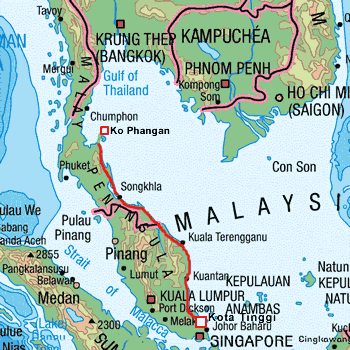
Our
cycling trip through Malaysia and Singapore: Click HERE
to view larger map and more details
Great to be back in the
land of smiles and mini things
It is 27 kilometres to the ferry border
crossing at Pengkalan Kubor. As soon as you are out
of the city bustle of Kota Bharu and have passed the
giant Tesco on the left, just seconds before you hit
the river crossing, the road will continue to become
more and more serene. The only pity is we seem to be
following a garbage collection truck. It's extremely
hot and needless to say, the stench trail it leaves
behind it correspondingly grotesque. We spy our first
magnificent golden buddhas towering over the landscape.
Immigration is a piece of cake and we are on the ferry
in no time, paying just 6 baht each for the crossing
and watching the same 'Welcome to Malaysia' billboard,
we saw 12 years ago, quickly disappear from sight.
The Thai 'Land of Smile' slogan
has sadly been replaced with something a bit more up-market
and immigration rules have changed, meaning that only
a 30 day visa is stamped in our passports upon entry.
This might need to be extended at a later date, but
at the moment we are just excited to be back in one
of our favourite destinations. The last time we were
here, Tak Bai was just a dead end town with a couple
of basic shops. Now it's quite a lively market, but
still, in comparison with other border crossings, small
enough to be a much nicer port of entry. It is immediately
recognisable, especially after Malaysia, that not everyone
speaks English, but that doesn't stop the big smiles
that Thailand is famous for.
Our first impressions are of how the
roads have changed for the better and how incredibly
modern the vehicles passing us are. No more plumes of
black exhaust smoke to choke on. Even the scooters are
state of the art. The not so becoming military presence
with regular check posts along the far south east of
the peninsula hasn't escaped our attention either. Still
with recent problems it is to be expected. Very surprisingly,
the cost of everyday commodities has barely changed
at all in the last 10 years. Water is still 5 baht a
bottle, a large beer: 45, a can of soft drink: only
15, and a plate of fried rice: 30. Admittedly, these
prices are only available in the non-touristy areas,
but still we find it quite amazing that there hasn't
been any inflation in this considerably long period
of time.
From Tak Bai it is just 40 odd kilometres
to Narathiwat and although we stayed
here before for a few nights, we hardly recognise anything
of the town. It's bigger and a lot more modern now,
though we can't find an English newspaper anywhere.
Seem to remember we had that problem last time as well.
There is an abundance of supermarkets and stores and
it is nice to see that they are still full of all consumable
items in mini denominations.
Narathiwat Hotel has such a worn out
sign that we initially miss the place altogether, but
manage to find it on the return search. We are the only
foreign guests and get to choose a fantastically clean
and airy room including sarong towels that smell like
Mum has just washed them, toilet paper, soap and a bottle
of drinking water. The view over the river from the
balcony outside our room is certainly a bonus and great
value for money at 140 baht (50 baht = 1 euro). The
staircase to our room upstairs is barricaded off with
a broom handle to keep the downstairs area, permanently
reserved for the girls that live there, separate. Ten
guesses for what their job is. There is not much chance
of any real disturbances though, since the hotel's doors
close at 9pm. This does seem awfully early for women
of such a trade. Still, there's no real objection on
our behalf, because the one hour time difference means
we have a 6.30am rise instead of the usual 7.30am. Early
to bed, early to rise as they say.
'Hello You!'
It's very flat and we cruise along the immaculate
wide shoulders that also double as cycle lanes. Boy,
it is hot today. Around 45 °C in the sun and we
have to stop just under every hour; don't much feel
like eating in this heat but welcome a cold soft drink
with eagerness. Go through 4 litres of fluids by myself,
and except for the excitement of seeing my first ever
live cobra in the wild, that's about all I can really
remember. Of course the military are still around in
droves, blocking roads or just patrolling, machine guns
braced, from the back of camouflaged pick-up trucks
and tanks. They are friendly enough as our passports
are more of an interest to them, than our threat as
muslim rebels.
As with the price of everyday goods,
the Thai hotel standard appears to have lifted somewhat
while the rate remains the same: now you get all the
added extras of towels, water, toilet paper and soap
thrown in as well as clean bed linen. Bathrooms could
always do with a bit more of a scrub as far as I'm concerned,
but then, I'm a bit of a stickler when it comes to that.
Besides, they are not that bad, especially when compared
to Central Asia and the Subcontinent. Palace Hotel is
180 baht and with absolutely no objections from the
hotel staff, we can literally wheel the loaded bikes
in and then conveniently out again the next morning,
which makes for an exceptionally early departure from
Pattani (93 km; 89m) the following
day.
We hear 'Hello You' for the
first time today and both smile at one another as it
brings a flood of memories back from our previous visits.
While considerably more people do speak English these
days, especially the younger generation, on the whole,
there is still a lot of stunted English, hand and feet
signing as well as a couple of Thai phrases we already
know being used to get messages across. Makes for a
totally interesting time in any case.
Police escort in Thailand?
Again, a stinking hot day and we are relieved
when the trees can occasionally shade us from the heat.
Its intensity is felt as early as 10am, when we stop
in the shade of an industrial complex to eat our roti
pissang and drink a couple of birdy iced coffees. Mmmm,
delicious breakfast! While I'm bathing in a pool of
sweat, Ali in all his optimism relays to me that it
is good that there are clouds looming behind us, because
they will unite and later give us cover. I just think:
what a load of bullshit, and my realism wins out; only
for the last 15 kilometres do we receive a bit of cloud
shade and then that is highly sporadic.
A few kilometres into our journey and
a couple of young policemen stop us, urging us to put
the bikes in the back of their utility van. We decline
the offer most politely and say we would prefer to cycle
the distance and so they, ever so politely back, escort
us the full 20 kilometres out of the region. And so
here we are in Thailand, of all places in the world,
being shepherded out of Pattani to about a kilometre
after the border with Songhkla. Here, they turn around
with a beep and a wave. At the time, we consider this
to be completely over the top, but just two days later,
we read in the Bangkok Post that a bomb goes off in
a hotel, not the one we were staying in, but nonetheless,
in Pattani. They really only had our best interests
at heart.
Almost to our destination and we have
to turn off and face headwinds: it was exactly the same
12 years ago as well. In keeping with tradition, we
have decided to go back to Amsterdam Guesthouse which
takes a bit of finding, and unfortunately, it is closed.
The owner, who is still just recognisable, is either
very old or in such poor health that he can barely talk
anymore. A little disappointed that the place is no
longer operating as a lodge, we enquire at Yoma 1, just
down the road and find there is absolutely no reason
to be disappointed at all. For 280 baht, less than we
paid more than a decade ago, we get a fancy room with
attached bathroom, fan, television and all the other
sweetly added extras. Wow, we really feel like we are
living it up this time around!
Songkhla (111 km; 97m)
has exactly the same feel as before, even though the
old market area is now a sort of mini-shopping complex
and gold shops have popped up all over the place. Only
real disillusionment is, I can't find any Songkhla cloth
anywhere, which I was kind of hoping to purchase as
a sarong for our stay on the beaches. Maybe you have
to go to the island of Ko Yo for that now.
As vegetarians, food is a lot more
difficult this time around. Mainly because, Thai cookery
is centred around seafood and every dish deserves a
good dose of fish sauce or generous wallop of oyster
sauce. Even more maddening, most of the curry pastes
are made with shrimp paste, so we really can't venture
too far from egg and vegetable fried rice, noodles of
the same description, or if we are really lucky: phad
pak ruam mit and khao: stir fried vegetables
on steamed rice. Doesn't really matter because these
meals are all pretty delicious and to be really honest,
I'm turning a blind eye these days to the odd bit of
chicken stock cube. It's just too difficult to fight
anymore and causes more confusion when trying to explain
than it does justice to the situation.
Just like last time, we take the ferry
across to the mouth of the inland sea for the ridiculous
price of 2 baht each. This saves us a monstrous 15 km
of highway trundle, though it has crushed any belief
I once had about boats being a more environmentally
friendly mode of transport. With a Jeremy Clarkson conscience,
our ferry chugs along, pumping out thick black goo from
both pipes into pristine blue skies. On the other side,
we search half heartedly for somewhere to have breakfast.
These days we have happily resigned ourselves to peanut
paste sandwiches and birdy iced coffee for our first
meal of the day. Firstly, it is easy for us to purchase,
secondly it's energy filled and thirdly, we can stop
when we are ready to stop and eat.
Once more, 10am marks the beginning
of the day's heat. It is a long, hard
trip. Hot and thirsty work as we push past the familiar
prawn farms. Though we are not directly on the beach,
the slightly more aqua shade of green sea against the
blue sky horizon is clearly visible from where we are.
A pleasant smell of salt lingers in the air as does
the intermittent but not so pleasant odour of fish farming.
The Muslim influence is definitely in minority levels
now and the police check points have completely disappeared.
On the up and up are the amount of snakes we encounter,
mostly flattened but a few still manage to slither past
us alive and remind me that a pair of boots is better
than sandals any day. We are also plagued with broken
spokes and realise that there has to be something wrong
with the tension. We have only two spares, so it is
not the time to start messing around with the wheels
and hope that we'll find a decent bike shop in Nakhon
Si Thammarat.
Twelve years ago, Hua Sai
(102 km; 66m) was just
a row of basic shops and a couple of restaurants. It
is now phenomenally different, though we spot a deserted
building which was the restaurant we ate in last time.
Here, we very memorably tried to order dishes of fried
chicken, fried vegetables and plain rice and it all
came out as one meal. Today's evening meal adventure
ends up quite similar to the past, thought there is
a little misunderstanding as far as the 'no meat message'
is concerned. It is ironed out in due course. Since
there is only one other option of a guesthouse on the
opposite side of town, we stay in the same resort this
time round as well, though the cheap bungalows of yesteryear
are no longer standing. The beach here leaves a lot
to be desired; blue plastic plumbing pumping liquids
both to and from the sea, bottles and rubbish lining
the beachfront and half hearted attempts at stone wall
breakers. Not very pretty at all.
Same, same really
The riding element today is like any other
day and I don't want to give any false impressions about
Thailand. Realistically, once you are used to how beautifully
green everything is, the roadside viewing is pretty
much the same everywhere you look. The eateries, stalls,
shops, nurseries, petrol stations and housing lining
the roads are all very much of a muchness as well. Of
course, I'm talking about the everyday Thailand and
not the tourist spots. But the one component that makes
this place so special for us, is the people. They have
this amazing smile. Everyone. Everywhere. No matter
what they are doing. It is truly so infectious that
sometimes I realise I have had a permanent grin on my
face for kilometres, which in turn makes me laugh. It
is great to feel so relaxed.
water |
950ml |
5 baht |
roti telur / pisang |
per piece |
10-15 baht |
| fresh juice/shake |
glass |
20 - 30 baht |
roasted cashew nuts |
500g |
130 baht |
| vege juice |
250ml pack |
9-13 baht |
peanuts |
200 gr pack |
25 baht |
| soft drink |
250ml bottle |
10 baht |
banana chips |
100 gr pack |
20 baht |
| |
330ml can |
15 baht |
bananas |
12 piece |
20 baht |
| beer (Chang) |
640ml |
40-60 baht |
pineapple sliced |
per portion |
10 baht |
| coffee / tea |
per cup |
10-15 baht |
vege fried rice / noodles |
per serve |
25-35 baht |
| biscuits |
90g packet |
6-18 baht |
100cc scooter (new) |
each |
13,000 baht |
*at the time of writing 100 Thai Baht = 2 Euros
These prices are only found in non-touristy areas. You
can expect the price to at least double, if visiting islands
or major resorts.
Thailand has seen the emergence of
7-Eleven in a big way. They have popped up all over
the place and definitely dominate petrol stations, but
it still doesn't prevent the locals from selling everything
from dried fish to the famous Thai broom wherever they
see fit along the roadside. Another typically famous
Thai product is the bird cage. They are quite ornately
attractive and these days, every household and business
seems to own a bird or two. Interestingly enough, the
men: I've only seen men doing this, travel everywhere
with their covered birdcages. In cars, on motor-bikes:
a birdcage in one hand, the other on the handlebar.
When they stop, they simply hang the cage up somewhere
appropriate: even in a tree along the side of the road.
Like Songkhla, Nakhon
Si Thammarat (70 km; 44m)
has the same feel it had many years ago,
even though it is a dynamic metropolis now. It even
has a Carrefour. The Siam Hotel is still there, right
in the middle of a food market, but we stumble upon
Nakorn Hotel first. We walk around for hours trying
to find the Indie Pub, where we met the really friendly
owner Lek, but to no avail. There's absolutely no way
of determining where it once stood: everything has changed
so much.
Nothing stays the same
forever
We start early for the long trip towards Don Sak, as
we are not quite sure whether we'll make it all the
way to Ko Phangan today or not. It depends on exactly
how far it is and of course when and if a ferry leaves
directly for this island. It is another scorcher day
and we make the ferry terminal with just 15 minutes
to buy a ticket (220 baht each and 60 baht for each
bike) and make the mad dash to the terminal, which is
a good 1.5 kilometres from the ticket office. After
tying our bikes to a ladder against the wall of the
car deck, we settle down upstairs for the two and a
half hour journey to Thongsala,
Ko Phangan; (118 km; 221m).
Looking around us, it is pretty obvious that everything
about this side of Thailand has changed: this is a fully-blown
tourist destination, this boat is packed with half naked
westerners still young enough not to know about the
hazards of smoking and cooley sporting a pair of fly-eyed
sunglasses similar to the pair Lee Majors wore all those
years ago. We are not quite sure what we should expect
of Ko Phangan this time round.
Basically, everything is different
from the moment we ride off the ferry: the modern pier
with park facilities; the sidewalks; the 7-Eleven; the
ATM's; the funky-new scooters and cars for hire; and
all the businesses that have sprung up along what was
once vacant land. It's already dark and we plonk ourselves
in the first guesthouse we see, right across the road
from the jetty. Four hundred baht seems a tad expensive
but I suppose we had better get used to it. Everything
has a big price-tag here.
Next morning we pack the bikes for
the trip to Mae Haad (14km; 133m).
It is difficult work: the climbs are on average 5% and
pushing the bike up 14% in the stinking heat is pushing
it hard. The road is the same, just a lot more development
along the way and when we hit Chaloklam, there is hardly
a business I recognise. This was just a tiny fishing
village, with a few bungalows, local shops and a couple
of restaurants. Now, there is no need to go to Thongsala
for supplies: everything is right here including a 7-Eleven
and ATMs. The dirt track to Mae Haad is now bitumised
and the once sparsely populated beach front is jammed
packed with resorts. On a positive note, they have done
a lot to clean up the beach area. It was never a really
good swimming beach, but now the white sandy frontage
is straddled with sun-baking holiday makers. It was
always good for snorkelling, though we were the only
ones out there most of the time, but it has now come
up in the world and recognised as one of the top 'diving
destinations' on the island. We witness an entourage
of boats coming in and hanging out around Ko Ma.
We stay only one night at Mae Haad
Bay Resort, formerly Mae Haad Bungalows, but the new
owners are only interested in guests that look like
they want to spend lots of money and our fanned bungalow,
for an outrageous 400 baht, is tucked right at the back
of nowhere, overlooking their rubbish dumping area.
The sand flies are atrocious and it is not long before
we are up and about in search of a better place. A walk
into Chaloklam doesn't give us any better options, though
the food at Fanta Bungalows is really good. We decide
to move further down the beach to Mae Haad View Resort.
At least here, we get a very simple bungalow overlooking
the ocean for 250 baht and the atmosphere a little more
akin to Thai tradition. It is pretty relaxed and we'll
stick it out here for a while I think.
Wi-fi
point , Thongsala, Ko Phangan, Thailand, 01-04-08
Where does the day go to?
Everyday, for the
past two weeks our routine barely falters, except for
the occasional burst of energy, when we take an afternoon
walk into Chaloklam, or much to the locals dismay, heave
the bikes up the hill and into Thong Sala. If it is
at all possible, they are in general, quite a lot lazier
than our current slothful frame of mind. Still, while
pushing the cycles up the 31% gradient from our bungalow
towards the main road, I do get to thinking that I'll
probably be cursing the fact that we chose this place
to stay when it comes time to leave and my bike is fully
loaded. Nonetheless, it will need to be this going
up a hill type torture or along the beach and
through the sand persecution. Haven't quite worked
out which one is worse at this stage. In keeping with
our present disposition, I guess we'll leave that issue
until the last day.
Anyway, in our little sanctuary at
Mae Haad View Resort, we do not do much else than sleep,
get up for breakfast, look out over the bay and watch
the fishing boats do their morning thing by lining up
in a row and bobbing about on the little waves they
themselves cause. It's probably close to 10.30 by now
and then we retreat to our bungalow, to hang out there,
in the hammock, or on the fan cooled bed inside to do
a bit of reading. Ali's been on this book marathon and
permanently has literature in his hands. I think he
secretly wants to surpass the number of books I've read
so far on this trip: he's currently trailing by three,
not that I'm counting.
Next, and only if the water looks inviting
enough, we'll snorkel out to the reef for an hour or
so before returning back to the exactly the same positions
we were in before we left, except we'll probably have
a banana shake in our hands this time round. A couple
of tofu burgers later and at 4.30pm, I'll wander out
onto the beach and lie in the not so harsh sun to try
and change the lilly white appearance of my body into
some sort of beigey-brown hue. Six o'clock and one of
us has walked to the shops to get a couple of cans of
tonic for my bottle of gin. Ali grabs himself a beer
and we sit on our porch, oohing and aahing over and
snapping way too many photographs of the brilliant exhibition
the sun puts on before he goes to sleep here and wakes
up somewhere else on this earth. Seems totally unfair
that not everyone gets to see this for themselves every
evening.
It is around this time and on cue that
the big black mosquitoes that Ali calls trucks, start
hurtling passed, ignoring him altogether and bee-lining
it for me. Mosi coils are lit as the solid darkness
of evening sets in and the moment to get ready for a
shower arrives. The nightly discussion about where we
are going to eat happens next, though personally, I
don't know why we even have it, because although there
are a number of restaurants to choose from, there's
only one that really does serve fantastic food. On average,
dishes here are about 20 baht more expensive than anywhere
else, that's 40 euros cents if you are wondering, but
it truly is worth it. Mae Haad Cove is just 50 metres
further on from where we are situated. After dinner,
we manage to fit in a bit more reading or chatting with
some of the other guests before closing our eyes and
thinking: where does the day go to.
|
|