Too much rain to start with.
And then from steaming hot to freezing cold.
Alti meters:
14,851 metres
Best accommodation:
Hostal Orbel in Junín.
Clean, modern, hot water, light working,
big room. What else do you need?
Special thanks to:
*
Rosa and Faustino
from
Hostal
Sol de Selva
in Tarapoto for inviting us for breakfast
(twice); letting us use their WiF and taking
us out on some nice daytrips around the
region.
*
Kevin
and
James
for waiting for us all that time in Mayocc
and having to drink all those beers. And
in the end we didn't even show up...
Breakdowns:
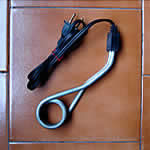
01: water heater (see below) Peru: 220V instead
of 110V...
02: flat tyre (Ali)
03: flat tyre (Ali)
20: flat tyre (Son x2, Ali x1)
31: flat tyre (Ali)
October
2009: I'd kill for
a cuppa...
Before we bought our water
heating element, there were many moments
when I could have killed for a cup of coffee
or tea. But let's face it, getting out the
multi-fuel stove each time and firing it
up, especially when you are not camping,
is a real pain in the neck. Well, we no
longer have that problem.
There are many makes and
models of water heating elements and the
cheapest on the market go for just a couple
of dollars. You can find them in camping
stores, travel departments or electrical
stores. So, if there is electricity, then
you can have boiled water at any time of
the day or night. Not only handy for a well
deserved cuppa or pot noodle snack, but
you can treat the tap water you are not
quite sure in a matter of minutes.
Hostal Sol de Selva,
[website]
Tarapoto, Peru,
12-10-09 Leaving the cool mountains behind
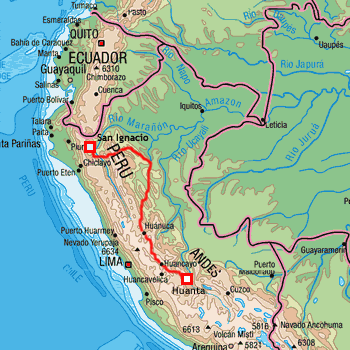
San Ignacio to Tarapoto (7 cycle days; 1 rest days;
528km; 5991m)
San Ignacio to Tamborapa (71km; 626m)
Tamborapa to Bagua Grande (70km; 731m)
Bagua Grande to Pedro Ruiz (67km; 1228m)
Pedro Ruiz to km 69 (69km; 1664m)
km 69 Nueva Cajamarca (89km; 423m)
Nueva Cajamarca to Moyobamba (46km; 240m)
Moyobamba to Tarapoto (116km; 1079m)
A smooth feel beneath the
wheels
Up until today, we have had ochre red dirt and beachy
white sand. Beneath the wheels, it is now a bright pink
combination of these colours. The initially short 4
kilometre climb out of San Ignacio is followed by a
contrastingly long hand deadening 15 kilometre and 800
altimetre drop, due to the excessively rocky surface.
The drizzle numbs us even further, but luckily enough
it isn't cold. As we descend further, the warmer the
temperature becomes and by the time we have levelled
out, the sun is well and truly with us: we are now as
wet with sweat as we were earlier with rain.
Rice paddies stretching as far as the
gorge is wide and on either side of the raging Tabaconas
River colour the landscape iridescent green. It is a
pleasant change to be flowing in the same direction
with such a force. The gushing sound heighten in echo
almost propels us along the inconsistent path. Its a
rolling 28 kilometre stretch of terrain that brings
us past Puerto Ciruelo: a small township connected only
to the highway by means of a drifting punt. We stop
to watch a car float across. Asphalt has been present
in patches all day which means, miraculously this little
more than a trail, was once bitumenised. It also leads
to questions as to why it has been left to disintegrate
like this. Every now and again, we are teasingly given
a taste of what it would be like to run effortlessly
down a smooth surface. At this stage though, we can
only fantasise. There is still 6 more kilometres of
wobbling through sand, bumping over rock, and sliding
in gravel; before our dream actually does become a reality.
At Perico, we are greeted with a pavement
only rivalled by the Chinese; and if you have been following
this blog, you'll know about my admiration for these
miraculous little road workers. Though stinking hot
in the 37° Celsius sun, what would have normally
taken us 3 hours in the last few days takes just one:
18 kilometres of smooth as a baby's bottom finally rolls
beneath our wheels.
Deception!
There is one thing that really gets my blood bubbling
up and over the cauldron and that is blatant dishonesty
by visual deception. You are probably thinking what
the heck is she on about now. Well, of course I am about
to explain. At 6.10pm, with the temperature still at
32° Celsius we are sitting in our cement box of
a room with chicken wire for a window This is the only
accommodation in Tamborapa (71km; 626m)
and technically speaking, it isn't really what you would
call a hostal at all. Ali goes up and views the room
with fluoro light and electrical point. The landlady
shows him the bathroom with flush toilet, shower nozzle
and sink. Though quite expensive for nothing more than
a single sized straw mattress (I kid you not) on an
iron frame, a cement floor and very basic facilities,
Ali agrees to pay the 10 Soles. The other option, of
camping, is not that appealing: firstly, we would have
to pitch the tent in someone's back yard because the
area is so populated and secondly, the sun has killer
rays today.
As soon as we have unpacked the bags
and settled into our impoverished room, up come the
pails of water, making it perfectly clear that there
is no running water. Okay, I can live with that, besides
a bucket shower in this heat is always refreshing. Still,
it is blatantly deceptive to show someone a bathroom
with all the plumbing and faucets in place and not mention
the fact that they are actually only of decorative value.
Half past six arrives and darkness begins its descent.
I go to switch on the light. Nothing. This is definitely
something to get unhappy about and had I not gone downstairs
and asked for a candle, we'd still be sitting on our
cement floor in the pitch black. If I'd wanted a jail
sentence, I would have asked for one and I certainly
wouldn't have forked out 10 Soles for the privilege.
Whether there is electricity or not,
is of no consequence for most people patronising Hostal
El Leon. This is where couples, like the one next door
to us, come for a marathon evening of shagging or as
in the case of the male counterpart diagonally adjacent,
for a quick bit of pleasure with his lover before showering
and slipping back home to his wife. The latter scenario
being normal event in latino lifestyle, or at least
all the men like to tell everyone this. So you see,
explicit sight is not necessarily a priority in this
establishment, but as far as I can see, this hostal
is simply a place of deception.
How far is it? It's 28 kilometres to the Bellavista turnoff, where
we leave the impeccably smooth rolling asphalt behind
and plunge back onto the dirt track which will hopefully
lead us to a small boat crossing. It does eventually,
but not without missing the unsignposted left hand turn
in the town and then having to backtrack a kilometer
or so. A couple of Belgium guys with a local tour guide
just happened to bump into us in time and also on bikes
they decide to escort us in the right direction. It's
a few kilometres to the beach, where we part ways. One
and half minutes and one-and-a-half Soles each later
and we are on the other side of the river and scrambling
up the rocky slopes to the dirt road. We pass a small
airfield, the monster Peru Petroleum plant and choke
our way along a dusty, straight as an arrow path. Escorting
us to the main highway, that deceivingly short distance
to the horizon is actually 6 or so kilometres and coupled
with hideous headwinds, it takes forever to complete.
Ali is already in the service station
waiting as I pull up. He wanders off to the shop to
find anything sweet and liquid and I question the two
old men, guns slung over their shoulders and spending
the afternoon at an infrequently visited petrol stop.
Me: ¿Cuantos kilometros
de Bagua Grande? [How many kilometres to Bagua Grande]
Man 01: Si, cuatro kilometros [Yes, 4 kilometres]
Me: No. ¿Cuantos kilometros?[How many kilometres]
Man 01: Si, cuatro kilometros [Yes, 4 kilometres]
Me:I just give up with this
line of questioning
Man 02: ¿Cuantos cambios?; as he is checking
out my bike [How many gears]
Man 01: walks over to the bike too and then asks me;¿Cuantos
cambios? [How many gears?]
Me: Veinte uno; I reply [21]
Man 01: looks at his mate and answers; Quince [15]
Me: No, I say. Veinte uno [No, 21]
Man 02: Ah quince, muy bien [Ah 15, very good]
Me: No quince, veinte uno; but I give up here
too. [Not 15, 21]
Ali comes back from the shop with refreshments
and I tell him that according to these two guys, it
is only 4 kilometres to Bagua Grande and we have 15
gears on our bikes. He looks at me as though I'm totally
cuckoo and tries making sense of it for himself. The
"how many gears on the bike" conversation
goes exactly the same reaction as it did for me, whereas
the" how far" takes a slightly different turn
this time.
Ali: ¿Cuantos kilometros
de Bagua Grande? [How many kilometres to Bagua Grande]
Man 01: Si, cuatro kilometros [Yes, 4 kilometres]
Ali: No. ¿Cuantos kilometros?[How many kilometres]
Man 01: Si, cuatro kilometros [Yes, 4 kilometres]
Man 02: Looking quite puzzled now and probably because
the question has been asked a million times, he comes
up with the enlightening: ¿Hay uno mil metros
en uno kilometro, si? [There's one thousand metres in
one kilometre, isn't there?]
Ali: Si [Yes]
Man 02: Ah, Bagua Grande es diaz o tal vez quince kilometros,
no cuatro kilometros [Oh, Bagua Grande is 10 or maybe
15 kilometres, not 4 kilometres]
Man 01 and Man 02 argue over exactly
how far it is for a while and neither party can agree.
Ali claims he is certain that the only two numbers Man
01 knows are four and fifteen. We eventually leave to
complete the rest of the rolling ride into Bagua Grande,
only stopping at a much more lively petrol station to
fill our fuel bottles up and for Ali to fix a flat tyre
to a crowd of admirers. It is actually 22 kilometres
from our recent conversations about "how far it
is" to Bagua Grande (70km; 731m).
The town is quite a bit bigger than
San Ignacio and has all the facilities we need for another
day of rest including a great vegetarian restaurant:
Salud y Vida where you can get a bowl of soup,
a small meal from a choice of 5 dishes and a glass of
camomile tea for 3 Soles. (that's $US1.00) Hotel Iris
is also the best we have had so far with hot water,
large airy, sunny room, cable television and a fan.
The price tag though is a little more than usual at
35 Soles per night.
The waiting game Just like South East Asia: watery rice paddies,
mango trees, coconut and banana palms fill our view.
It smells of hot bitumen and steamy green. Patches of
road turn completely to dirt or rock, but the ride starts
off relatively smoothly: rolling hills that are not
too steep with a slight tilt on going up. The roadwork's
department are out in force on this stretch of road
and when we reach Salao after 26 kilometres, there's
a major block only to be opened at 12 midday. We just
cycle through and no one says anything. The 12 kilometre
stretch to Aserradero is more of an ascent, but nothing
too difficult, however the climb out of here is a monster:
a snaking path of crumbling limestone rock that regularly
hits 18%. And making the pedalling all the more difficult,
the barriers have been lifted in Salao about a half
hour ago and all the banked up traffic now catches up
with us: buses, trucks, taxis, cars and motorbikes hurtle
past, flicking blankets of stones and thick white dust
in their path.
From here on in the waiting game begins.
The 29 kilometres, taking us up an altitude of 733 metres,
is a stunning stretch of road with sheer cliff faces
protruding almost vertically out of the ground on either
side of us and towering way into the blue sky. A surging
river forges its path in between. When this highway
is complete, it will be an amazing cycling trip, but
for now we have to content with sand, rubble and constantly
coming to a standstill. The road blocks are frustratingly
frequent. Ten minutes here, twenty there and on one
occasion for nearly 40 minutes. Road workers hang from
ropes attached to trees dislodging loose rock from the
overhang or they are simply relaying new bitumen. The
motorised transport has already passed and the thoroughfare
is closed to traffic again: its only us and the road
department vehicles. At one point, I get sick of holding
my bike up and lay it and myself on the ground, which
prompts the workers to let us through, so I use the
ploy, much to Ali's embarrassment, for the rest of the
journey into Pedro Ruiz (67km; 1228m).
The waiting game continues...
We arrive a little after 5pm and pull up at the fanciest
hotel in town. No-one is at reception, so we wait. The
shopkeeper below is certain that someone will turn up
in a few minutes. Fifteen minutes later, Ali gets to
talk to an employee and finds out a room costs 30 Soles,
but unfortunately the owner is elsewhere and has all
the keys. We wait. A further 15 minutes passes. Ali
then checks out another place of accommodation. They
don't have a double just yet. We couldwait
until 6pm, but we've both had enough of killing time
and just want to get showered and fed. Up the road,
two other establishments are completely closed for business.
A third, Hospedaje Nafre, and the last on the stretch
leading out of town, has a pokey double with bathroom
and television with no channel signals for 15 Soles.
We take it, thinking our waiting game is finally over.
Ali gets ready to have a shower and
goes to turn on the water. Nothing. If there was a window
low enough, I could almost stick my hand out the window
and feel the cool river water gushing past the walls
of the building. Ironically, we can hear water loud
enough. Our host says half an hour and the water in
the town will be turned on. We wait half an hour. Still
nothing. We wait another thirty minutes, before I am
downstairs asking for a bucket. The landlady insists
she'll bring it up herself. We wait another fifteen
minutes. A half full 20 litre jerry can and jug arrive
at our door at a little after 7pm. At least it is water
and at least we don't have to wait anymore.
Never far from a village Nothing is particularly comfortable about our room
or sleep and we are happy to leave the next morning.
It is at Pedro Ruiz that most travellers turn off to
Chachapoyas to visit the nearby Kuelap Inca ruins. Besides
the fact that after this attraction, a dirt road goes
up to three passes of 3680, 3200, and 3620 altimetres
and plummets each time into low lying valleys; we are
not quite ready to pop into a tourist haven just yet
and we continue east towards the Amazon jungle.
There's a strong fermentation odour
in the air as coffee beans are being raked on plastic
sheets to dry in the morning sun and a young man peddles
a box of chicks balanced on his head. It must be chicha
or chicha de jora: a fermented maíz
[corn] drink flavoured with aromatic herbs, that we
can smell. The road goes up at an average of 3% for
the entire 29 kilometres and 1031 altimetres. It is
3½ hours of saddle time before we reach the pass
(2281m) with a wonderful view of Lago Pomacochas
and just 2 kilometres from the township of Florida Pomacochas.
While you are never far from a village along this highway,
this is the last place with official accommodation until
Nueva Cajamarca. In fact, we are amazed at just how
much of the land is being farmed and to the wild camping
potential's detriment, fenced off with barbed wire.
The 16 kilometres of drop from Florida
towards Puente Vilcaniza is not as far down as we expected
to go and before we know it, we are climbing again towards
Buenos Aires, which despite its suggestively large name,
is just a village. Three old ladies, who look like sisters,
wearing their matching wide brimmed straw hats, wave
at Ali as he passes. As soon as they see me, there's
way more enthusiasm and with both thumbs up in excited
unison they scream: "Ahhhh! gringa!, gringa! gringa!".
There's definitely a sisterhood thing happening in Peru.
The road continues up and down through
the towns dotted on our map. With names like La
Esperanza [Hope] and El Progreso [Progress],
you'd surely think that they would have at least one
place of lodging, but no, there's absolutely nothing.
Furthermore, there is nowhere safe nor flat to pitch
the tent except by the river after 65 kilometres. Unfortunately
a bar full of loud drunken men stands just above it.
We venture on up the hill for another few kilometres
and pull off at the only other unfenced section we have
seen for the last few hours at km 69 (69km;
1664m). Amongst the tall wild plants,
there is a spot just big enough for the tent and we
can't really be seen from the road either.
Sweating like the pig
It is a reasonably peaceful nights sleep for such a
slope and the constant truck roar. It also rained during
the night for a few hours, which woke me up. Ali remained
asleep, oblivious to it all. With breakfast out the
way, we are packing the bags as locals are walking their
happily snorting pig up the highway beside us. While
cleaning my teeth, the pig begins to squeal. Not just
the normal "stop annoying me" or "I'm
hungry" squeals, but blood curdling screams that
cut the morning air as sharply as the knife that had
just slit his throat. It is as if you could hear the
pain and terror in his voice. I can't do anything but
stand numb for what seems like eternity, while these
humiliating sounds continue. In reality, it is probably
only two minutes. The silence that follows is immediately
filled with sadness and my first thoughts of, I'm so
glad the pig isn't hurting anymore, transform quickly
to a hatred for human beings that make innocent animals
suffer like this.
As we pedal up the same path the pig
had taken just a half an hour ago, the pungent fumes
of burning hair and the sight of a stiffened pork carcass
spitted on an open fire confirm the early morning activities.
The mother sow a kilometre or so further on, with her
six little piglets gets a quick word of caution from
me. She looks at me with her piggy eyes, quite bewildered
at the sound of my voice and snorts indignantly a few
times in my direction. Can't say I didn't warn her.
One animal we don't have respect for
are domesticated dogs that come sprinting out of houses,
restaurants, down from fields, baring their teeth, snapping
aggressively at our heels and causing us to stop cycling.
Come to think of it we have no respect for the apathetic
owners either, who don't exercise any control over their
animals. In Peru, both owners and dogs are the worst
we have encountered since Turkey. Most homes in the
countryside have a pack of four or five varying in breed
from the silky terrier crossed with a taller mutt to
make a bigger version of the brainless yapper to a viciously
vindictive doberman without a mask. It only takes one
to start the chase and then the entire village is in
pursuit. Stopping normally results in the chase being
over; raising your arm like you have a stick or stone
in your hand sometimes gets them to retreat; throwing
a stone further helps; and our dog dazer works about
80% of the time. Having an owner who could be in command
of their canine pets would be a lot easier.
Contrastingly, the journey is dazzlingly
spectacular today: cascading waters; green lush rainforest;
grassy verges; flora of all dimensions; birds and butterflies:
Initially, we rise for a few kilometres to reach the
peak (2222m). For a few kilometres a vulture glides
a few metres above Ali using the same wind current that
sails us down the 36 kilometres of winding slopes. The
roads are mostly smooth with only the occasional hiccup
and there are few excellent wild camping possibilities
here.
The town of Agua Verdes marks the start
of the plateau, though undulating a little until you
hit Naranjos. The ride from here to Nueva
Cajamarca (89km; 423m) is virtually flat
and the first time we have experienced doing speeds
around 20 kilometres an hour for a very long time. We
had planned to reach Rioja today, but the black skies
ahead convince us to stay where we are.
There are a few hotels to choose from
and although our room at Hotel Chota is big and spacious,
upon closer inspection its a grot-box, infested with
ants and in bad need of repair. All this despite the
absurdity of their own posts on the wall claiming, in
a comparable Spanish proverb, that "cleanliness
is next to godliness". And what we don't know
beforehand is the mosquitoes result in us sleeping with
the balcony door shut. Last night at 2500 altimetres
it would have been perfectly alright, but tonight at
883 metres above sea level we are sweating almost as
much as the pig that passed away this morning.
Three things we really
like: rice, bananas and coffee
A late start is planned this morning as we only have
40 odd kilometres to do to reach Moyobama, city of the
orchids. Waking up at 8am is a treat and the 9.30am
start cool and overcast. We fly along the long, straight,
flat highway taking us past fields mixed with rice,
bananas and coffee: three of our favourite energy-boosting
consumables. The landscape is jungle-like: wooden huts
with thatched roofs intersperse the rich green forest;
heliconias droop from hard to reach places and the intermittent
orchid pushes it way towards the light and into view.
People are not as openly friendly talkative here but
the deafening ring of insects makes up for the lack
of sound. It is obvious, by the fits of laughter from
adults as well as children, that gringos are not often
spotted in these parts, let alone a couple riding a
fully loaded bike.
The last leg of the journey becomes
slightly more undulating and the sun peeks through every
now and again making the hill climbing very warm work.
We make Moyobamba (46km; 240m)
just as it hits 12 midday and the rain comes tumbling
down for the day. Hotel Rocio is pricey for Peru at
30 Soles, but the room is decorated tastefully with
its cobalt blues and wood combinations: bed, cable tv
and modern looking bathroom (except for the lack of
toilet seat) all add to the comfort. Conveniently, the
local market across the road has everything you could
possibly want for and so we are set for the afternoon.
A bit of work, bit of tellie, bit of food and then the
well earned sleep readying us for the 120 odd kilometre
journey into Tarapoto tomorrow.
A new door, an unknown
surprise It is drizzling as we leave Moyobama, but by the
end of the day the sun is in full force. The journey
is a recurrent pattern of rise and fall. The road is
good in parts and bad in others, though the latter case
never being for very long. Its a quiet ride with very
little traffic until we reach close to Tarapoto. We
wind up and down past villages with grassy centre squares,
banana farms; rain forests with palm leaves the size
of five men tall and so much rice in its varying degrees
of processing. And that stands to reason since San Martin
is the leading province for rice production in Peru.
Tarapoto (116km; 1079m)is the biggest city we have come across in Peru
so far. There are plenty of hotels, plenty of shops,
plenty of street vendors, at least three Chifa (Chinese)
restaurants that we know about and plague proportions
of noisy motokars (tuk-tuks). What Tarapoto doesn't
have is an abundance of wifi connections. After a fruitless
search for even a decent internet cafe (though I do
find out you could use the internet in the library for
free during their sporadic opening hours), I stumble
upon a wifi zone in
Hostal
Sol de Selva
. While it is not in our budget to stay here, Rosita,
the really charming landlady, allows me to piggyback
their connection. Soon her husband, Faustino, has befriended
me as well and the next thing I know, Ali and I are
having breakfast with them the following morning and
planning a couple of a side trips to the local waterfall
and to the indigenous town of Lamas. Whether you are
travelling or not, you just never know what unknown
surprise is in store, each time you open a new door.
Hostal Florida, Ayacocho,
Peru, 03-11-09 Jungle warmth to mountain frostiness
Tarapoto to Huánuco (2½ cycle days; 204km;
2472m; 2 and a bit car travel days)
Tarapoto to Bellavista(99km; 528m)
Bellavista to Juanjui (37km; 320m)
Juan Jui to Tocache (180km by car)
Tocache to Tingo Maria (169km by car)
Tingo Maria to Huánuco (cycling: 68km; 1624m;
car: 50km)
Where's the jungle?
Rice paddies, papaya, bananas and sweet smelling jacaranda-like
trees warming their leaves in the early sun plus all
the other usual kind of tropical green pass us by. Butterflies
are in plague proportion and apart from one variety
with a spectacular shape making up for its rather dull
leaf-brown wing, the air is filled with colours of tortoise
shell, red and yellow stripes; dazzling orange; iridescent
blues; and mink white leopard patterns.
As well as the great visual attraction,
it is a smooth, easy ride as we fly towards the only
climb we have today: up and over a brilliant red cliff
bringing us to the riverside. The undulations continue
cutting their path along the overhang until Buenos Aires,
where the landscape flattens out and we continue to
follow the massive flow of water irrigating the patchwork
of rice paddies. By this stage, we have accrued 46 kilometres
and 351 altimetres.
The whole region is so much more populated
than we had expected that we are beginning to wonder
where you actually need to travel to get away from it
all. The next 16 kilometres to Picota are basically
flat. A few more modest ups and downs are in store for
the last 37 kilometres into Bellavista(99km;
528m), bragging its status as "future
metropolis of Huallaga" on the welcome board a
few kilometres from the actual town.
At first, we pass an ominous line of
housing and small shops on both sides of the street
and hope that this isn't supposed to be the centre.
A roundabout materialises either signalling the end
or the beginning of the town. We hope it is the last
option, though doubtful as we bump our way down a very
poor condition dirt track. A kilometre or so later and
a neat and tidy fully-blown town emerges out of literally
no-where. For 30 Soles, we spend the night at Hostal
Casa Blanca: one of the nicest "two star"
accommodations we have had to date in Peru.
For-ever-green
Well, today we can really say we are in
the middle of the Amazon jungle. After a short, but
beautifully crafted section of road, we hit dirt, though
nothing too difficult as the roadwork's department is
stationed along the entire length and very close to
laying bitumen. From Bellavista to the highest point
(518m) its 28 kilometres and 304 altimetres. A
further 9 kilometres of easy off-road pedalling will
see you in the bustling little township of Juanjui
(37km; 320m).
The next stretch of road is supposedly
some of the worst tracks in Peru and we had decided
a few days back, that we would use a car to travel this
leg of the journey. According to internet sources, there
is no accommodation either and the area is dubious as
far as security is concerned owing to drug trafficking.
Finding a ride is simple enough and negotiating the
price of 30 Soles each, also not a problem. In Peru,
you don't pay extra for your luggage on local transport
and although it is highly possible that we pay a bit
more than locals for the trip, our bikes are whipped
from us and expertly tied to the sides of the hilux
tray top without a blink of an eyelid or murmur of complaint:
Right up to the last minute in Asia or worse still,
Turkey, we would be negotiating the price of the bicycles
down from full-fare each to something in the vicinity
of half price. Besides, the expedition will be worth
every cent as far as we are concerned.
We had arrived at the taxi terminal
at 11am or so and by 12.30pm, we are itching to go.
Everyone is motioned to get in and it appears we are
on our way. At least grandma01 with the blue hearts
blouse on, sitting next to us in the back of the cab,
believes so and is grateful to start on her long journey
home to Tocache. A few circles of town, a stop to pick
up a few whipper snippers from the husquvana shop and
an unexpected return to the terminal waylay us a further
hour. Even grandma01 is bewildered as to what is going
on. In the meantime, we have collected quite a number
of extra commuters. including grandma02, who joins us
in the front seat and the late arrival of grandma03,
who is not happy about having to stand up with all the
luggage and everyone else in back of the tray.
While I'm still tossing thoughts around
regarding how astonishingly overloaded our car is, we
pull up behind another at the petrol station. It has
chairs, tables, jerry cans and people hanging from every
available rung. As I turn my head, another taxi rolls
in to our right with a motokar (tuk-tuk) full of passengers
on top. That I have to get a photo of.
The road is, well actually not a road
at all. In Juanjui, Ali asked our driver, Jimmy, what
the path would be like and although he told us it would
take 5 hours of driving, according to him it was not
that bad. We figure he is exagerating about the time
factor. An hour into the journey and we are glad that
we didn't change our decision and cycle this stretch
based on our drivers opinion. It is really the worst
we have seen: beats Pakistan and the road to Sary Tash
hands down. On the other hand, with the exception of
food crops around the villages and a bit of deforestation,
it is pristine jungle. And the beauty of roads like
this, is the region will stay this way. Tree tops high
in the sky, creepers wrapping themselves around intertwining
ferns and palms making the banks busting with heliconia
red, green and yellow totally impassable. A very green
sensory overload.
The 180 kilometre stretch takes Jimmy
6½ hours to complete. Admittedly, we stop to
pick up every Jhon, Jhosep and Jhuan along the way with
their sacks of rice, bags of peanuts, cartons of spaghetti,
carved bed heads and guitars, but we still estimate
that it would have taken us at least 3 long days of
strenuous pushing. The road is incredibly undulating,
with wheel sinking gravel, pebbles, boulders, rivers,
mud, several collapsed bridges that require expert wheel
placement on ordinary wooden planks or ferrying the
car across the waterways on a couple of boats tied together,
acting as a barge. Every time, we pass one of these
road obstacles, grandma01 grabs the unused front seatbelt
firmly, becomes vocally nervous, followed by immediate
excitement when we are safe on the other side. Jimmy's
expert and surprisingly courteous driving skills would
give Michael Schumacher a run for his money any day.
Conflicting with internet information
on the region, there are lots of villages along the
way and once you have reached Nuevo Jaen,after 68 kilometre,
there is plenty of official accommodation too: Balsayuca;
Polvora; and Pizano all have hospedajes or hostals.
Grandma02 gets out smack bang in the middle of nowhere
and heads down the path that leads to her wooden hut
with proportionately tall thatched roof. Grandma01 turns
to us and affectionately comments: "her little
paradise". Grandma03 leaves us a few kilometres
further on too. So, if people like these grandmas live
here, then I guess as far as security is concerned,
it is reasonably safe. In broad daylight and going on
gut instinct, it feels harmless enough. Later in the
evening, when we are still navigating our way along
atrocious jungle roads, there are a number of men roadside
with rifles clearly on display, but then again, wherever
you are, the idea is not to be roaming around in the
dark.
It is strange entering your destination
at night. You have no bearings compared with the orientation
you get from cycling your way in during the day. With
our bikes and bags unloaded and repacked in Tocache
(180km by car), Jimmy comes up, shakes
our hands and wishes us good luck for the rest of our
travels in Peru. Not only a good driver, but a nice
guy as well. We head straight to the first accommodation
we see. Hospedaje Sol y Luna is definitely what you
would term a grot box; but has a fan and private bathroom;
only costs 15 Soles; we are tired and hungry; and a
Chifa (Chinese) restaurant is next door. It will have
to do for the night.
Reflecting on the day, from our bed
in the little cement sweatbox while the fan cools me
down and my eyes grow heavy, I figure that if anyone
ever enquires as to whether I have been to the Amazon
Jungle, my answer will certainly be, "yes".
And if they ask me what it was like, I would have to
say: "green; very green; in fact it goes on
for-ever-green".
Tocache to Tingo Maria
(car travel)
Today's driver is the complete opposite of yesterday's:
a testosterone charged, highway hogging, horn honking,
freak who thinks only of his importance and nothing
else. Making matters worse, I have a man next to me
who believes he has the right to half of the backseat
and Ali and I should share the rest. I spend a good
part of the journey pushing him back into position,
trying to gain just a miniscule bit of space.
The first 25 kilometres out of Tocache
is smoothly paved, flat and we sense a few pangs of
guilt to be sitting in a car for such an easy cycling
stretch, but that feeling soon leaves when we hit the
dirt road. Although a bit better than yesterday's jungle
trek, is still ridiculously bad. Still, travel by station
wagon is way more comfortable than pick-up truck and
we don't stop every minute of the journey to give a
ride to others. The trip to Tingo Maria
(169km by car) takes three hours as they
quoted and costs 35 soles including strapping the bikes
firm and fast on the roof rack.
I don't quite know what Ali was on
about when he said he wanted something better than yesterday's
lodgings and then chooses the rather expensive Gran
Hotel with its lack of fan, television or power points
all together for 25 Soles. For lesser facilities and
an only marginally cleaner room, he pays 10 soles more.
Tingo Maria is a bustling town, has a vegetarian restaurant
as well as a Chifa and a huge market area with every
conceivable product thinkable. Close by, are also a
variety of bicycle shops. While we don't need any bike
parts just yet, we do need to stock up on energy boosting
supplies. Tomorrow, we will leave the warmth and unpredicted
friendliness of the jungle and the climbing will start
again.
Bad, bad, bad...
The 18 kilometre section out of Tingo Maria and towards
Las Palmas is simple enough, though the accent is on
going up ever so slightly. Cayumba, a further 8 kilometres
on, is the next port of call with the last hostal we
will see until Acomayo, 10 clicks after the Tunnel
Abra Carpish (2640m) close to the top. The terrain
remains relatively docile for the next hour or so before
we really embark on the switchback ascent up the mountain.
While the gradients are never particularly unreasonable,
the progressively bad roads making the course cumbersome
and the developing bad weather, is.
At 4.45pm, with more than 600 metres
left until the top, we are soaked from both sides through
with sweat and rain alike. It grows colder. For some
reason, our Freytag & Berndt road map of Peru has
the town of Chinchao marked enroute. Why this is, is
a complete mystery as we enter the nothing village and
find no suitable place to spend the night. Since Cayumba
we have traversed 1210 altimetres over 32 kilometres
of continuous up. We push on a further 10 kilometres
and 225 altimetres away from Chinchao, before Ali tells
me that we will need to get a lift the rest of the way
to Acomayo, where a hostal is said to exist.
There is absolutely no-where suitable
to wild-camp here. Sheer cliff faces on either side
of the road prevent any penetration of the countryside
and any possible concealment of our tent. All levelled
areas are adorned with simple mud housing. I would just
as happily ask to set up near one of the farm huts,
but Ali is insistent that we don't. He later tells me
that on two separate occasions, men had hung their heads
out of the car and signalled a slitting of the throat.
From today's experience, I have to admit that people
in these parts have not been overly friendly towards
us. Weighing this up, with the very poor background
of this location and such threatening gestures from
locals, I can understand his concern. I agree: hitching
instead of pitching, it is.
Not much ventures past us in the next
twenty minutes and it is getting increasingly wetter,
darker and mistier. Ali pulls over the next utility.
Even though it is already half full, the occupants are
more than happy to help us out. With a bit of effort,
the bikes and all our luggage are strapped on the back
and we are squashed in with all the backseat articles
for the journey. I am drenched through and remove my,
about as useless as a canary yellow kleenex, Marmot
rain jacket. I have to replace it when I get to Chile.
It is a long, cold way to Tunnel Abra Carpish (2640m).
Just after, the terrain finally begins to drop. The
landscape changes immediately as we exit: from jungle
one side to an almost mountainous desert-like environment
on the other.
We are offered a lift all the way to
Huánuco (cycling: 68km;
1624m; car: 50km), and figure:
why not? Arriving at around 7pm, after a couple of military
and police road blocks, our driver directs us to a "safe"
part of town as he terms it. A 3-star hotel is also
arranged for us at the discounted price of 30 Soles.
It is obvious Ali pulled over some men with influence
in this town. After thanking our rescuers profusely,
we warm ourselves up in our comfortable room at Hotel
Huánuco.
Another couple of cyclists pull in
the same night and miraculously choose the same hotel
as us.
James
and
Kevin
have had plenty of interesting adventures of their own
and more about these two guys can be read on their own
websites. We leave the next day, while they stay on
for a well earned day of rest after a couple of 4700
metre passes. No doubt we'll cross cycle paths again.
We are all heading towards Cusco.
Plateauing out
Huánuco to Huancayo (5 cycle days; 370km; 3586m)
Huánuco to Huariaca (69km; 1142m)
Huariaca to Cerro de Pasco (51km; 1422m)
Cerro de Pasco to Junín (72km; 412m)
Junin to La Oroya (55km; 218m)
La Oroya to Huancayo (123km; 392m)
Its amazing what a difference
a tunnel can make
Ali has been reading a few blogs about other cyclists
experiences in these parts and everyone has noticed
the difference between people on the jungle side of
Tunnel Abra and the desolate region we are pedalling
through today. Its a relatively easy climb, only averaging
2% and reaching a maximum of 7% over the entire day.
We push gently upstream as the river weaves down through
the verdant valley floor. This is all that is green
though. The further away from the water source you go,
the browner and more barren the countryside gets.
Our path rolls its way along potholed
and crackly bitumen with a thin strip of semi-decent
road near the right hand edge: just wide enough to keep
the bikes on. People are instantly responsive and sociable
along this stretch of road and the popularity of indigenous
dress is the most prevalent we have seen in Peru so
far.
Roads have a habit of worsening as
you near each village and there are plenty of these
along the way with a few basic accommodation options
available as well. In between, there is relatively little
except the occasional farm, though more and more wild
camping opportunities arise from this partial desolation.
Rain hits us around 12 midday and increases in strength
throughout the afternoon, though as we ride into Huariaca
(69km; 1142m), the sun has decided to
burn brightly.
Rude awakenings
We head straight to Hostal Rosa Nautica because it was
recommended in someone's blog and Kevin and James, 24
hours behind us, tell us a few days later that it really
is the best value in town. The other choices we pass
on the main street must be complete dumps, because Rosa
Nautica is not one of the better lodgings we have frequented.
For 20 soles we get two single beds with ungraciously
sagging mattresses in a cement block, meagerly decorated
with one rickety table and a basic chair. No more, no
less, unless you count the grime smeared walls and battered
nylon curtain as part of the deal. The bathroom is akin
to a pig pen with a half length swing door that everyone
can look over or under, depending on their preference,
and containing the one and only share shower and toilet.
A hot water system is connected in a rudimentary way
that should you dare touch the tap, which you will inevitably
need to do since the temperature fluctuates so dramatically
during your shower, your neighbours will be in for a
rude awakening with your electric shock yelping.
We are given a room, which I routinely
inspect. Like a Ferrero Roche, the first bed is hard
around the edges and soft in the centre. I sample the
next one, but as I sit in the middle of it, a wooden
slat breaks leaving a hole as unwanted as any sweet-tooth
cavity. The owner comes over immediately and impertinently
remarks: "Muchas pesas!" [Too heavy!].
Now a bit overweight, I have been from time to
time in my life, but at the moment I definitely am not
and if his bed can't hold 65kg, then there is something
severely wrong with it. Besides, how dare he, with his
belly hanging over his belt, have the audacity to say
such a thing to a paying customer. To prove my point
to this rather ignorant male, I lift up the mattress
to reveal yet again, another typical "Peruvian
hostal botch carpentry job": the slat that dropped
is way too short for the bed width anyway and there
are gaps all over the place creating that saggy mattress
syndrome, that every budget traveller dreads, but soon
grows accustomed to.
Ali thinks the whole scenario is hilarious
and calls me "fatso" all evening. Luckily
I'm a little more thick skinned than breaking at his
name calling and anyway, he soon changes his tune when
he tries out his bed. The slats missing from where his
upper back lay make it impossible for him to get to
sleep. Only after pinching one from the end of my bed
-being short can have its advantages- does he finally
get some comfort.
The following morning starts off with
a 15 minute car alarm session at precisely 5am. The
type that continually hoots and whirrs and whistles
and honks and then begins the sequence all over again.
The type that has you following the pattern, desperately
anticipating each instance of silence as the moment
when the commotion will finally stop and you can return
to your slumber. And obviously the type that needs to
be owned by someone with a better intellect than the
idiot staying at our hostal. The type who doesn't have
a clue how to turn the damned thing off. I just get
back to sleep and my alarm goes off.
Up there!
We pedal out of the village early enough. The road is
unpaved or in bad repair for the good part of the morning.
I am travelling at around 6 kilometres a hour and according
to Aaldrik, that is not good enough if we want to attain
today's destination. Personally I figure, if we can't
reach Cerro de Pasco, then too bad, we can camp. Besides,
we are cycling at around 3000 metres and foresee rising
to somewhere near 4300 metres. It is climbing all the
way and though never particularly steep, I am still
finding the going a little tough. Nonetheless, we end
up having one of those "Sonya's going too slow
arguments". A dispute that can never ever
be resolved.
I put on my iPod shuffle, which helps
me go a little faster and cycle on up front, reminiscing
about good times to Van Morrison's "Bright side
of the road". By the time we have pedalled 12 kilometres
and 408 altimetres, we have reached the monster dam
and equally monstrous eyesaw at, if my memory serves
me right, Cajamarquilla. Ali is cycling in close range
of me again and we continue on through the next 7 kilometres
of climbing to Chicrin / Yanapampa (3541m)
and then a further 8 kilometres to Pariamarca (3706m):
both having some form of accommodation. From here on
in, the countryside takes on a whole new perspective:
rolling velvet of olive yellow randomly studded with
low-lying shrubs; rocky crevices gushing waterfalls;
stone walls imprinting hillside swirls; coloured ribbons
threaded through grazing cow's ears; and curious llamas
popping their heads up to see just what it is that has
passed them by on two wheels. There are great camping
prospects to be seen everywhere: barren nature and only
a sprinkling of traffic.
Why climbing high
can make you hit rock bottom By the time we reach 4000 metres above
sea level, I have the makings of a monster headache:
the type that makes you feel like throwing up;
the type where someone has put a vice on your
skull and is turning it very, very slowly. It's
horrible.
Basically, the higher you go, the less oxygen
there is in the atmosphere. With slow and short
ascents, your body has a better chance of adapting
to the decreased oxygen, but the more rapid
the climb and the greater the height covered,
the higher the risk of altitude sickness. And
the strange thing is, it can hit anyone: at
any time; at any age; and at any level of physical
fitness.
It usually begins with a headache, though
that could also be a symptom of dehydration.
Blood thickens at high elevations as fluids
flow into the body's tissues. Naturally, this
decreases the efficiency of distribution of
essential elements and elimination of unwanted
components. The outcome is a headache, weariness
and extreme thirst. It goes without saying,
that drinking lots of fluids prior to and while
climbing is essential.
In Peru and Bolivia, the indigenous population
have been using coca leaves for centuries as
a stimulant and to combat the effects of altitude
sickness. Either chewing a couple of leaves
or drinking the coca mate [coca tea]
is said to energize you and suppress hunger,
thirst, pain, and fatigue. Now before you start
thinking that, I'm endorsing some sort of contraband
drug, I should explain that coca leaves are
perfectly legal here. While it contains an average
of 0.8% cocaine, the effects from consumption
of the fresh leaves do not produce the euphoric
and psychoactive effects associated with use
of the drug. So, before we embarked on this
leg of the journey, I purchased a little bag
of coca leaves for 50 soles cents (€0.17)
in Tingo Maria. In hindsight, I could have bought
them from any one of the small villages along
the way: coca leaves are literally drying everywhere
in this region.
I can vouch that it is a stimulant for sure
and if you had a really bad toothache, it is
capable of numbing your gums quite effectively,
but unfortunately it did nothing to stop my
pending headache from turning into a fully blown
migraine. Maybe I should have chewed on a few
leaves before I left. I'll leave that for the
mountain experiment.
The turnoff (4298m) to our
destination is blocked and a 5.7 kilometre detour put
in place. We decide to risk climbing over the rubble
and it pays off. The 2.5 kilometres of road is perfect
all the way to the arched entry gate (4350m)
and the highest point we have ever reached so far on
our trip. Only at this point, do we need to slide our
way down a few very steep dirt slopes to find our way
to the centre of Cerro de Pasco (51km; 1422m).
Local kids can't resist following us excitedly on their
bikes.
The city is not the prettiest we have
ever seen and while trying to cross a drain near one
of the many local plazas my foot slips, falls through
the grate and into the shit (literally), dramatically
followed by the thump of me hitting the ground and then
my bike landing on top. locals scramble to help me up
and I don't know how I managed to get free without a
scrape nor a broken bone, but I do. Maybe the gods were
feeling a little sorry for dishing me up such a headache
and didn't want to burden me with any more pain.
We continue with our search for accommodation
and find that everything is pretty appalling considering
the prices landlords are asking. Most places Ali turns
away from after simply poking his head inside, if not
from the filth, then from the daunting thought about
trying to get the bikes up the abnormally steep stairways.
We end up settling for an icy room with share bathroom
facilities at Hostal Santa Rosa. It costs 20 soles and
compared to what we have had previously for this price,
it is a total rip off.
We get one towel the size of a tea-cloth;
no toilet paper; no soap; there is no hot water upstairs
we are situated; and the shower downstairs has been
installed by the scroogey man running the place. It
takes 30 seconds to warm up to temperature and then
the electricity cuts out and it goes cold again. the
process repeats itself, so you never really get warm,
which also has something to do with the fact that the
shower is outside in the courtyard with a half-length
saloon bar swing door, a cement floor and just incase
you have forgotten we are at 4289 metres and it is freezing.
I feel so sick: the vice still on my skull and a churned
stomach. I almost have to crawl my way back up the stairs
to our room. Fully clothed, I slink under the four blankets,
take half a panadol and pray that sleep will relieve
me from the pain.
Ali goes out for dinner by himself
and when he gets back, I can manage a smile and have
enough appetite for the delicious bowl of noodle soup,
bread roll and sweet herbal tea that he prepares for
me. Nothing much else is achieved that evening except
for sleep.
A perfect little town
Just so you know that our landlord really is a scrooge
and that I am not simply exaggerating for the story;
a few minutes after we have woken, he turns off the
electricity in our room, forcing us to open the shutters
for light and allow more cold into the room. Before
we have finished with our toiletry routine, he shuts
off the water and tells us we have to go downstairs
to use the bathroom amenities. For 20 soles, I'm a little
ticked off.
We venture along the 7 kilometres of
badly unpaved road until bitumen reappears. Stunning
cloud formations hang over the mountain range to our
right. Seagulls with black heads soar above the lake
pools, llamas stare us out even more than their fellow
Peruvians and it is all too pleasant to worry about
the fact I only have three gears available. Two metal
clips giving the spring in the levers of my rapid fire
gears have snapped. It is no wonder, considering they
are 15 years old and very well used, but now the chain
can't really be moved from its middle position on the
cassette. My three gears come about only from shifting
up and down on my crank set. Actually it does make you
realise, that for not too difficult conditions, you
only really need a couple of gears: even with a fully-loaded
bike.
The bustling town of Carhuamayo is
34 kilometres from the start of the asphalt and its
pretty easy sailing all the way, apart from the strong
side winds that pick up with fury every now and again.
The next 29 kilometres, though, become a lot harder
as my headache worsens and I am really happy to arrive
in Junín (72km; 412m).
Hostal Orbel is almost brand spanking
new and so far removed from yesterday's accommodation
that it is hard to believe it is only 5 soles more:
hot water in our private bathroom, clean, neat, comfortable
bed, television, soap and toilet paper. The only downside
are the flannel-sized towels. If it goes on like this,
then tomorrow they'll be handkerchief dimensions and
the next night nothing at all. At least we get two.
For some reason even if you pay for two people, in both
Central and South America, you only get one towel. And
for some even stranger reason, they look at you as if
you are from another planet when you ask for an additional
one. Obviously, hotel owners in this neck of the woods
have never had to experience being the one who gets
to use the towel second.
From our window we have an expansive
view across the plateau and the perfect spy point for
people watching. Women in colourful pleated skirts,
full with petticoat layers and belt sashes, wrapped
snuggly in their woven blankets intersperse between
motorbike-cars, donkeys, sheep, bicycles and modernly
clothed individuals too. The one thing the indigenous
women have in common is a pair of knitting needles.
They walk up and down the street clicking their sticks,
occasionally chatting to a passerby while creating a
new pair of socks for the pending winter.
The plaza is like any other plaza,
statue in the middle, bench seats and green shrubbery,
but unlike in Mexico or Colombia, they don't seem to
pull much of a crowd. Street sellers and snack carts
surround area and a covered market area has just about
everything you could possibly want. Except that is,
for bread: stale buns in the convenience store across
the road are about the extent of what is left for us
today. I guess you have got to be early.
A perfect day I think back to where we were a week ago and
I simply can't remember. Looking back in the diary,
I see it was Tarapoto with its sweaty humid temperatures
and jungle green landscapes. Now, I'm thinking I could
quite easily add a fifth blanket layer to the bed and
I won't go near a cold shower. The last couple of nights
have been well above 4000 metres and I awake regularly
from wildly vivid dreams, gasping for air. The air is
thin and its hard to breath, even at rest state.
The alarm goes off at 6am. Ali looks
outside at the bleak grey skies and thrashing rain.
I need little encouragement to roll over and pull the
covers a little higher. At 7am, we can't hear the storm
anymore: it is snowing. Twelve midday is check-out time,
so we can dawdle around this morning and see how the
day pans out. We can always do a short trip to La Oroya.
La Oroya is the type of place where
almost nobody plans to stay. Besides being a crossroad
town, with one highway heading towards Huancuyo and
a second branching off to Lima, it has another asset
clearly keeping tourists at bay. It is said to be one
of the dirtiest towns in the world, due to the heavy
metal mining and processing by an American-owned smelter.
We figure it is only for one night and seeing as we
survived India, we are certain we can handle a bit of
industrial stench. So, after a leisurely breakfast and
some computer updating, 10.30 arrives along with a little
bit of blue in the sky. A few dark clouds threaten,
but the sun is beckoning and we can't resist getting
back in the saddle.
From Junín there is 14 kilometres
of up and down rolling until the turnoff to San Pedro
de Cajas (4186m). We take a quick break here, but are
on our bikes as quickly as we got off when a black cloud
rolls in directly over us. It doesn't last long and
the perfect day eventuates. A wide shoulder protects
us as we past the nothingness of barren hills and rock
faces; a perfect amount of sun keeps the chill factor
down; a perfect 1% downhill glide on a pretty well perfect
highway. No brakes required: now, you can't get more
perfect than that.
The turnoff to Tarma comes after adding
a further 18 kilometres and restful 200 altimetres down
to the journey. The occasional village can be spotted
as we float as easily downstream as the river next to
us. I imagine that the limestone studded cliffs could
have only been crafted by an expert inlay jeweller of
grand proportions. A large green water pipe is the only
distraction from the peaceful scenery. Another 13 kilometres
and another 200 altimetres down and we enter Paccha
with, according to the road sign, accommodation. Though
exactly how reliable this information is, is doubtful.
The sign also says it is 131 kilometres to Cerro de
Pasco when it should read 115 kilometres and that we
are at an altitude of 3720 metres. It is more likely
50 metres higher than that.
The landscape might still wow us, but
the road is not quite as tranquil for the eleven kilometres
into La Oroya (55km; 218m).
The shoulder virtually disappears and trucks miraculously
materialise from out of nowhere. Despite being cluttered
with electrical wires, machinery; railway lines and
water pipes, the limestone rock faces towering way above
us in all their powdery white glory, are pretty spectacular.
The town itself is no more smelly than
any other industrial town we have previously visited.
Though after a bit of research, it is apparent that
at least 99% of the children in this Peruvian township
have lead levels in their blood that way exceed safe
limits. Little is being done to clean up the effects
of the Doe Run Smelter by either the Peruvian Government
(its former owner) or the unit of the U.S.-based Renco
Group, who took control of the company in 1997. And
it is obvious that people who live around these parts
have little concern for their health either. The river
is none other than a floating rubbish bin.
Accommodation is severely lacking on
the section of road leading out of town, so we double
back to the Lima turnoff and try our luck there. Three
hospedajes present themselves in a row: we opt for El
Viajero as it has a room with a private bathroom. It
is an astronomical 30 Soles for an old run-down box
with make-shift private bathroom and cable tv. I am
now completely bamboozled as to what to expect for your
money in Peru: the further south we go, the more random
the accommodation gets. Tonight's saggy beds for 5 Soles
more than our pristine lodgings last night, seem completely
about turn. But then again, it is way better than the
dumpy grovel with share bathroom amenities and a cheapskate
landlord in Cerro de Pasco.
I'm gonna jump through
your airspace and rip your bloody arms off?
There is no water when we awake and I should have known
better and been a bit more wary of possible follow-on
effects to the initial bad start, but I am totally enjoying
the early morning commencement and the 15 kilometre
per hour pedal down the empty street. Empty that is,
except for one parked taxi on my right. When the idiot
inside opens his car door and knocks me for six across
the bitumen, my temperament takes on a whole new light.
Besides performing one of those flying spread-eagle
slow-motion stunts, landing first on my shoulder and
then thumping my face hard against the metal drain,
I am pissed off at having my peaceful morning thoughts
disturbed with such an onslaught of thoughtlessness.
Now, I could have forgiven the driver
had he come across: asked how I was; apologised for
his totally inconsiderate and absent minded action;
and offered to help me up from the tarmac. But no, we
can also add arrogance and chauvinism to this guy's
list of qualities, because as well as ignoring the fact
that I am still horizontal with the road surface, he
immediately starts waving his hands about and blaming
me for the accident, saying I should have looked first.
Could somebody please tell me, how
one is supposed to guess the precise point at which
a person, in a darkened glass vehicle, is thinking about
stepping out? Telepathy? Orange flag waving? And then
pray-tell, what miracle trick would you need to execute
to be able to pull a fully-loaded bicycle up to a halt
within milliseconds without flying over the handlebars
first? Besides, this man hits my back right pannier,
which clearly indicates I was already passing at the
moment his lordship decided to open his car door. And
so I ask you dear readers, who should have been looking?
His adamance of innocence just further
infuriates my distaste for those fuelled with importance
based on size and strength and I'm going to blame the
adrenalin swirling its every way through my veins for
the screaming; ranting; crying; poking; stomping; more
screaming and complete lunatic hand and feet actions
that follow. I just want to jump through his airspace
and rip his bloody arms off.
My frustration heightens as an old
man leaps on the bandwagon trying, with his patronising
"this is a highway" speech, to disregard
any entitlement I may have to road space. Well, I certainly
agree with him that this is a main thoroughfare, but
it is also an urban zone and not only bicycles, but
donkeys, carts, taxis, trucks and all types of vehicles
have the right to travel here too. I bet you his attitude
would be entirely different had his innocent walk down
the street turned into an unwelcomed trapeze flying
event when our taxi-man opened his door. The irony of
it all is, the only place in the whole of Peru, where
we have seen cyclist warning signs is here in La Oroya.
And because I am still feeling quite
bitter that I have received no consolation or words
of kindness from the car door perpetrator, I make him
feel bad too by relaying that after 41,000 kilometres,
the only place in the world where we have had problems
is here. I know, its a bit mean and a little far fetched,
considering our escapades in India, but then again me
jumping through his airspace and ripping his bloody
arms off is also highly improbable, even though I still
#######################################
Luck on our side?
I am even more determined to get to our destination
today as the effects of the adrenalin wear off. My hip
and shoulder throb; so does my knee and elbow; and I
know darned well tomorrow, I won't be springing out
of bed all rosy and eager to get back in the saddle.
I consider myself pretty lucky though not to have suffered
anything major from the accident and the aches and pain
evaporate a little in the beauty of our perfect cycling
environment. Colourful cliff faces covered with agave
cacti and their curling asparagus sprouts shooting sky
high; a raging river with white water caps coursing
their way downstream; fairly flat terrain and warm sunshine
keeping a smile on our faces, well at least until lunchtime
when a killjoy cloud, as black as I was furious this
morning, rolls in behind the mountain range. We are
heading for an obvious collision course, but somehow
with a bit of wind on our side, a bit of deserving luck
and an impromptu stop to fend a snapping mongrel off
my leg, the cloud is miraculously passing over the canyon
as we slip through it with only a couple of raindrops
to agonise over.
At Jauja the road forks and both directions
lead to Huancayo: both paths are 50 kilometres long
as well. From other blogs we already know that the left
road has little shoulder, so it can do no harm to try
the right highway. It is a good choice with its wide
protective lanes and excellent asphalt. Apart from a
touristy theme park (Peruvian style), it is farming
and small villages the whole way into the outskirts
of El Tambo: potatoes, artichokes and corn line the
paddocks on either side.
Only one major hill to traverse as
you enter Huancayo (123km; 392m),
but it isn't half as bad as the impatient horn honking
and pushing for road space. Finding a hotel takes Ali
almost 45 minutes. There are plenty available, but they
are either way over our budget or way under our standard
of living. He does discover Hotel Agape, which is a
little gem of a place with its neat and tidy room; cable
tv; piping hot water in the private bathroom with taps
that don't come off in your hand when you turn them;
and free wifi connection in the lobby. Only pitfall
is that our bed is on the fifth floor and let me tell
you taking all twelve plus bags upstairs is almost as
difficult as a day's cycling. Nonetheless, luggage inside,
we settle in nicely for a few days.
Cycling the length of a
rainbow
Huancayo to Ayacocho (4 cycle days; 218km; 2802m) Huancayo to km. 86 (86km; 935m)
km. 86 to km. 128 (42km; 370m)
km. 128 to km. 177 (49km; 707m)
km. 177 to Huanta (42km; 790m)
The colours of Autumn Kevin and James enter Huancayo a day later than
us and we catch up for a drink and the usual exchange
of cycling adventures. It is a little hard finding somewhere
that sells beer and that's quiet enough to listen to
one another. Most venues are pumping the music out at
decibels loud enough to permanently damage the hearing.
We settle for a place where our eardrums still tickle,
but at least the music choice is bearable and we don't
have to auction off our belongings to pay for a bottle
of beer.
It is easier getting out of Huancayo,
than it was getting in and from the outskirts onwards,
the road simply rises 700 odd gracious altimetres, passed
a patchwork of farmland in all the latest autumn colours
for 30 kilometres. It is obviously time for sowing the
crops because there are oxen and ploughs dotted across
the sandy barren hillsides. The road drops gently from
the Alto de Imperial (3922m) through to Ñahuimpaquio,
a word you don't want to get on your first day of Spanish
lessons, Acostambo and then down a perfect series of
zigzags on immaculate tarmac. All in all, its an amazing
31 kilometres of downhill splendour passed cornfields,
mud housing and some pretty massive mountain ranges.
Izuchaca comes after a daily total
of 70 kilometres and from here on in our journey continues
on a dirt track until Huanta. The friendliness from
locals today surpasses anything we have experienced
in Peru so far and travelling here feels extremely comfortable.
Five kilometres out of Mariscal Caceres and just before
the afternoon rain really sets in, we scramble above
the road, dodging cacti and prickle bushes at km.
86 (86km; 935m). Out of sight and in the
nick of time, the tent is set up and we are inside before
anything gets too wet.
Orange River The night had been a difficult one for me: sweaty
with fever; cramped with diarrhea; and listless with
fatigue. Repetitive tent exits; little sleep; and lack
of appetite have had their toll when we rise at 6am.
I have no inclination to start riding just yet and we
decide to sit put for a few hours, so I can sleep a
bit more. I started a ciprofloxacin course at 12 midnight
and so I'm hoping they will kick in soon. They do, at
least enough for me to get back on the bike at around
11am.
The day is as beautiful as the thick
orange river we are following. We stop to filter water
at the first accessible point we come to and Kevin and
James cycle past. Continuing on together is a slower
process than normal, but also a lot of fun: Kevin and
James are two really relaxed guys. Another event is
taking place along this stretch of road to brighten
things up as well: a motor-taxi race from Huancayo in
Peru to Asunción in Paraguay and should you wish
to read some of the crazy antics of this contest then
check out the
mototaxi
junket
website. They too are a pretty unusual bunch of people.
The boys stop to kick a football around
for a bit of extra exercise in the three house village
just above where we decide to camp for the evening.
A grassy stretch of bankat
km. 128 (42km; 370m) is perfect
for us to pitch all three tents, light a fire and settle
into a cool, starry night. Before that though, three
strangely tanned boys make there way into the freezing
(for an Ozzie), river.
Pink river; pink road;
pink pepper trees Another beautiful morning, but a painful night
for Ali. While I've gained my strength, Ali has lost
his and is feeling rather miserable after an evening
similar to the one I had the previous night. The first
climb is long and takes us to around 2900 altimetres
and probably our highest point of the day. I suggest
the guys continue on alone as our journey is most likely
going to be very long and very slow. They do, though
with loose plans to possibly meet up later on in the
day and camp together just outside of Mayocc.
Our journey is indeed laborious and
when it is clear that Ali is deteriorating as the kilometres
click on, we plan to stock up in La Esmeralda aka Anco
and find a suitable camp spot as quickly as possible.
Revitalised after an Inca Cola (Peru's version of cream
soda pop), an apple and the news that Kevin and James
are only 30 minutes ahead of us, we push on. The sun
continues to blister the landscape's palette of hot
and dusty pinks. Not only the river, the rock faces
and the road, but the pungent scented pepper-berries
of the Schinus Molle trees lining our path splash hues
of this vivid colour across the vista.
The road is undulating and hard going
in parts, but a fabulous cycle if you are not feeling
under the weather. The landscape becomes dryer and more
desert like as we make our way towards Mayocc. The last
hill before we tumble and bounce our way down the gorge
and to the river, Superman clearly needs some assistance.
After dropping my bike at the top, I walk back down
the path and give him a little helping push from behind.
You can call me Wonder-woman if you like; I much prefer
her outfit to Superwoman's.
At km. 177 (49km; 707m)
and road marker 299, Ali cannot pedal one more revolution
and we slip down a side path heading towards the river.
I move off to find water, while Ali sets the tent up
and when I get back he's crawling inside to rest. After
a wash in the river, I finish off the chores, filter
water and prepare dinner. Its a peaceful evening with
a bright moon for light.
In Mayocc, 10 kilometres down the road,
the boys are sipping on beers on a street bench, waiting
to see if we'll show up. Many beers later, they end
up spending the night at a local's house instead of
the hospedaje. While quite a number of the villages
along this route have accommodation on offer,
(see
our country information pages for more info)
, it is incredibly basic and expensive for what you
get. Camping wild is a much better option and there
are plenty of opportunities to do so.
All the colours of a rainbow Another hot day and a landscape akin to the cactus
strewn views of Baja California. Only difference is
the addition of a raging river and the absence of the
snowbirds and their motor homes. Colour is again nature's
little gift to our journey. Rolling roads to Mayocc
are followed by some decent winding climbs out of the
village. Red, orange and pink tones variegate the mountain
range to our left. Our path leading down to Puente
Allccomachy (2239m) disintegrates as gradually
as the landscape dries up. The now upstream river leaves
our side and we struggle to reach Huanta
(42km; 790m) on some pretty poor roads
before the afternoon rain storm blows over us. It is
uphill all the way.
Bitumen reappears as we enter the city
and it is actually bigger than we had expected. Accommodation,
however, is as bad as it gets: dirty, dank and depressing.
It still comes with a 25 Soles price tag mind you. The
pizza restaurant in the main plaza wants the same amount
for a small 6-piece pizza, and we end up walking the
lengths of town to find a Chifa. With a bit of persuasion,
they will make us two vegetarian fried rice dishes:
plain and simple, but packed with carbs. It does the
trick.
In a way, our meal is quite reflective
of the best of this last month of cycling. Simple lifestyle;
simple camping; simple eating, packed with diverse landscapes;
diverse people and diverse experiences. Peru really
is a wonderfully colourful place to pedal.
Country info
directory
Want to know more details about the route we
took, the hotels we stayed in,
or the altimeters climbed? Check out our country
information pages for: