30: new tyres Ali, new front derailler and headset
Son
Tip
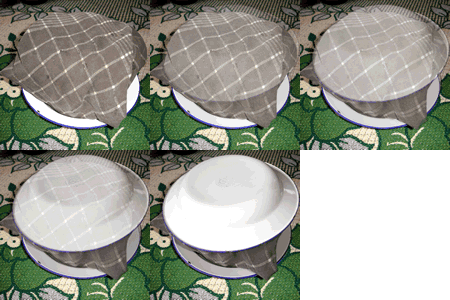
of the month: teatowel pan caddy
We have mentioned this
tip before, but with the rise in popularity
of cooking-caddies, we would like to re-iterate
one of the many uses of the common 100%
cotton teatowel. Tea towels can act as an
insulator too and we use ours as a cooking
caddy. Pasta only needs to be cooked for
a third of the cooking time and then wrapped
up and left to continue soaking until the
sauce is prepared. Rice takes a little longer
but performs exactly the same.
When camping and staying
in colder environments, we also place our
enamel plates on the top and bottom for
extra insulation. Added benefit here being,
it also warms the plates up before serving
the meal. So, not only can you use the teatowel
for drying your dishes or a picnic cloth
for preparing the sandwiches roadside, but
it can save on your fuel consumption as
well.
Artenet Internet, Quepos,
Costa Rica, 04-06-09 Nicoya to Quepos (3 cycle days; 1 ferry
trip; 221km; 1237m) Nicoya to Playa Naranjo (75km; 388m)
Playa Naranjo to Jacó (78km; 682m)
Jacó Quepos (68km; 167m)
Turner green
Even though we sleep through the alarm and are plagued
by flats tyres before we even get started, it doesn't
deter from another fantastic day of riding in Costa
Rica. Take a quiet winding French country lane and pop
it into the richest of tropical surroundings and that
is what cycling on the Nicoya Peninsula is like. Friendly
inhabitants and diverse landscapes filled with mangoes,
bananas, corn, rice, all arrays of palms, mangroves,
murky rivers; one lane bridges, parks; quaint villages;
and not to forget plenty of cows. It is almost unbelievable
to think that this area was dry as a bone just three
weeks back. I just have a wonderful time admiring each
and every view and its potential of becoming a Turner
landscape.
Local friendliness
Hardly anyone is using the road leading to Playa Naranja.
The trip is a little more rolling than yesterday, but
its an easy ride. About 20 kilometres before our destination
the road disintegrates before our very eyes and it is
hard pedalling. But there is only 10 kilometres of shaking
the bones around in the saddle, before we glide back
onto bitumen again and into Playa Naranjo
75km; 388m. It is not what you would call
a happening place and in fact we can't find any cheap
accommodation at all. We decide to hang out the 4 hour
wait for the ferry in a little restaurant overlooking
the bay. Larry and Samantha pull in on a ATV and convince
us that our decision to sail to Punta Arenas tonight
is not a very good idea and after a phone call, Larry
has teed up a cabina for 10,000 Colones at a friend's
lodge. Maquinays is run by a Belgian and Colombian couple
and our simple room is perfect for a good night's rest.
that is after we have erected the mosquito net. There
are an awful lot of little bugs flying about.
Ferries and wild wonders
The one hour and fifteen minute ferry
trip across the Nocoya Gulf is a great start to the
day. It leaves at 8am, so we get on the road quite a
bit later than usual. Since there were no stores in
Playa Naranja, we ate our last morsels for breakfast
this morning, and the necessary stop at a Pali discount
store pushes the start to our day even further forward.
The town of Punta Arenas is situated on a long thin
peninsula of about three roads wide for roughly 13 kilometres.
It isn't a particularly good road but then we make the
right hand turn onto a beautifully surfaced CA 32. According
to Larry, it is the first time that the area has contracted
the building of the road out to a private company and
luck has it that it has just been completed. Not only
does it have a smooth wide shoulder, but a cycle path
leading all the way to Caldera where we turn right onto
the autopista. The bike path has gone but a great shoulder
leads us safely up and down the highway until the turnoff
to Jacó.
This part of journey dishes up all
sorts of wild wonders. Apart from an abundance of flying
ants, crocodiles: the biggest I have seen in the wild,
bathe on the muddy edges of rivers, lizards of stunning
blues and greens scuttle away as we ride past and even
a giant iguana who didn't quite make it across the road
in time lay dead, but on full display. A last hill 12
odd kilometres before our destination is a killer 4
kilometres long at the end of the day and in the hot
and humid conditions. The ride down the other side is
much more gratifying, though the road is plenty patchworked
and not a smooth descent at all.
Sign posting has been completely outrageous
the whole way through Costa Rica. Upon entering the
country a board stated that Punta Arenas was 280 odd
kilometres away, when in actual fact it is barely 200.
Even with us taking the longer route down through the
Nicoya Peninsula we only manage to clock up 240 kilometres.
And now leading into Jacó with approximately
5 kilometres to go, signs contradict one another even
just a 100 metres apart.
Including its prestigious 2009 World's
Best Surf Spot title, Jacó (78km;
682m) pretty well has it all for such
a small town: sushi bars; pizzerias; surf shops; souvenirs
and tattoo palours. Many of them run by foreigners.
Accommodation is a few rungs up on the price tag ladder
and the cheapest spot we can find is 15,000 Colones.
The room at Cabanas Iguana is pretty good, though the
promise of hot water doesn't come through and the guy
at reception seems way more interested in flirting with
his girlfriend than seeing us comfortably checked in.
The heavens open up just as we have unpacked our bags
and are settling comfortably in our room. The whole
evening is a spitter and sputter of rain, lighting and
booming cracks of thunder.
Miniature but pleasant
destinations
A road sign on the CA 34, just past the last turnoff
into Jacó says Quepos is 106km. Our estimations
suggest that this is 50 kilometres too much. Going on
yesterday's territory, we had expected more hills today,
but the the ride is an easy pedal. Virtually flat apart
from an initial short climb, the road is also pretty
good until we hit Monterrey where it gets quite patchy.
It picks up again after Parrito. The Pacific coastline
lies to our right most of the way, though we only get
a few glimpses of it. Friendly waves and thumbs up from
locals working the green luscious land.
We hit rows and rows of African oil
palms, which typically reminds us of Malaysia, though
I never saw anyone there wielding a seven metre pole
with a machete attached to end of it. These workers
are also on bikes, which is pretty clever considering
the size of their work-tool. The outskirt of Quepos
(68km; 167m) is run down and doesn't look
at all promising, but after the one lane bridge, we
hit the actual town. Its again very small and has its
fair share of foreigners and consequent facilities.
The vibe is good though and our very clean, decent sized
room with no-frills bathroom at Hotel Ramu's is okay
for a couple of days. The 10,000 Colones for these facilities
is about rock bottom price in Costa Rica for double
accommodation with ensuite.
The price of tourism?
Quepos is 7 kilometres north of Parque National Manuel
Antonio and we find ourselves paying the 200 Colones
each (25 euro cents) for the bus trip which takes us
up a monster incline that only a madman would want to
cycle. It must be well over 15% in parts, but it is
great viewing from the comfort of our little plastic
covered seats. The biggest surprise is how many lodges,
backpackers, eco-accommodation, shopping areas, restaurants,
pizzerias and tour shops there are. In fact, they by
far outnumber what the town of Quepos has on offer.
The area on the beach front is also lined with stalls
selling all the same sort of stuff you see in every
tourist spot in the world, only it has Costa Rica plastered
all over it.
The walk to the park entrance is pleasant
enough, but the $10 US fee each is not (Costa Ricans
pay $3) and we decide not to enter for that price. The
place is small and packed with tourists and we are likely
to see only monkeys, lizards and some birds. We experience
stuff like that everyday on the road, so its just a
wander around the surroundings before spending some
time on the beach warding off cigar and pottery salesmen
and then moseying our way back to Quepos. Even without
achieving our original plan, it is a relaxing morning.
Mamma mia, what
a ripoff?
Last night however, had been far from tranquil,
though it was entirely our intention. For the
first time since we left, we decided to eat out
in a semi-upmarket restaurant. We figured, we
deserved it and the thought of not having to cook
or having to eat pizza was tempting enough to
choose a little Italian spot on the next street.
Everything starts off fine as
the waiter fusses over us, napkins, olive oil
and balsamic vinegar jugs, bread. Both thinking
that it was such a long time ago that this had
happened, we smile. Menu's are delivered and we
are told the special of the day is vegetarian
lasagne. Ali's face lights up immediately. Perfect,
we'll have that and the spaghetti pesto (€4.30)
and the rucola, orange and onion salad (€3
euros). I ask how much the lasagne is just to
be sure and it is a little pricey at (€
6), but the waiter had shown us a recipe book
saying it comes out like the deliciously layered
pasta dish pictured on the page. I can tell you
it looked mouth watering.
Our tiny salad spread out thinly
on a large plate appears. The sparingly incorporated
rucola is mixed with cos lettuce; the onions are
certainly in plentiful supply and so are the massive
pips in the tough skinned juicing oranges the
chef has used. We had asked for everything together,
but other plans in the kitchen meant the salad
is finished before the four small spaghetti bundles
arrive. Fancy basil-balsamic droplets bordering
the square white china plate most likely took
longer to decorate than preparing the microwaved
dish. Not only the little 'pings' resonating from
behind the kitchen door, but the fact that just
the centres are warm and the rest of the coils
are stone cold are a dead give away that this
meal has been zapped.
The lasagne also makes its grand
entrance and it is also cold, but we are more
overwhelmed at how small it is. There are just
two layers, barely rising above the plate, with
three pieces of lasagne measuring roughly 12 x
5cm filled with two thin rounds of aubergine and
a few tablespoons of tomato sauce. Now had this
instead, been oozing with rich tomato concase,
a compliment of vegetables, homemade béchamel
sauce and tasty cheddar cheese, I could have easily
overlooked the fact that even a fashion model
might complain about this portion size too. Ali
puts his head in his hands. We debate, whether
we should say something or not.
There is no way, we can let this
slip. It is just too sad for words and the amount
they are charging us is worthy of so much more.
We wait for our waiter. And we wait. In the end,
I pop my head around the swing entrance to the
kitchen and say, "I'm sorry but our food
is cold". Ali further talks to the waiter
about the ridiculous size of the meal. He apologises
saying it is the kitchen's fault; that he only
works here and will solve the problem by zapping
everything for a second time. Furthermore, he
delivers the lasagne even flatter than the first
time, with the message that we can have it for
half price. This is not really what we had in
mind. A decent sized serving for the original
price would have been adequate.
Before we can get a mouthful
in, Mamma Mia waddles out of the kitchen in all
her big bellied glory. First, she establishes
where we come from and then starts rattling off
in German to Ali (all of which I can understand).
I wish I could have replied back in German because
I would have loved to have dazzled this would-be-chef
with some of my kitchen finesse: and anyone that
knows me well, also knows the storms I have cooked
up: be it campfire, Primus stove or fully fledged
workspace. Anyway, her first line of argument
is that everything is expensive in Costa Rica
and that she only uses the best and imported ingredients
from far, far away. Besides she boasts that everything
is homemade and we therefore should appreciate
and savour her culinary skills. If picking out
orange pips in a salad and swallowing cold minimally
flavoured spaghetti is her idea of gastronomic
heaven, then she is less aware of food and its
potential than I thought.
I reveal the picture the waiter
showed us and place it next to her dish. It is
a dismal comparison, but she retaliates that it
is only a picture. She becomes quite abusive at
this stage with remarks that it is typical of
a Dutch person to make such a complaint and that
if we are not happy, then we know where the door
is. She also chastises me in Spanish at the top
of lungs for not being able to conduct a conversation,
or should I say argument in her mother-language.
I leave. Ali follows close behind.
A simple baguette fashioned with
avocado, mayonnaise, tomato and cos lettuce in
our hotel room never tasted so good. The ingredients
were just short of €2 for the both of us.
Even though the altercation in the
restaurant was not a particularly pleasant one, we didn't
have to pay a cent for our untoward experience and we
still enjoy our stay in Quepos immensely. Our hotel
is perfect: clean, friendly staff with big smiles. The
internet café, though double the normal Costa
Rican rate at 1000 per hour is well set up for wifi,
air conditioned and most importantly the connection
is fast. The town has a Pali store, so we can purchase
local food at reasonable prices. Four nights after arriving,
we finally set off to Playa Dominical.
Internet Café,
Panama City, Panama, 19-06-09 Quepos to David - Panama (4 cycle days;
259km; 1627m)
Quepos to Dominical (45km; 152m)
Dominical to Palmar Norte (63km; 552m)
Palmar Norte to Ciudad Neily (77km; 439m)
Ciudad Neily - Costa Rica to David - Panama (74km; 484m)
Bit of dirt never killed anyone
Our route is in some degree of unpaved proportion for
the entire journey to Playa Dominical. It starts off
reasonably good, where the roadwork department are doing
their best to get a bitumen surface down before the
monsoons really hit, but eventually the state of the
road becomes quite slushy and harder work than normal.
Even so, it is a great ride through the little coastal
villages, well away from the Pan American and with the
sound of waves pounding the beach from behind a jungle
strip of palms. This part of Costa Rica has a lovely
feel about it: people give us the thumbs up, say either
"hello, hola, buenos" or have even
caught us by surprise with a "have a great
trip". The scenery is so green at this time
of year it is almost surreal. There is little traffic
and vehicles are generally patient. Worth all the slipping
and sliding around on gravel and in the mud.
Our destination comes after three and
bit hours of pedalling and we are immediately welcomed
by an enthusiastic American family that own a house
a bit up the road. Playa Dominical (45km;
152m) has it's fair share of tourist elements
and surf culture, but it is by no means pretentious
like many of the same spots along the Mexican Coast.
Buildings blend in nicely with the landscape and tropical
flowers adorn every piece of available ground. As do
the giant iguanas, who with their prehistoric features
and silly walks, keep Ali and myself snap happy and
in total wonderment for hours.
Our first look in at accommodation
is Posada Del Sol. It is immaculately coordinated and
pretty well perfect, but the 17,000 Colones is a bit
over our budget. Though, if you were thinking of spoiling
yourself, this price is a steal for what you get. El
Coco is a restaurant-come-bar close to the beachfront
with a few hostel like rooms at the back and at the
more budget price of 8,000 Colones for two. Can't really
complain about the simple, clean hut with fan and share
bathrooms for that price tag. Shopping is a bit more
expensive and fresh produce quite limited, so it would
pay to bring in supplies.
Even with all its washed up wood,
coconuts, rocks, trees, and shells from such turbulent
currents, a walk along the beach reveals a relaxed family
atmosphere, though not too many people are taking heed
of the tide warning signs. There is basically no rubbish
anywhere to be seen, which I admire at once. Camping
is easy as the maritime rule applies in Costa Rica,
like in Mexico and many countries throughout Central
America. From the ocean's edge to 50 metres above high
tide is public domain, though security plays an important
role in the decision of whether or not to set up the
tent. Playa Dominical seems safe enough, however the
mosquitoes might have some influence on how many nights
you stay. Repellent in some form is an absolute must.
Stunning cloud formations and sunset lights are as dramatic
as the powerfully thumping surf. The only aesthetic
downfall as far as I can see is the black sand: it just
doesn't do it for this spoilt Ozzie, born and raised
with white powdery grains squeaking between her toes.
Hitting the jackpot
Another fairly easy trip, though more hills to traverse
than the previous days. Being drenched by our first
thunderstorm cloud in Central America is a relatively
short incident and we emerge out the other side into
steamy hot sunrays, which are actually harder to bear
than the downpour. Playa Uvita also looks like a pretty
nice place to stop overnight and it has a decent sized
supermarket on the main road for stocking up on any
goodies you might like. Palmar Norte (63km;
552m) where we stop for the night has
a Super Mas and a Pali store as well.
The first Chinese restaurant and hotel
we hit we enquire about the price of a room. It is 8,000
Colones which is the cheapest we have found yet in Costa
Rica. The room is okay except for the whopping hole
in the window where the air conditioner used to be.
It is bad enough that all the mosquitoes and flying
things can penetrate the gap, but the fact that a person
could easily crawl through it is more worrying. We ask
to see another, but they say there are no more available
rooms. Seems a little difficult to believe at this time
of day, so we move the 30 metres to Hotel Hong Kong
where we absolutely hit the jackpot. The well kept,
spic and span operation is run by a quite comical, but
genuine Chinese couple. Our lovely room costs 10,000
Colones and although our dinner wasn't the tastiest
we have ever ordered, it was filling and the enthusiastic
wave good night from the owner certainly made up for
the lack of flavour.
A couple of wet warnings I know its getting a bit boring to hear,
but its another wonderful cycling day: past momone (rambutan)
stalls and farm houses nestled amongst jungle green
forests. African palm oil plantations only ever occupy
one side of the road at a time and though overcast skies
threaten rain, we make it to Ciudad Neily
(77km; 439m) just in time to witness the
heavens opening up. Our hotel room is 8,500 Colones
and infested with cockroaches, so out comes the Teva
sandal and we sleep with the light on. The following
day, the ride to the border town of Paso Canoas is much
the same as any of our Costa Rica journeys, though the
traffic does appear to become a little more impatient.
The road is atrocious considering it is the main highway:
no shoulder and a patchwork of repairs.
Crossing into Panama is easy; no fees
to pay either, but everyone else we have spoken to since
has paid $US 1 to enter. The highway also looks promising
with its dual lanes and wide shoulder, but that disappears
after a few kilometres and the uncomfortable feeling
returns. The driving is fast and furious and quite hairy
on occasions. The gravel side shoulder is impossible
to use most of the time and we have to sit out a short
storm in a bus shelter just 5 kilometres from David
- Panama (74km; 484m). Reaching the city
centre in the early afternoon, we ride around a bit
before realising that the accommodation prices here
are going to force us to do a quick surf in an internet
cafe to find something halfway cheap.
Her Lady Purpleness The
Purple House
is where we end up after another quick shelter from
a longer bout of rain. As the name suggests, the place
is very, very purple indeed. Andrea, who is extremely
dedicated to this colour, runs a tight purple ship.
Maybe a little too tight for us, but we meet and converse
with some other really friendly travellers. The $US
20 private room with ensuite is pricey for our budget,
but very clean. Free tea and coffee as well as a weak
wifi link are also included. Of course there is the
bonus of the kitchen, which is also sparkling purple
and complimented with colour coordinated washing-up
detergent. A couple of days under the directive of Her
Lady Purpleness is enough, though we have fun exchanging
information and researching our next part of the journey
to Panama City. The only downfall is we just can't seem
to book our flight out on-line. For some reason, our
credit cards keep getting rejected. And no we haven't
run out of money quite just yet.
After a trip to the 24 hour Super 99
just down the road and while on the subject of money,
we thought it would be useful to include a small comparison
chart of the price of a few goods and services in Mexico
and Central American countries.
Mexico
Guatemala
Belize
El Salvador
Honduras
Nicaragua
Costa Rica
Panama
currency
+ rate
to the US Dollar
Peso
14.95
Quetsale
8.06
Dollar 1.95
US Dollar 1.00
Lempiras
18.89
Corboda
19.12
Colones 575
US Dollar
1.00
water
1.5 litre
0.67
0.68
1.03
0.60
0.53
0.58
1.03
0.75
10.00
5.50
2.00
-
10.00
11.00
590
(1.75L)
-
water
1 gal (3.78 L)
0.67-0.94
0.81-1.24
1.54-2.05
0.65
1.06
0.89-1.25
2.70
2.45
10-14.00
6.50-10.00
3.00-4.00
-
20.00
17-24.00
1550
(6L)
-
juice
1 litre
0.87
1.12
0.82
1.15
0.79
1.44
1.30
0.99
13
9.00
(1.5L)
1.60
(1.5L)
-
15.00
27.50
750
-
local
beer
333-350ml
0.47-0.74
1.24
1.28-1.54
0.75
1.01
0.78
0.87
0.47
7-11
10.00
2.50-3.00
-
19.00
15.00
500
-
biscuits-maria
140-160g
0.33
0.40
0.77
0.70
0.42
0.52
0.70
0.85
5
3.25
1.50
-
8.00
10.00
400
-
tortillas-wheat
250g
0.54
0.99
n/a
1.10
0.58
0.76
0.70
1.05
8
8.00
-
-
11.00
14.50
400
-
pasta
200g
0.20
0.34
0.56
0.50
0.48
0.37
0.48
0.43
3-5
2.75
1.10
-
9.00
7.00
270
-
bananas
each
0.13
0.12
0.06
0.15
0.16
0.09
0.07
0.12
2
1.00
0.12
-
3.00
1.75
40
-
peanut
butter
340g
2.14
2.11
2.18
3.55
n/a
2.56
3.53
2.19
32
17.00
4.25
-
-
49.00
2030
-
internet
per hour
0.67-1.34
0.62-1.24
2.05-4.10
0.75-1.00
1.06-1.32
0.52
0.87+
0.50-1.00
10-20
5.00-10.00
4.00-8.00
-
20-25.00
10.00
500+
-
budget
double accommodation
with bathroom
12.04+
8.68-12.41
14-25.64
12-16.00
10.59+
6.28-10.46
17,39+
14-22.00
180+
70-100
28-50.00
-
200+
120-200
10,000
-
* All prices in US$ (bold). Local
currency underneath. All prices converted to US Dollars
using the exchange rate at the time of collecting information.
David to Panama City
(5 cycle days; 467km; 3882m) David to Las Lajas (81km; 640m)
Las Lajas to Santiago (122km; 1503m)
Santiago to Penonomé (102km; 333m)
Penonome to La Chorrera (117km; 924m)
La Chorrera to Panama City (45km; 482m)
A few more hills than expected
Eight o'clock is pretty late to get on the road today,
but that is to be expected when staying in a hostel.
You can't just do things when you want to, there are
several other guests using the same facilities as you.
The traffic is heavy duty on the way out, but after
an hour, I notice that it has died down quite considerably.
The 32 kilometre point marks the beginning of a fantastic
stretch of tarmac. Smooth and with a massive wide shoulder
for us to use. Riding couldn't be more blissful.
Several blogs we have read recently
state that the journey is 'mostly flat'. We
couldn't disagree more and would more accurately term
the topography as rolling. The climbs are neither long,
nor steep, but nonetheless it is an up and down pedal,
through a green, but not so spectacular landscape. Plenty
of cool tumbling waterfalls to be seen along the way.
Trucks toot with melodious tune and
everyone welcomes us with a wave. It's a pleasant enough
trip. The turnoff to Playa Las Lajas (81km;
640m) takes us past the village, where
we learn that there is no other accommodation this time
of year, apart from Paradise Inn, unless we want to
travel a further 10 kilometres to the beach. Only problem
with this is we'll have to cycle back out again tomorrow
and add more kilometres to an already potentially difficult
day. Christian, the owner very pleasantly offers us
the amazing room at 25% discount. So, for $37.50, we
live it up in luxury for just one night. It is our first
hot water shower since Chiapas in Mexico which was 47
days ago.
Hellier journey
Try in vain to leave early this morning,
but Ali has teed a possible website up with the owners
and I need to make some photographs for the page. It
takes a bit more than half an hour, which I think is
pretty good going, but leaving at 7.45am, when we know
we have more than 1550 metres to climb over 120 kilometres
is not particularly clever planning. There is not really
any way around it, but it still stresses me out, as
I know I'm going to find the journey very demanding.
And I am right. It is a non-stop long,
hard grind for the entire day. None of the climbs are
particularly steep, but they are relentless and normally
when you spy one of the microwave towers, you can be
rest assured you are at the top. Not today however:
it goes up and down like a yo-yo and those red and white
masts dot the hillside like lighthouses guiding you
through rugged terrain. And for those interested in
the nitty gritty of the trip, here's the finer details:
Las Lajas to Santiago cycling details(122km; 1503m)
The first hill you think you have reached after
31kilometres (265m), actually peaks at 36 kilometers
(289m). By this stage you will have traversed
513m alitmetres in total. Just a third of the
day's effort. A wonderful plummet down over
the next 7 kilometres to 50 metres above sea
level, gives you time to catch your breath for
the short 100 altimetre climb that follows.
Again, you drop to 50 metres and from then on
a gradual ascend to 315 metres at the 51 kilometre
mark of the trip. You are a little over the
halfway point on the day's climbing scale.
An up and down affair follows until another
peak of 376m at the 58 kilometre point. The
microwave tower to your left is no indication
of the true top and a further 2 kilometre stretch
takes you to 413 metres high. Total altimetres
covered by now are 974. Another plunge towards
sea level follows. Don't believe the signpost
just before the 71km mark saying that you still
have 77 kilometres to go. It is wrong. A smaller
ascend, though still worth mentioning, to 177m
brings you to a completed distance of 77 kilometres
so far.
There's a whole lot more up and down for the
next 15 kilometres where you will peak once
more at 183m. From here the next 20 kilometres
to the finish line are pretty easy going as
far as the natural landscape is concerned. Your
biggest worry will be trying to cut a decent
and safe path on the extremely bad road surface.
After 122 kilometres you will reach Santiago
at roughly 95 metres.
We stop for lunch after 51 kilometres
and 754 altimetres of climbing and as a dark cloud descends
in on us. Sheltering for long is out of the question;
we take off again in light drizzle. The further we cycle
the worse the showers get. I get two flats: both caused
by wire strands from discarded truck tyres and my front
derailleur seizes leaving me with just the middle crank
to ride the hills on. Ali also has limited use of his
gears. It is times like these, that everything takes
on a new perspective: at least it is cold and not hot;
I am grateful for use of all seven gears on the middle
chain wheel; my recently screwed out socks are better
than the squelching soggy ones I rode with for several
kilometres; a sweat-damp shirt under a saturated rain-jacket
feels way more comfortable than a drenched shirt with
no protection; and when we hit the 65 kilometre mark
and have to continue the undulating terrain on an atrociously
bad surface, I pity all those poor souls who have made
this trip before, when the entire length of highway
was like a world war took place on it. Nothing short
of absolute hell.
Covered in mud, wet, tired and with
less than an hour before dark, we pull into Santiago
(122km; 1503m). Hotel Hong, recommended
by a couple of cyclists in a
Crazyguyonabike
blog say the place is pretty alright. Their standards
must be a little lower than ours, or they didn't care
much for details after such a journey. The no frills
room with a fan and quite a bit of dirt is cramped,
but a place to lay our weary bodies to rest. It is Sunday
and hardly anything is open, so it is a delve into the
reserve supplies. Anything warm and filling tastes good
after a day like this.
Perfect cloud skies
We try all we can to get out of bed on time, but it
just doesn't work: neither of us wants to budge and
it is almost 6.30am before the aching bones start to
creak. My backside is sore and my legs are still tired
from yesterday's pedalling. A simple breakfast of peanut
paste and jam sandwiches (separate for those wondering)
and a couple of cups of freshly brewed coffee do the
trick and it is a slow but definite wake up to the day
and the realisation that I have a flat tyre.
It is also a flat cycle in contrast
to yesterday's roller coaster ride, but hardly boring
with the perfect cloud formations starkly picturesque
against the farmland green: the type of views postcards
are made of. Colourful bus stop murals depicting Panamanian
culture keep me entertained for most of the journey,
but even they have little amusement in the mid afternoon
hours: it reaches 45° Celsius in the sun and I can
feel the piercing rays penetrating the thick white layer
of 50+ sunscreen on my face and arms. We rest quite
often and drink a tonne of water. Ali gets a flat tyre
early on in the morning and as we are powering on the
last lengths, I get one too, which comes as a bit of
a nuisance to the last legs of the journey. The roads
in Panama are constantly full of crap!
There never seems to be any decent
signage directing you into a town either. Nearly every
board you see is a sponsored plaque, with some relevant
distance or directional information, but also advertising:
the latter seemingly playing the more important role.
Street names are almost never represented, which makes
me wonder how people know their way around their city.
At crossroads with the highway running alongside Penonomé (102km; 333m),
Hotel Dos Continentas stands quite majestically and
looks ominously expensive for our budget. It is a little,
at $22.00, but with such a mixed bag of accommodation
in the last few days, we are not certain of what the
average cost is. We figure we'll fork out the extra
few dollars for tonight.
Our massive room is amazing: tv, hot
shower, comfy bed, small dining table and chairs, lounging
stool, dressing table, clean, neat, colour coordinated;
and wonderfully friendly staff. While Costa Rica is
the greenest, Panama is by far the more modern of all
the Central American countries.
Pushing on through a day
of aggression and a lesson learnt
After a fabulous nights sleep, the 75 kilometres to
Chamé, no matter if the terrain is hilly or not,
seems like a cinch in comparison to the last few days.
Unfortunately, even after a short but sweet side tour
of the little village, we find nothing and decide to
push on to the next town. Seems quite strange seeing
as every township leading up to our proposed destination:
Anton; Rio Hato; Santa Clara; San Carlos and at the
turn off to El Coronado; has ample accommodation prospects.
The next spot, Capira, has a derelict and closed hotel
on the outskirts of town, but that is about it. We have
to push on again, only this time up a hill from 30 to
217metres. The gradient is not to difficult, but the
hot afternoon sun is draining the will out of me.
To make matters worse, after El Coronado,
the truck traffic especially picks up and they become
inconsiderably aggressive. We are constantly fighting
for road space when the shoulder disappears. Which,
by the way, happens regularly. Our lives literally flash
before our eyes as one truck comes way too close for
comfort, even when he had the freedom to use the lane
to the left of him. There is nowhere for us to go either,
as a couple of semis are parked on the gravel shoulder
to our right. If it wasn't for Ali's scream to me to
move over, I would not be writing this piece right now.
The driver is sandwiching us on purpose. And it makes
Aaldrik furious.
So furious in fact, that when he sees
the truck pulled in at a gas station, a few kilometres
on, he decides to confront the guy. There are only a
couple of extreme circumstances when Ali gets hostile:
one of them being, when someone tries to blatantly hurt
me. Very gallant of him really, but Ali is not a fighter
in any way shape or form and I like that very much about
him. But, it also means he is no match for the bulky
latino driver who is already kicking his legs in the
air and has his hands ready for a round of fisty cuffs.
He knew exactly what he had done, but is adamant that
we shouldn't be on the highway and just as he was ready
to wipe me from the road with one of his metre and half
high truck tyres, he's ready to fight about it.
I am less than half his weight and
not much help either, though I can scream pretty annoyingly
in someone's face, which I do at every available opportunity.
A bit of a tussle starts and the weakling reaches inside
the door of his tool kit. Nice one, that's all we need
an angry latino wielding a crowbar. I slam the door
shut on his hand to stop this deed from going any further.
He grabs Ali and pushes him to the ground, which is
when, thank goodness, everything stops. Another man
steps in to calm the situation and I grab my camera.
This action has our truck driver jumping promptly in
his cabin and driving off as fast as he can.
A few other truck drivers come over
and ask if we are okay. Apparently, they know this guy
and mention that he is a nasty piece of work. "No
kidding", I say. He tried to kill me with
his truck, when there was absolutely no need for it.
I try to get the name of the company he works for out
of them, but they say they don't know. I get the distinct
impression they are hiding something, but hopefully
with a trailer and truck licence plate number and a
good photograph I can at least try and contact the company
myself.
The rest of the day's journey is just
as suicidal and the traffic just doesn't care whether
they plough us over or not. The road and shoulder are
not always in good repair, so it is impossible to remain
on the right side of the white line. We are honked and
pushed from the road continually. It is horribly nerve
racking and such a divergence from what we experienced
up until now in Panama. Today is up there in the top
echelon of the most unpleasant cycle days I have ever
experienced. Just 5 kilometres before the actual township
of La Chorrera (117km; 924m),
a backpackers-hotel comes into sight. We decide to move
into the town, which is just as maniacal as the highway
and stay in a rather drab double at Hospedaje Lamas
for $14. The town is dirty and unkempt and not a welcoming
sight, though one man that we asked directions from
was more than happy to let us sleep on the bench outside
his car-workshop.
Ali is quite sombre all evening and
rightly so. As well as nursing a couple of sore spots,
he feels bad about what happened and how his anger took
over his thoughts of reason. I think it is chivalrous,
his concern for my safety, but he is no warrior. I make
him promise that he'll not go running after any truck-drivers
again. Learning to grin and bear the torment a few malicious
individuals inflict on us while cycling is part of the
tour too. We just have to hope that it will not be the
way we leave this planet.
Celebrating the end of
a difficult stretch with pizza, beer and icecream
It is raining when we wake at 7.00am;
teeming down when we want to leave at 8.30am; and still
spitting when we finally take to the road at 9.00am.
The journey out of town requires some time and effort
and we are glad when a shoulder finally appears, be
it muddy and full of debris.
Pushing slowly to the top of the hill
remaining focussed on the white line and the 30cm wide
shoulder I've got to manoeuvre, I notice a man walking
towards me. He won't step aside onto the footpath, he
is determined to make me move across into the lane.
I don't budge, there is too much traffic behind me.
He reluctantly shifts to my right at the last minute.
The shoulder disappears and I'm forced to move left.
A taxi immediately blasts his horn. I'm still climbing
in my second lowest gear. Have been for the last five
minutes. The road spray is oily and dirty. My bags are
covered. I'm covered. My gears aren't working as well
as they should be. Sweat is dripping from my brow. My
eyes sting from the salt. Drop by drop it lands on my
cross bar. making it the cleanest part of my bike. Buses
push past intolerantly pumping black billows of exhaust
into my airspace. I have no option than to suck it all
in. Someone throws a empty juice can out of the bus
window. It rolls in front of me and comes to rest along
with all the other discarded rubbish.
The rain stops early on and Ali starts
chirping in my ear: "Is it getting flatter,
or is it just me?". I reply quite coolly with:
"No, its just you!" The climbing
is strenuous and once again relentless. The extremely
poor state of the roads coupled with the heavy traffic,
makes it seriously dangerous in parts. We get to the
foot of the bridge and are immediately stopped by policemen
from all directions telling us we can't cross into Panama
City. This had been mentioned enough on a few blogs
that we were prepared for this little obstruction. Apparently
a few years ago they closed the bridge to pedestrians
and cyclists. The reason behind this is that too many
people, in dire financial difficulty threatened to jump,
unless of course, their debts were cleared. The police
think its pretty crazy that we have cycled all the way
from Holland, but they obviously don't think we are
about to end our lives just yet. After a courteous and
calm intercourse, a motorcycle is promptly organised
to escort us across the Puente de las Americas. Though
they trusted our motives for crossing, there was no
way they would chance a stop to take photographs, so
you'll just have to believe me that the views from all
angles were pretty amazing.
The navigation through the city was
harmless enough, except for the sling-shot stones aimed
at us in a not so well-to-do neighbourhood. And there
are plenty of run-down areas on the outskirts. We later
find out that the incident occured in the suburb of
Curundú and you don't want to stop in this area
for love or money. According to the owner of our guesthouse,
at the height of the monsoon season, the area floods
badly. So much so, that traffic slows down to almost
a halt and if this happens there is a high possibility
that you'll get mugged in your car. I guess we were
lucky then.
The skyscrapers in the CBD paint an
entirely different picture of Panama City
(45km; 482m) and at night time, it's more
akin to Vegas with all its glamour and glitsy flashing
lights. We find the Gran Morrison on Avenida de España,
which is where all the hostels apparently are. After
a couple of circumnavigations of the area due to a complete
lack of street signs, we end up stumbling upon Zulys
Hostel. A decent sized private room with share bathroom
right outside costs $22.00 per night. Considering, the
neighbourhood is safe and this is actually inexpensive
for accommodation in the capital city, we take it.
We glue ourselves to the common-room
chairs and celebrate the end of our Central America
tour with pizza, beer and icecream. Total heaven after
a number of hell experiences.
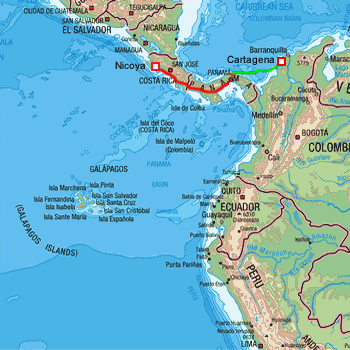
Internet Cafe, Cartegena,
Colombia, 04-07-09 Panama City - Panama to Cartagena - Colombia
via the San Blas Islands
Seven of us for six nights and five days in a ten metre
boat
Panama City is much like any other city stay for us.
Leisurely ambles around the town, not really with too
much in mind except for dodging the monsoon rains, filling
up on delicious food in the vegetarian buffet restaurants,
organising our boat trip to Colombia and visiting the
Panama Canal. I had sailed through here in 1972 on a
cruise ship with my parents and I remember it quite
vividly. Well, at least all the fuss that was made about
the event.
It was not disappointing this time
either and a spectacular display is put on just as we
arrive by two cargo ships simultaneously faring through
this fascinating piece of engineering genius. Apart
from the monster building from where we huddled with
hoards of other tourists to experience the rise and
fall of boats and waters, it was much the same as an
eight year old could recall. Probably, the most significant
change since that time is the handing over of the canal
and its locks by the US to the Panamanians on 31 December
1999. Currently, an expansion project is underway to
build a bigger and more efficient lock system and is
projected to be in operation by the middle of the next
decade. It is certainly worth paying the extra fee to
wander around the museum and see the explanatory film.
Fabian from
SailingKoala
had already been around to give us the spiel about his
boat and all its finer points and we had accepted our
spots for the ocean journey to Colombia. Several hours
of procrastination over the pros and cons of either
flying or sailing had lead to the decision to face the
waves: mostly due to
Aires
website not accepting any of our credit cards (a common
complaint from travellers) and the arduous task of getting
ourselves, bikes, luggage and boxes to the airport by
taxi. Furthermore, a couple of days on the apparently
beautiful San Blas Islands were included in the US$375
per head fee. The downfall will be obvious if you have
been following our trip at all as you'll be well aware
that my legs are made for being firmly placed on mother
earth's firm bits. Still, with much trepidation, I prepare
myself for the journey by reading a surprisingly dedicated
US Coast Guard's website concerned purely with the ins
and outs of seasickness. Following his advice, I fill
the toiletry bag full of Dramamine tablets.
Fabian's Isle
Just sit right back and you'll hear a tale,
a tale of a crazy trip,
that started out from Panama
aboard this a tiny ship.
The captain was a laugh-a-minute man
and his mate was to be allured
from six passengers that sailed that away
for the five day tour; the five day tour.
The weather didn't get too rough,
still the tiny ship was pitched
but nothing would stop the passengers
from their avo aperitif; their avo aperitif.
The ship set anchor on the shore of
one
Kuna' tropic isle
with Fabian, Captain Morgan too,
the Cyclist and his Wife,
the Swedish Gal, Pépé and Mr Perfect:
Stan
here on Fabian's Isle...
Sorry about that folks, but being a
total
Gilligan's Island
fan, I couldn't resist the parallel. For those of you
thinking I've gone completely mad: Gilligan's Island
was a very silly, but addictively adorable American
television series in the 70's. The theme song went something
like the lyrics above. There's plenty of information
on internet if you have some time to waste.
It actually went more like
this:
The bike ride to the bus station was a cinch and took
us less time than Morgan's taxi. Morgan was also staying
at
Zuly's
Hostel
in Panama City. The bus driver didn't bat an eyelid
when we rocked up with fully loaded bikes. (Turkish
bus attendants take note!). Up came the compartment
doors and after a bit of pushing and shoving of other
customers' luggage, our bikes are slid in with all the
bags still attached at no extra charge ($US2.50 each
for the bus trip). The change of buses to the local
variety on the outskirts of Colón doesn't phase
the transport workers either and with a quick hup, hup
the bikes are pushed in the aisle via the back entrance.
This time they cost the price of a passenger, but at
$US1.00 each for the 30 odd kilometre journey, we can
hardly complain.
Caribbean reggae is blaring from the
speakers; hot pink feather boa's wound around the dashboard
and front mirrors are blowing excitedly in the wind;
all ages, shapes and sizes board the bus swinging their
hips or tossing their deadlock hair. It's all very vibrant
and happy. Fabian, also very vibrant and happy, is waiting
for us at Portabelo. We make our way to the jetty and
it is about here that any form of pleasure in the thought
of what we are about to undertake ceases for me.
Don't rock the boat
Our 10 metre craft is rocking and swaying in the wind
swept marina like a miniature rubber duck in a bathtub
that a sumo wrestler has just stepped out of. I wait
quite frantic on dry land before I, like the bikes and
luggage, am shipped across by blow-up dingy. On board,
I am shown our sardine can shaped bed and here I immediately
lay down my belongings and unbalanced head, not before
sucking the life out of a Dramamine pill. Yes, according
to the wise words of the US Coast Guard, this is the
way to achieve maximum and immediate effect. It tastes
absolutely disgusting but he was right. Almost instantaneous
effect, though sadly not enough stability returned to
allow me to raise my head from its horizontal position.
Even my overwhelming desire to film the movement moments
for all those disbelieving souls is dampened when the
boat decides to embark on its daily yoga routine. And
left side down to the waters edge and up and right side
down and stretch. Ali is on deck with a young guy, obviously
from Holland by the guttural tones and they seem to
be having a way better time than me.
Minutes later, though it could well
be more as the Dramamine has made me quite drowsy, there
are some urgent cries of Spanish from a neighbouring
boat and a quick peek out the rear-vision sized window
reveals a dangerously close vessel in front of us. I
gather the Sailing Koala has been drifting, but I quite
hopelessly resume my position and pray that the boys
have everything under control. Next noise is that of
the dingy motor and then Ali telling me that he's going
into the town to buy water. He further adds that I should
watch out that I don't crash into the boat behind me.
Before I can heave myself out of bed, they are motoring
towards the shore laughing and waving at me. Well the
guys are at least. Linn, on the other hand has a look
of panic on her face. I turn around to see what has
caused her facial contortions and freeze with fright
to see I am only a few metres away from violently smashing
into a rather large fishing boat."What the
f#*k am I supposed to do?", I scream back
as I white knuckle anything in sight to keep myself
from being catapulted out across the deck and into the
water.
My first thought is: "How could
Ali leave me here like this?" He knows full well
my fear of any seafaring vessel and that my knowledge
of them is about as vast as my love for them. Seeing
as I can barely keep myself vertical, I take to lying
back down, closing my eyes and praying quite seriously
this time. Luckily, the boys got a hold of their senses
and came back almost immediately to remedy the situation.
Up comes the anchor and we drift away from danger. And
while I can't say the ocean came to rest, I at least
rested with the peace of mind that I wasn't going to
make tomorrow's horror headlines.
San Blas Paradise
Topped up with Dramamine, the evenings sail isn't so
bad. In fact I actually manage to sit upright on deck
for most of the night, which results in me praising,
on more than one occasion, the wondrous little pill
I am dissolving in my mouth every 4 hours or so. Sitting
upright, I do need to clarify is actually more out of
necessity with seven of us aboard such a tiny boat.
Over the next five days, we will all be experts in the
phrase, "Excuse me, I'm sorry, but can I put
my foot there?"
The next morning, we all awake to the
distant vision of Chichimin Island in the San Blas Archipelago.
It looks like pure paradise, with its white sands, palm
trees and perfectly blue waters. The Kunas are the owners
of this autonomous territory and they make a living
out of selling coconuts foremost. Tourists like us however,
also supplement their incomes when we pop into town.
They'll be round to sell crayfish and fish, their beautifully
handcrafted sewing or beadwork or just to collect the
rubbish for a small fee or donation of a bag of rice.
They are the most happy and relaxed indigenous people
I have had the pleasure of seeing in their authentic
environment and apart from thanking all the world's
gods for collecting together a bunch of compatible travel
partners in the boat, it was the highlight of the trip
for me.
For a couple of days we laze around
swimming, eating, sleeping and of course readying ourselves
for the afternoon's aperitif. And there Ali and I sit
sipping on our warm gin and squirt with Florence (Pépé
le Pou) from France, Linn from Sweden, Morgan (Captain
Morgan) from Belgium, Stan (Mr Perfect) from Holland
and of course the real skipper of the boat, Fabian from
Colombia. As I mentioned before, it was a blessing that
we all got on so well, because for five days and six
nights, we are in one and others' faces literally!
So close and yet so far
The last 43 hours of constant sailing is a dismal experience.
There is a period during these two days when everyone,
except Captain Morgan, who has found his true calling
in life, has a moment of weakness. I feel pretty well
shaken up for most of it, but much of that comes from
untimely monthly cramps. There isn't a shower on board,
it is stinking hot on the open sea and very little or
no cover from the suns rays on deck during daylight
hours. Inside is like an oven, unless you lie perfectly
still with a little battery-run fan angled directly
on your face.
As we near the habour of Cartagena,
Florence is threatening to swim to shore and the rest
of us including the skipper are all itching to get to
land. The promise of a private room with attached bathroom
is the most divine thought possible, but our dreams
are dashed when a storm moves in as we are anchoring
in the marina. We can see land but I have to wait an
hour before I have my lips firmly pressed against the
jetty floor giving thanks for the earth beneath my feet.
Welcome to Cartagena
There is a multitude of accommodation to choose from
on Calle de la Media Luna, depending on your budget
and taste. Ali and I along with Stan end up at the more
budget but very friendly run Hotel Holiday. Our double
room with bathroom costs us 15,000 pesos each (approx
US$7.50). Unfortunately, it is Sunday and everything
is shut as it is the next day too due to a public holiday,
but when the city does wake up on Tuesday morning, things
are immediately alive and kicking.
The promise of great bike shops is
a little overrated, though after a nearly 10 kilometre
pedal through kamikaze traffic, we find somewhere to
replace my dubiously creaking headset and almost rusted
in position front derailleur. Parts are dirt cheap and
while I'm happy enough with the Trans-X headset, the
derailleur is a bit cheap and nasty looking, so we'll
see just how long a US$5 part will last me. It is, in
any case, working much better than the previous one
was. By the way, the hour and a half labour on my bike
cost just 8,000 Colombian pesos (US$4).
We find some really good road maps,
which keeps Ali happily entertained as I write this
update and we spend a good part of our free time sitting
in one of the plazas watching locals while away the
evening hours. It is great to see all ages out and about
together in the evening, whether it be playing communal
games, dancing or just contemplating the day. There
is a comfortable feel about Cartagena, but after a seven
day rest it is time to get a feel for the rest of Colombia.
Country info
directory
Want to know more details about the route we
took, the hotels we stayed in,
or the altimeters climbed? Check out our country
information pages for: