on the road preparations tools country information links about us contact home
ON THE ROAD: SEPTEMBER 2007 photos: video:
previous / next month view our slide show entering Amritsar (3,79 MB)

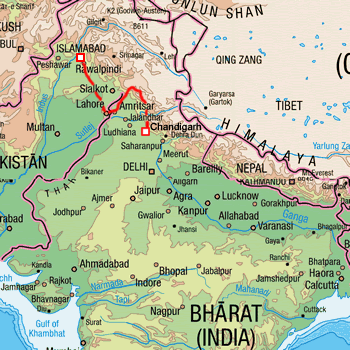
Islamabad (Pakistan) - Chandigarh (India)

Kilometers: 934 kilometers and 630 meters
Riding days: 14
Weather: sunny, but temperatures (finally) going down
Alti meters: 6492 meters
Best accomodation::

Green Hotel in McLeod Ganj for their fantastic food and wireless internet

Special thanks to:
* the owner of Induskorea.eu for offering to drive us around Lahore and dropping us off on the other side of town
* the Hashmi family in Wapda Town Gujranwala for feeding us, offering us a place to sleep and the nice conversations
* all the people (and pets) that remembered Ali's birthday on September 7

Breakdowns:
11: flat tyre
11: spoke
12: flat tyre
12: spoke
26: spoke
28: flat tyre
29: spoke (all of the above by Son...)

 

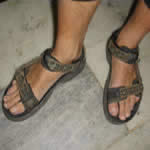
smelly tevas

Tip of the month: Smelly Tevas?
Got this great tip from the Wereldfietser Forum.

Tevas are renowned for stinking. So if this happens to you, soak them overnight in a bucket of reasonably concentrated Dettol solution. Can't hurt to give them a bit of a scrub in the stuff as well.

Should stay pretty fresh for at least a month.

Want more tips? Visit our publications page for an overview...


Green Hotel, [website] McLeod Ganj 23-09-07
It's all or nothing
(Islamabad to Amritsar: 5 cycle days; 4 rest days; 373 km; 808 m)
Whoever designed Islamabad must have had Europe in mind as it would have made a beautifully green city environment. What they forgot to take into account is that Pakistani's would be living here. Consequently, lining the roadsides in between the main sectors are scores of filthy tent villages and the apartment blocks and housing making up a large percentage of the "working class" area are considerably decayed and in such a state of rack and ruin that you can hardly believe this city is the young age of 40 something years.

The other side of the coin is the business and governmental sector, which in all it's pomp and grandeur stands out like a sore thumb against the poverty of the everyday folk. After coming out of Aabpara, where we are staying, it's almost like taking a taxi ride through a fairy tale land. So green and pristine; white marble and fountained courtyards. The more affluent area of Jinnah Super Market has some pretty good examples of upper class Pakistan as well. Besides the trendy brand-name clad inhabitants, internet cafes can cost four and a half times the price in other areas; they are at least virus free. Icecream parlours sell 3 scoops for 160 rupees, whereas you can purchase the same quantity in the Blue Area's Food Mall for just 45 rupees. Instead of lounging on stylish wrought iron framed seats however, you'll have to battle for a free seat in a giant upstairs food court.

What we find most tiring about this place is the need to be constantly on the ball. Check your bills thoroughly, and your change, be prepared to barter hard with taxi drivers and although it is a complete pain in the neck, walk away when you don't get the going price (no more than 60 rupees). After spending every breakfast for nearly two weeks and half that time eating dinners at the Ambassador Hotel, we notice that the evening staff have been diddling the bill. Stupidly, we had trusted them after the dockets from the first couple of nights were all in order. We simply went on paying them the verbal amount suggested after each meal. One evening though, it strikes me that it is very expensive. Years of waitressing work pay back when I rattle off the food and prices of everything we had ordered for the past four evenings. Apparently, these guys have been pocketing between 100 and 200 rupees each time. We decide to see if they'll do it just one more time and await the bill after our last meal at the Ambassador restaurant. Unaware of the trap, the waiter quotes more than what it should be and when confronted, this staff member suggests paying us back. We decide speaking with the general manager the following day is a better idea. Even though, he tries his best to be grateful for bringing this matter to his attention and refunds the discrepancies, we are not quite sure if anyone in this hotel understands the real issue at hand: it's not about the money, but about trust. We donate the money to the door staff.

On the Santiago de Compostella trail again?
It feels great to finally leave Islamabad, Indian visa in hand and though we don't get exactly what we had asked for, the 6 month, double entry is good enough for the first leg of our journey. Today is also pleasantly overcast until around 1pm. After that we find ourselves catching any bit of shade the trucks can give us while cycling up the inclines. Roads are pretty okay, so we average 18km per hour which is considerably slower than the hoards of Christian cyclists, mostly from Peshawar and Islamabad, en route to a festival some 30 kms from Lahore. Very strange concept in Pakistan indeed. While they may appear to travel faster and constantly push us to keep up with them, at the end of the day, we make our destination before nightfall and they are still hours behind us. Too many recouperative breaks needed. They do have the most intriguingly decorative bikes though.

There are plenty of shops and pitstops along the road to Dina (105 km; 446 m), which we arrive in around 5pm. A bustling town with two hotels right next door to one and other: 1500 rupee rooms on the left handside and 500 rupee staff quarters on right handside if you ask for a cheap room. Restaurant food is excellent.

Again, we wake to overcast skies and it lasts the whole day which is a true blessing. We need to travel 130kms to reach our destination today. There are a number of hotels along the way should anyone want to stop off in the rather poverty stricken villages. This part of Pakistan is really not at all pretty. We pass township after township of rubbish laden streets, market stalls and buffalo alike swallowed by muddy water, discarded ceramics strewn across factory frontages and stagnant water patches that make me dry reach from the stench on several occasions. The "if we don't want it anymore, then dump it" attitude is taken way too far when we see discarded household rubbish set in place by surplus ceramic cement. It is really a good indication of some of the problems facing a third world country.

Ali is once again the centre of attention as we pedal along the highway and he is constantly in conversation with someone. I sit behind, quite unnoticed which suits me fine most of the time. We roll into town (Dina to Gujranwala 130 km; 228 m) and stop to find accommodation for the evening. I wait near the taxi stand and become engulfed by men who refuse to shake hands with me but want to know everything else about me. Ali rescues me from the crowd and as we venture in the direction of a supposedly budget hotel, we are escorted by an entourage of curious locals on bike, motorcycle, auto-rickshaw and car. It becomes quite dangerous at times and I feel very uncomfortable. Ali gets talking to a man on a motorcycle, who turns out to be our host for the evening. He very generously offers us a room in his well to do place in an upper-class area just a few kilometres out of town. We are fed with all sorts of delicious foods which I am also permitted to consume with the men but at the same time we are interrogated about our atheism. It's a little difficult to explain to a highly devoted Muslim that love can and does exist outside religion. The early morning preaching at the breakfast table goes in one ear and out the other without further indigestion.

La-hole...sorry I mean Lahore.
After the photo session and thanking our hosts for their kind-hearted hospitality, we ride back to the main road leading to Lahore. The roads are really bad on this stretch and the closer we get to our destination, the more the smog-fill inhibits your view. (Gujranwala to Lahore 75 km; 51m) Headache causing exhaust fumes are pumped unrestrainedly into the air from every conceivable form of transport and a deafening chorus of horns is blasted every free moment the driving hand gets. It stinks and it's hot and it's way too busy for comfort. It's total chaos and finding Afzaal Tourism Family Guest House is a little harder than we think. Though, well worth the effort as Wadhat Colony is quite a pleasant retreat away from a very dusty, over polluted city centre. Furthermore, there's all you need as far as restaurants, market stalls, bakeries and convenience stores on Wadhat road, just a ten minute walk from the guesthouse.

Since meeting the Christian cyclists and discovering the effect of the air pressure horn, we've been toying with the idea of buying some ourselves for the bikes. We figure, if we can't beat them, then we'll have to join them. A trip to bike alley in Lahore to purchase these high decibel devices is a real treat for any bike enthusiast: everything and anything to do with this mode of transport: tubes with car valves are pretty expensive though.

We decide to do a couple of touristy things in Lahore, even though our disappointment with similar efforts still smarts a little. Unfortunately, there is little difference from our previous experiences and once again you find yourself amidst extremely poorly cared for attractions. The museum, with a sign boasting its status as one of the 10 best museums in the world leaves quite a lot to be desired. It is famous for its Ghandara statues and the most well-known is the rather scarily gaunt but expertly crafted sculpture of the fasting buddha. While these artifacts are quite interesting, the problem lies in the badly displayed and labelled cases, some pieces having only the information: circa 20th century. This doesn't really show much initiative on the curators side, now does it? Still it is an eclectic collection of goodies; just a pity I couldn't learn more about each piece.

The fort, also a wonderful piece of architecture and obviously an important part of Lahore's history, is full of what were long ago beautiful frescos and tiled walls They are hardly recognisable now with the amount of graffiti covering them. It costs 200 rupees for foreigners and locals pay 10. Inside, we are also offered to fork out a further 100 rupees each, which we decline, if we want to look behind the wire fencing shrouding the once stunningly beautiful mirrored walls. The other, much talked about place to visit is the old city. It is like stepping back a few hundred years in history and fine if you like seeing just how primitive people can live. The best part of this day's outing was meeting Julie and Ian and our plans to cycle to the Wagah border together.

A ceremony to end all ceremonies
We meet Ian and Julie at the corner of Canal and Mall Road and after mending a broken spoke on my bike, we easily ride out of Lahore along the canal where bathers and water buffalo cool off together in the hot morning sun. We make it to Wagah (30 km; 30 m) around lunch time and sit the afternoon away, sipping on Mountain Dew soft drinks and chatting with the infamous guy who has a small exchange book stall at the border. There is little else to do except wait until the border ceremony at 5.30pm. It's the day before Ramadan and ample reason for the Pakistanis to flock to this event. A lot of quite bizarre goose-stepping, indignant strutting and impertinent facial expressions can be seen on both sides of the gate. This outlandish display of pomp and resonant formality takes about 40 minutes in total and leads us all to believe that the guards definitely have personal copies of John Cleeses "silly walks" skit. In any case, there's certainly enough drama going on to warrant keeping a team of choreographers constantly planning new moves. Needless to say, the ceremony is well worth visiting and pretty much the highlight of our southern areas trip. A piece of advice: if you are crossing from the Pakistani side into India, you may as well stay in the hotel at the border, it's only 700 rupees for a double with a fan, whereas a taxi journey from Lahore to Wagah is 1100 rupees for two persons. Just check your sheets and demand clean ones if there are one too many black hairs present. Food in the restaurant is a little wanting but there are good food stalls outside, though you'll have to be early. Everything closes pretty quickly after the ceremony. The second highlight of the day was the pack of Douwe Egberts coffee and plunger that Ian and Julie pull out of their luggage. Mmmmmm...that was a long time ago!


Our cycling trip through Pakistan: Click HERE to view larger map and more details


When the pseudo toast (bread slightly tinged over the gas hob) lands on our table the next morning, we are all pretty disappointed, but hey it's our last hours in Pakistan and hopefully the Indians have learned more from the English about this western breakfast favourite. The bureaucratic procedures turn out to be a piece of cake. A friendly Pakistani official asks a few questions and is impressed by our 7 week stay in his country. The exit stamps are in our passports before we know it and we trundle down the path to the Indian immigration office snapping a few photos along the way. May as well take advantage of this privilege as it is probably the last time it will be permitted.

A couple of forms later and we are free to ride the very short distance into Amritsar (33 km; 53 m). The city is quite hectic but we manage to find our way to the Golden Temple by following the signs. Plan is to stay at the temple complex overnight and then see what the rest of the town has on offer as far as accommodation is concerned. But the plans don't quite come to fruition as there's only three bedroom dorms and that doesn't suit either parties. We ask at the first hotel we come to at Bharam Buta Market near Sri Guru Ram Dass and the room is 450 rupees for a double with fan, but he'll do it for 400 (at the time of writing: 56 rupees = 1 euro but this can go substantially up or down). Sachdeva Guesthouse, just next door has similar rooms for 250 rupees, which proves, yet again, that it pays to shop around.


Cycling into Amritsar India

A taxi from Amritsar to the border costs just 60 rupees per person, so the four of us catch one back to border to see the closing ceremony from the Indian point of view. Although its experienced by 10 times the crowd, it doesn't really have the same impact as the Pakistani display.

Peaceful waters
We say goodbye to Ian and Julie who spend just two nights in Amritsar before heading towards Delhi. We remain for three prior to braving the mountainous climb to Upper Dharamsala. It had been great riding the short distance with them chatting about the same things that always consume travelling cyclists' conversations: kilometres, safety, road conditions, bike parts, handy tips, travel insurance and always interesting, the identical but disputable issues that rise between touring couples. It's obvious that men are stronger than women and there's nothing either party can do about it, except for live with it.

Amritsar is an intricately networked town crossed between well-planned tourism, sacredness and impulsive mayhem. The twist comes as soon as you leave the tout infested streets to enter the sublimely peaceful Golden Temple. This is especially true at night when the golden gild and lights shimmer it's beauty in the structurally contained lake. Back during the day, though still quite a meditative refuge, it doesn't quite exude the same feel as the night before. Possibly due to it being the weekend. We wait for a while in the long cramped queue before the temple which contains the Adi Grantha, the sacred scripture of the Sikhs. As we draw nearer the entrance, the pushing begins, chanting becomes more frenzied, eyes half close and hands go up in prayer; in turn, clusters of people are thrust forward into the overly-crowded, richly ornate Hari Mandir. Within the jewel studded glitz and golden gilding, a band sings a mantra while Sikhs' eyes roll back in their head as if unconscious. The mass swaying shoots waves that impel the crowd to move uncontrollably from side to side. I actually find it a scary, suffocating experience and after forcefully pushing myself outside the shrine, take solace in the fresh air and freedom of movement. It's much more my scene to sit contemplatively on the side of the peaceful waters. Take note: never point the souls of your feet towards the temple, or anything sacred for that matter.

No road rules where cows rule the road.
(Amritsar to McLeod Ganj: 4 cycle days; 215 km; 2065 m)
Looking forward to getting up into the mountains to cool off, we quickly discover that there is a lot of cycling work in store for us. Roads are not always good, especially in and around the townships, but it has to be said that compared to Pakistan the highways are impeccable. Another striking difference between Pakistan and India is enterprise. Though it still happens, there is less hanging around by the male population, doing absolutely sod all. Apart from the beggars, of course, who either have a reason to or have created a good enough reason to loiter, the rest of men are quite the entrepreneurial salesmen. It's easy to see that the "there is always something to offer in exchange for a few rupees" attitude reigns here. Ali and I however, have differing opinions about which country is friendlier. I have to say India because for the first time in a very long time I see couples holding hands in public, women and men both smile at me and although it's still quite conservative here, which would be nice if a few blinkered travellers would take on board as well, it's not half as inhibiting as in Pakistan. Ali on the other hand, probably because he was the centre of attention, king of all kings in Muslim countries, especially when travelling with two females on bikes, (most thought were both his wives) has had to come down a notch.

One thing we both agree on though, are the appalling manners in traffic. In the coming days, our horns will be used to the maximum, our voices taken to decibels over and above what we think are our actual abilities, Ali will be nearly wiped off his bike on two occasions and I'll be aimed at by a frustrated driver, made to stop on a 10% incline for a greedy inconsiderate bus driver to make a u-turn and actually hit by a bus along the way. The last, luckily not resulting in serious injury but certainly making me cry and despise all Indian drivers. We also learn that when confronted with their inexcusable lack of respect, they are cowards and go running for cover. They know full well that they are in the wrong, but somehow the size of their bus gives them the go ahead to turn into a perilous road-hogging tyrant.

Cows wander aimlessly around and traffic swerves expertly around them. Pity they don't do the same to a couple of cyclists on loaded bikes. Quite insulting actually. I've suggested getting t-shirts made with "I'm a holy cow" printed on them but Ali thinks it won't do our cause any good. Apparently, while Indian standards permit the near killing of a cyclist, using the cows name in vain is blasphemie.

A very sweaty affair
The ride out of Amritsar is confusing and we need to ask at every intersection, which is a lot of asking, until an inconspicuous signpost is spotted by Ali indicating the way to Batala. Absolutely, no photo's taken today which kind of explains the degree of fascination with the ride. Flat and quite a boring stint; hot and a considerably sweaty affair. We just keep pedalling until we reach Gurdaspur (73 km; 66 m). Green Hotel is the first place we see and it's 300 rupees for a rather too well used room. Ali agrees it's quite a bit dirtier once inside than on first inspection. Still, there's a restaurant downstairs and a cold beer awaits us after the balmy, thirsty weather. The beer is very refreshing and our meal pretty tasty considering it comes out of a packet. We enquire about breakfast and according to our host, eggs and toast will definitely be on the menu. The eggs, we can forget about; somehow miraculously consumed overnight. Could well have been the rat scurrying away from our bikes in the downstairs garage. Toast, we get but comes in the form of a small loaf of white sliced bread still in the wrapper from it's recent purchase outside. Plonked in this state on a plate before us, I am left with no other option than to fish the peanut butter and marmalade stores out of my back panniers.

Today's journey is a little bit the same as yesterdays: overcast begin, sunny end and again Ali is not stimulated to get the camera out. Probably has something to do with his upset stomach as well. Since the stomach cramps began in Amritsar he has not been the best of health. We hit a detour just out of Pathankot, due to a fallen bridge, which takes us in and about tiny villages on badly surfaced roads. We stop 4 kms before our intended destination of Nurpur at Jassur (67 km; 262 m). The place is just as uninspiring as Gurdaspur and the Shagun Hotel, complete with it's little brown cockroaches, quite a turn off. After asking for clean sheets and pillow cases on three occasions, our room finally gains a bit of civility about it. Common to both Pakistan and India is the half hearted way of finishing any building work: seats are often only placed on top of the toilet bowl, which can lead to an almost horrific calamity if you are not careful, half the visible taps are not connected, which means you have to try them out before knowing if there's any water at the sink or shower. They are rarely ever fastened to their ceramic surround and light switches appear to operate someone else's bulb or electrical source. This leads to quite a considerable list of things to tick off in your head before accepting a room in both these countries and after a hot days journey, when all you are thinking about is getting out of your very sweaty clothes and having a shower, you can easily miss a couple of consequential details.

Much harder than we thought
Not far out of Jassur and we begin to climb. Not too ghastly at first but we appear to be going down almost as much as we go up. Not a good sign for the end of the day as we need to be at 1700m or so if we want to reach McLeod Ganj, a mere 44kms away. Scenery picks up a bit as we get higher. It's quite luscious and green in parts. Monkeys are running all over the place showing off their little red bottoms and apart from amusing the Indian male population of all ages, we have found another use for our bike horns: scaring them away when advancing us. Cows lie lazily abreast the whole road, without a worry in the world.

Six kilometres from Shahpur and we reach a split in the road. A local shopkeeper tells that both roads go to Dharamsala, so we choose the shortest route. It proves a killer to climb but apparently, the other road is just as bad. Sweat is dripping in bucket loads from both our bodies. I have to stop quite regularly over the next 12 kms as we traverse the road from an initial height of 700m to an altitude of 1132m when we finally quit for the evening. My knee gives me a bit of trouble on the very steep bits and we end up stopping 4 kms from Dharamsala at Pine View Hotel. (Jassur to Sudher 31 km; 1160 m) A beautifully clean and well amenitied room here costs just 300 rupees out of season. This is certainly a place to come and stay: beautifully set, quiet and overlooking the mountains. There's not much consolation in our view of the long climb in store for us tomorrow, but a very good reason to make good use of the comfortable bed with nice smelling sheets.

After just 1.8km we have climbed an incredible 120m and I know I'm absolutely exhausted when I try to spit and it just falls listlessly onto my toeclipped boot. It doesn't let up either. The roads are narrow and winding with bad edges and a number of muscle crunching climbs remaining at plus 10% for well over a few hundred metres. Six kilometres from McLeod Ganj, and the signpost reads 1600m but we actually work it out to be around 1500m. The last few kilometres are easy in comparison to the earlier climb and we make it into town early afternoon and just before the heavens open up to drench us completely.(Sudher to McLeod Ganj 13 km; 577 m)

The room we get is small but adequate, though a little damp. There's hot water which is a wonderful luxury after so many cold bucket baths. The temperature here is noticeably cooler and considering, just an hour before we were sweating our butts off coming up the hill, it's quite an amazing contrast. The first impressions are of the degree of tourism this place harbours and the amount of Tibetan monks roaming around. You could donate your life away to one good cause or another here and before we know it, I'm giving an hour and a half of English lessons each day as well as building a website with Ali for our board and free wireless internet. The food here, and especially in Green Hotel, is quite delicious and the best we've had anywhere apart from a couple of places in Thailand. McLeod Ganj is streaming with tourists and volunteer workers from all over the world plus a few throw-backs from western society that have spent one too many months in India.

Apart from being residence to the Dalai Lama and the headquarters of the Tibetan Government in exile, McLeod Ganj is a major tourist hub and that is obvious as you make you way along the bustling bazaar, best not visited on a Sunday, or down the winding lane ways brimming with restaurants, market stalls, convenience stores, video halls and shops full of Tibetan artifacts and handicrafts. And if that is not enough to keep you occupied you could visit one of the numerous museums or organisations dedicated to the Tibetan culture and refugee community, even dedicate some of your time to one of their causes, take a stroll on one of the many walks around the area, attend a massage, reiki or meditation session or even learn to cook your own Tibetan meal. This place definitely caters for all walks of life.

Though all these activities are pretty tempting, apart from the odd meander around town, we are preoccupied with other things. After the Green Hotel site is finished, this update is uploaded and we've eaten enough good food for it to no longer excite us, it's definitely time to get the feet back into the pedalling rhythm and our lives back on the road. The next path will lead us to Delhi. Should take about a week and a lot of concentration getting ourselves through the 13.7 million people metropolis and one of the most notoriously riddled tout cities of the world. We are already planning our toot messages for when we undoubtedly get separated in traffic.

Ajay Guesthouse, [website] Delhi 06-10-07
Assault to all the senses
(McCleod Ganj to Chandigarh: 5 cycle days; 347km; 3619 m)
In true Indian style, I'm going to scoop these days together, throw them in an old rice sack, shake a bit of spice around and finish off with a little dash of rose water for good measures. So much happens that we can hardly remember what happens, but one thing is for sure, the journey to Chandigarh and then further on into Delhi is like nothing else we have ever experienced and we hope that we never have to again. At the end of each day, we are mentally and physically exhausted and certainly not interested in smiling or talking to anyone, let alone trying to barter the price of the dirty grot box room with filthy bed linen down from some outrageous amount. We are incapable of little else than eating and sleeping, which we do with fervour and the slight possibility of mustering up enough strength to pull a horn zealous Indian out of his vehicle by the throat and strangle the living daylights out of him. Like their music clips, they just don't know when to stop and as I find out pretty quickly, they also have a pretty warped sense of humour. Evidently, steering your truck head on towards a female cyclist on the other side of the road, before swerving off at the last minute and all the while laughing your head off, is how the male drivers in this country get their kicks. This happens on one too many occasions for me to cope with it anymore and on a difficult incline on the way to Roopnagar, just after another one of these assaults, I break down sobbing in full view of a curious but unsympathetic monkey clan.

Too close for comfort
For the first four nights, we stay in Top in Town Hotel in Joginder Nagar (86km; 1100m), Partap Palace in Mandi (58km; 641m), Kwality Hotel in Bilaspur (67km; 731m) and some shoddy joint whose name we can't remember, nor would we recommend in Roopnagar (92km; 1031m). In fact Roopnagar, also known as Ropar is a frightfully dirty, sleazy and a not particularly pleasurable town. Prices range from 200 to 300 rupees per night and there is always an abundance of dhaba-style eateries or restaurants to get your food fill from. And while on that subject, food in India is unbelievably delicious, varied and widely available. As a vegetarian, it is just sheer luxury not having to ask the all important question "Is there meat in it?" All our hotels are mediocre and have their fair share of sociable vermin, massively fanged spiders, irritating insects and years of built up filth, with the exception of Kwality Hotel, which almost lived up to it's name and was, quite surprisingly, the cheapest place of the lot. Top in Town Hotel in Joginder Nagar had especially good food cooked by a very proud and caring owner.

The journey from McLeod Ganj to Roopnagar (303km; 3503m) is basically an uphill grind all the way with a few welcomed downhill plummets to catch the breath on. We wind our way through tea plantations, corn fields, the tiniest and poorest of villages as well as a few larger, more frenzied townships. More than often, roads are not very good, but strangely enough when they are okay, they are excellent. We are thankful of the tall luscious green trees entangled with tropical vines and wild mint shading us and the maiden hair ferns lining the rocky roadside from the hot morning sun. Butterflies of dazzling colours and sizes flit between us and the other side of the road where brilliant yellow trumpet flowers adorn the shrubbery inhibiting our view of the sheer drop below. Although the scenery here is pretty spectacular, we get very little time to enjoy it as it's eyes on the road and both hands on the handle bar terrain. The best part of each day is spent climbing in the lowest gear and avoiding collisions with buses, public and goods carriers, motorcycles, cars and anything else moving faster and more furiously than us. Ali receives a grazed elbow from one jeep that ventures to close to him, is pushed from the road incessantly over the length of the four day expedition until he reaches boiling point and retaliates in the form of smashing the side-mirrors off cars that come a little too close for comfort. We meet a group of Ozzie blokes on Enfield motorcycles just before Roopnagar, cursing in a very verbal way the lack of courtesy on the Indian roads. In Delhi a few days later, we also witness another traveller totally do his na-na at a horn-hungry driver in the Paharganj Main Bazaar area. There is a tiny bit of solitude knowing we are not the only ones going out of our minds .However, there is no solace in the thought of spending 6 months in this country. We need to reassess our travel plans when we get to Delhi.

Hit or miss
Like Islamabad, it was somehow decided that Chandigarh should be planned. Like Islamabad, it's an ugly, impractical concrete complex of sectors spread out over kilometres. No centralised area, absolutely no heart. And just to make things interesting, it's designer: Le Corbusier thought he'd include roundabouts at every intersection of the city's road grid. Just try explaining that concept to an Indian. This is a country, where the biggest on the road rules and if you've got a turban on your head all the better. So, if you are of a lesser influence, then you give way to the left. The roundabouts become banked up with bikes and rickshaws, while buses, cars and tuk-tuks dart dangerously in between. It has to be the most ludicrous riding experience ever.

The trip into Chandigarh (44km; 116m) is short and purposefully so. We want to have some time to visit the city's claim to fame: Nek Chand's Rock Garden. It turns out to be quite a stunning and very impressive achievement for the former Engineering Department's Road inspector and one of the few tourist attractions not using a dual pricing system. (Adult: 10 INDR / Child: 5 INDR). If you are a Gaudi fan like myself, then this place will quite tickle your fancy. You are lead through a series of small arches that in turn open up into the most beautiful fairy-tale scenes of bridges, waterfalls and wall mosaics of all things discarded, from electrical sockets to broken porcelain. Creatures of real and fantasy embellish rock terraces and just for a moment you can forget that you are smack bang in the middle of Le Corbusier's designed urban jungle-city.

Phase 3 of the Rock Garden is where the artistry ends and the commercialism begins. The magic disappears and makes way for food and drink stalls, camel rides, souvenir shops and a centre stage for a group of young boy dancers to strut their stuff. It's Sunday and truly the family day out. Young and old sit side by side on mosaic terraces cheering the talent in front of them. We wander round the complex for a while and on return I notice that the cheers are more intense. To my astonishment, these innocent looking lads have taken to smashing fluorescent tubes over their bodies during their dance routine and are chewing on broken shards like some crunchy chocolate bar. There's blood pouring from their bodies and glass everywhere. I turn around to find the same crowds of young and old still sitting side by side. The boys are now rolling on their backs in the glass fragments on the ground. The crowd is absolutely beside themselves. I think the responsible parenting comment, not to mention the environmental issue at hand are best left to the reader to fathom. I leave the complex with quite a sick feeling in my stomach.

Country info directory

Want to know more details about the route we took, the hotels we stayed in,
or the altimeters climbed? Check out our country information pages for:

country information Pakistan country information India

   
top
previous / next month
 
 
sonali.tk - justifiable web design