on the road preparations tools country information links about us contact home
ON THE ROAD: AUGUST 2007 photos: video:
previous / next month view our slide show Babusar to Besal (2,07 MB)

Karimabad (Pakistan) - Islamabad (Pakistan)

Kilometers: 589 kilometers and 910 meters
Riding days: 10 days again
Weather: from extremely hot to hail in just a week
Alti meters: 5399 meters
Best accomodation:

Gandhara Restaurant and soon to be hotel in Taxila

Special thanks to:
* The Brothers Taseer in Thalichi for offering us their warm hospitality and great food
* The Lahore lawyers who took one overheated Ali and his bike to Chilas
* Molly for the pizza meal and room with a bathtub in Abbottabad, not to mention the companionship from Gilgit to Islamabad. And for letting us use some of her photos in our slide show

Breakdowns:
10: flat tyre (Ali)
11: flat tyre 2x (Ali)
18: flat tyre (Son)
19: flat tyre (Son)
26: 2 tent poles
28: tent pole
29: tent pole...

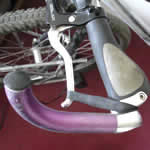
hand brakes

Tip of the month: Inner tube bike stabilisers.
Miriam and Javier told us about this great tip for stabilising your bike in almost any parked situation. Just cut your old inner tube into rubber band like strips and put them around the ends of your handle bar. When resting the bike on a hill, slope or position likely to result in the cycle falling over or rolling away, use the bands to hold your front and/or back brakes in position.

The elastic bands also come in handy for setting your brake blocks in place.

Furthermore, if you cut the strips thin enough, you can use them as normal elastic bands.
They are super strong and don't deteriorate as quickly in the sun and heat like the normal variety do.

Want more tips? Visit our publications page for an overview...


One of the internet cafés in Aabpara, Islamabad, 25-08-07
Never a dull moment
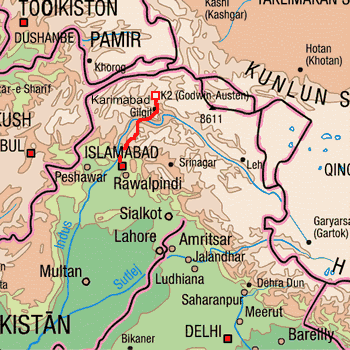
(Karimabad to Islamabad via Babusar Pass: 10 cycle days; 4 rest days; 590km; 5399m; 45km by bus)
Time passes quickly in Pakistan. Before we know it our 30-day visa is running out and in need of renewal when we finally make it to Islamabad. There is never a dull moment anywhere in this country. On the road you either contend with soaring temperatures, landslides, mountainous terrain, lack of bitumen, newly formed rivers across the track or the complete madness of the toot-happy truck and bus drivers. In any township, you'll be the centre of attraction and especially if you are male. People are incredibly friendly wherever you go and they go out of their way to help you with anything you need. They'll dart through traffic to come and shake your hand or drop what they are doing to escort you to the hotel you are looking for. Policemen, security guards and officials smile in Pakistan and locals yell "welcome, welcome, thank you", as you pass through their village.

It is then strange indeed that adverse reports of terrorist attacks in far-flung corners of the globe will have the rest of the world in a barking frenzy. They will be cancelling intial travel plans and getting on other planes to other places. But the truth is, Northern Pakistan is isolated physically, spiritually, and politically from these extremist batlles. The international media can blow even the most minor incident so far out of proportion. So far in fact, that it could well appear, from the comfortable confines of your sun-dappled lazy-boy, an entire country is focussed on mass destruction.

It is not. I feel safer here, walking around than in Athens or even some of the seedy side-streets in The Netherlands. The lack of confidence from the rest of the world has lead to a major lull in the tourism trade and while, selfishly, I'd like to keep this magical place for myself and the travel-daring few, I'd still recommend putting Pakistan high on your travel itinery. Long live Pakistan!

On the downside, as a woman in Muslim territory you are likely to face a few difficulties. As a female cyclist, you are totally threatening the manhood of this publicly male-dominated culture. You'll therefore have to contend with the suggestive clicking noise, which I abhor, but nothing that a return glare of repulsion, or if it gets a bit out of hand, a slap in the face doesn't cure. One ill-mannered man thought it would be appropriate to wiggle his saliva dripping tongue at me as we crossed paths on route to Abbottabad. An immature gesture obviously representative of both his penis and brain size. Then again, these male types are dotted all over the globe and not just inhabitants of here. And let's not allow a tainted few to spoil the hospitality and warm heartedness of the majority of men in Pakistan.

It's not until we reach Islamabad that I can really comment on the women. They are rarely present in everyday life, whether on the streets, in shops, hotels or restaurants. More likely impelled to work in the fields or look after the household. The closer we get to the capital however, the more I hear their hellos and see their cheerfully pretty faces; the latter not always covered mind you. Though the rest of the dress code is substantially more modest. The traditional and extremely colourful three-piece Pakistani outfit is the norm and fully on display, despite western clothing being readily available everywhere.

Double Gee-pers!
I think we have broken all records by staying in Karimabad for almost two weeks without doing one single trek! In fact, we do little else than update our site, work on a few new ones, send out the "one year on the road mail bomb", catch up on all the other emails and just simply enjoy the magnificent views from our bedroom window. In all honesty, another break is needed; and the last 4 weeks have been a bit like a vacation away from our cycling vacation. Rather indulgent you might agree. Still, August 7 and we lift our rested legs over the saddle and place the feet firmly in the toe clips for the onward adventure towards Islamabad. The route is still uncertain and we will decide which path we will take once we make it to Gilgit.

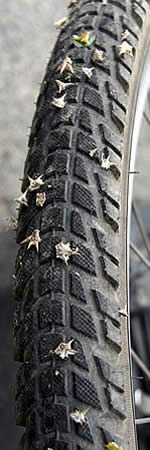
The road is incredibly undulating and there's nearly 900m of climbing to get the leg muscles pumping. Entering some towns along the way can be painfully exhausting in the heat of the day. In general, there are some smooth bits, lots of bumpy sections, certain parts that you can't call a road at all and a couple of places where nature has reclaimed the man-made terrain back as a river. One important piece of advice for anyone riding the KKH: Whatever you do don't pull off to the side of the highway without checking carefully for double-gee (also known as bindie) prickles. And try and keep well away from the sandy sides of the road. These spikey perpetrators are in plague proportions and it will be more than an ordinary patch job on the inner tube if you happen to roll over one of the innocent-looking, low-lying shrubs. Ali rolls over a section around lunch-time and it takes us 2 frustrating hours of roadside repairs before we are mobile again. Later that evening, we discover 16 holes before giving up on one of his tubes and throwing it once and for all in the rubbish bin.

Gulmet is definitely the place to stop and refuel. It's 30km's from Karimabad and just past the uphill, 4km dirt-track turn-off to Minapin. Refreshingly cool water cascades down from Rakaposhi's glacier past the terraced area where you can sit and enjoy the mountainous view from every direction. It's clearly touristic and there are a couple of guest-houses here if you like the cool, relaxing scene. We continue on and today's journey takes us through numerous villages, all with plentiful supplies for cyclists. The spitter, spatter of rain remains almost all day by our sides but never eventuates into anything too threatening. On the other hand, a couple of kids throw apples from an orchard at Ali, but to their demise, in view of an elderly local man. And boy, does he give them what for! Also makes one of the offenders give Ali a handful of apples as a peace offering. Very nice gesture indeed and as an added bonus they are quite delicious.

A few hours from Gilgit and the late afternoon sun intermittently highlights a colour spectrum of golden greens on the blue-brown hued silhouette of the mountain range before us. The rock formation soars high into a clouded blue sky back dropping the landscape. Petite wisps of fluffy cloud sit to the front of the picture, just as if someone has ripped a cotton wool ball into little pieces and glued them ad hoc on the scene. To the left and well in the distance, a vivid rainbow caught between the sides of two adjacent rock faces shines every colour with fervour. A sight that no photograph can really do justice.

As we enter Dainyor we are on the look-out for the shortcut that takes you through a tunnel and via two suspension bridges to Gilgit. We miss it altogether and irritatingly add another 10kms to our trip. It's well and truly dark before we arrive at Mountain Refuge, where we stop for three nights in total. (Karimabad to Gilgit: 108km; 893m) The gardens here are beautiful to sit in and relax and you would hardly know that you are right smack bang in the middle of a city. The rooms have clean bed linen while the bathroom is a little run down. Accommodation is a reasonable 250 rupees per double, however the food is remarkably expensive for what you get. A simple potato and pea curry with chapatti will set you back 125 rupees each, then again like anywhere else in Pakistan you can ask for seconds. Breakfast is also overpriced according to local standards. Every morning Ali had a heartily large bowl of porridge and I, a decent serving of hunza bread with mango jam. We both ordered 2 black coffees each and after three mornings our breakfast bill was a grand 600 rupees.

While in Gilgit we need to book the NAPWD (Northern Areas Public Works Department) resthouse in Thalichi and we venture to their office on the outskirts of town. The Chief Officer is pleasant and officious and assures us that it will be no problem to stay at the lodgings. According to him, even if they are full, we may camp. We also want information about the state of the roads leading to and from the Babusar Pass. In his own words, they are "very good". Apparently, the roadwork department has been working extremely hard to bring them up to scratch for the polo match at Gittidas on Pakistan's Independence Day (14th August). Apart from banking, sending off some postage and trying to find an internet café that has a connection with absolutely no luck whatsoever, there is little else Gilgit can offer us. The town itself is hot, grotty and dusty and no at all appealing. Adding further to the disenchantment, the electricity is forever out.

Really too hot for words
It is at Mountain Refuge that we meet Molly, a lone cyclist from San Francisco. She decides to join us for the ride out of Gilgit and plans to stop in Jaglot, 25km from Gilgit. We are all on the road by 8.30am but Ali gets a flat just outside the town. Neither Molly nor myself mind resting in the shade of a conveniently placed advertising board. It is already a baking heat and actually reaches our all time record of 55°C in the sun today. Needless to say, we stop frequently to rehydrate and convalesce. It hits Ali the most and he is lack lustre for the better part of the afternoon. And so we discover that this Superman's kryptonite is raging heat.

We get reasonably close to Jaglot and take it in turns to venture below to a pipe spurting deliciously cold water from the stream following the road. Entirely soaked, we ride on with our own custom air-conditioning. Unfortunately, it soon dries up and we roll into Jaglot itself, where Molly is intending to stay. The numerous serias (budget travellers inns) or hotel mentioned in LP do not exist and the town is more like a military base than anything else. We manage to find a crummy shack like room with no lock on the inside or running water. The army presence is enough to put anyone off staying overnight and she decides to join us in attempting the Babusar Pass and cycling on to Islamabad. Road has been and continues to be an up and down excursion: an energy taxing grind for every minute of the way. What with the added strain of 50 plus temperatures in the open and the risk of overheating and dehydration, this is definitely dangerous country. By the time we reach Thalichi we are all totally numb, frazzled, hungry and ready for a wash, food and sleep. (Gilgit to Thalichi: 65km; 650m)

The NAPWD resthouse is easy enough to find, but a rude and arrogant militant refuses to let us further than the stairs leading to the bedrooms. The place has been occupied by the military, it's evidently full and we are not permitted nor welcome to stay under any circumstances. Even our reservation slip signed by the "Chief Officer in Charge" himself is not enough to persuade this big-headed, big-weaponed soldier to give in. A young man comes to our rescue and offers us a place to stay at his "soon to be" hotel. There is one simple, mud floored room finished, which he fills with three charpoys (rope-strung beds). A primitive bucket bath and toilet are out the back and much better than they sound after the heat of today. The brothers of this hotel cook us a delicious meal comprising fresh chapatti and two different dishes of lady-fingers (okra) and fried tomato, onion and egg. The company is quite charming, the sunset view of Nanga Parbat (8126m) absolutely beautiful and we consider the change of lodgings a blessing in disguise, considering the not so warm welcome at the NAPWD camp.

We are all in bed by 8.30pm but the night's sleep is sporadic. Our room is situated close to the highway and the trucks stop outside our window all night long. It is stifling hot in the little stone space and the sweat pools under our bodies. Not a breath of fresh air reaches us, even though a hot wind storm brews outside and remains till morning when we wake at 5am.

We manage to leave at 6.30am after a breakfast of stale bread and sweet tea. It is 32 degrees at 7.15am and it feels like it is going to outdo yesterday's heat. It reaches the same centigrade and travelling feels like riding down a tunnelled furnace with hot headwinds of course. My eyeballs are dry and irritated and every push on the pedal is hard work and not much fun at all. We pass way above where the blue-grey Gilgit River meets the brown-grey Indus. KKH itself is winding, rocky, sandy and barren of plant life. Not particularly pretty at all. Our tiny forms are insignificant as we pedal along the cut-out track on sheer cliff-face drops to the massive river flowing below.

After roughly 50kms, Ali simply can't cycle anymore. His appearance is terrible and I have never seem him like this before: completely red, no energy to drink or eat, let alone push the fully loaded bike up and down these killer climbs. After resting for little more than half an hour, the situation doesn't get any better, so we flag down a car. Ali and his bike are motored on into Chilas about 15 km's further on up the road. He waits at a soda-stop just outside the town for Molly and myself to pedal the final distance. One and a half hours later, we find him rehydrated and looking much better. On the contrary, we are completely shattered from the journey and it is difficult to concentrate, converse, or collect any more thoughts about the day. Our heads are aching, even though we have been pumping as much liquid into our bodies as possible. We settle for a triple room at Karimabad Inn (500 rupees, down from 700). (Thalichi to Chilas: 53+15km; 445+126m) We shower; we eat; and we crash straight away, only to be woken at 6am when the electricity cuts out and the fan stops. It's an unbearable sweatbox once again.

Where have all the women gone?
Our bodies need a rest and we spend the next day cheering and booing in our hotel room as the electricity comes on and goes off respectively. We drink almost the cost of an overnight stay in water at the elevated price of 50 rupees a bottle. Though, it must be said that the food in the restaurant is great with tonnes of veggie options and not at all expensive. Added bonus of an English menu as well.

In Gilgit, the women that you did see on the streets, were completely covered; mouth included. But at least there were women. Kinda spooky, when all you see are men milling around in groups, not doing very much at all. It is overly noticeable that there are no women to be seen here or in the actual township of Chilas, 3kms further on up a steep, winding road, come gravel track. We decide to try our luck at the bus station in this village, after we are quoted 4500 rupees for a jeep to cross Babusar Pass via the owner of the hotel. The price is a little less at 4000 rupees for a jeep or the insignificant amount of 300 rupees each for a seat on a bus. A few opportunistic buses are going up the pass in light of the Independence Day celebrations in Gittidas. Later that afternoon, our hotel owner is impressed with the 300 rupee charge and before we know it, he has someone else that will match this price as well as pick us up directly from our hotel. Too good to be true and no cycling up that uninviting hill to Chilas bus station in the morning sun.

Waiting by the bus... stopped
A storm kicks in early evening with incredibly powerful winds and rain but all is clear the following morning. Bus arrives at just after 8am as promised and the bikes and bags are loaded on top. We are off. First 15kms or so are okay and then we hit the outcome of last nights storms: almost a kilometre of landslides. We, along with all the other traffic, wait for an hour for roadworkers to level it off and then the attempt to get the bus up the boggy slopes begins. Takes several goes, with the first half of the bus disembarking to assist pushing the vehicle up and over the hills. Back passengers have to remain seated for traction. It becomes apparent after several clashes with boulders and a nasty clutch burnt odour that the bus is not really up to it. Half an hour down the road and we are stopped again. This time the axle is out of alignment and transmission needs bleeding. Ninety minutes later and we are back in the bus. The state of the road surprises us after what the Chief Commissioner in Gilgit had said: road is very good due to the festivities at hand. It winds up before us to an altitude of 4175m and the road looks treacherous. We are certainly happy about the seat in contrast to a saddle, but it is a white knuckle ride as we grip the seat in front; partly to keep ourselves from landing on the floor and also as an added but futile push, while we all wish the bus over the other side with all our might.

As we bounce along, everyone is very friendly: welcome signs and waving from locals are a total contrast to comments in guidebooks about how inhospitable this area is supposed to be. We don't experience any untoward behaviour at all. Maybe the celebrations have put everyone in a good mood: maybe not.

By now there is an incredible clunking sound from under the bus and it finally stops again on an incline that all traffic is finding difficult to negotiate. They secure the axle in place with string and we are mobile yet again. The passengers in the middle section of the bus must continually jump off to push. They then have the added task of catching up with the bus afterwards. Some of the more unlucky ones need to traverse mountain sides to meet the bus on the other side of the switchback. Just 6kms from the top and the crossed hand signal from a fellow passenger indicates the death of our transport. The axle is split in two with innards lying on the ground. Molly and I take this as the end of our semi-comfortable ride and start unpacking everything from the roof rack. Ali is one of those that needed to scale the mountain side and we keep expecting to see him waltzing up the path any minute. He doesn't, which worries me slightly and also to my bewilderment, the bus takes off after 20 minutes and actually looks like it is going to makes it over the pass. The axle has been tied back together with a piece of string. From this day on I'll place a little more trust in the Pakistani ability to repair a broken down vehicle.

So we've abandoned ship, which is now chugging up the pass and Ali finally appears from the opposite direction. He'd been waiting for the bus and was almost at the top, but had to climb back down to us, when he saw that we weren't on board. Immediately, he spots that there's one bag missing. The one containing our computer and electronic equipment. I'd like to put it down to not thinking straight at high altitude but stupidly enough, I'd forgotten to grab it from under his seat in the bus. After a few words that I will not repeat in this report, he is on the back of a van heading back up the pass for the second time. A road block stops him from reaching his target and he attempts to run the rest. Unfortunately, altitude wins over and he has to hitch with another car. Luckily for us, the bus has broken down yet again and he successfully rescues our bag to the amusement of the driver and passengers. He crosses the pass for the second time on his way back.

Wind picks up and we optimistically get on our bikes to pedal. After less than fifty metres, Molly and I are walking. I turn around to see how Ali is coping and he's doing exactly the same. We push the 1.7km's of 7% average climb. At one stage we need to huff and puff up 29% of rubble and grit. That's tough in anyone's book and the 106 metres up to the Babusar Pass (4175m) takes more than half an hour. At the top we are stopped for a picture for the Gilgit Daily before dropping into a valley 5km below. (Chilas to Gittidas: 45km by bus; 6.2km; 106m) We are hassled by police to register on immediate arrival and although we are obviously exhausted and it's starting to rain, they are insistent. So are we and after quite a bit of yelling and obstinacy, we win and can go and set our tent up. By this stage the rain is pelting down which really annoys me. Molly is suffering badly from altitude sickness and can't do much but get out her mattress and lie her head down. Tent is erected and Ali and I venture out to find some food. It's the worst meal of mutton flavoured dahl and smokey rice we have ever had. The vendors tried to get 300 rupees out of us for it. Ali, in no mood for games, pays an outrageous 200 and we get back to the tent before the next downpour. Being quite the gentleman, Ali sleeps in the vestibule, while Molly and I crash in the inner tent. We share my sleeping bag as it's less than 5°C.

Following morning and our petrol stove won't work. Some of the off-duty police kindly lend us their gas cooker for making our breakfast. We stay to watch the highest polo match in the world, which is quite exciting, but take off before the formalities of giving out the trophies begin. It's around 1pm when we start the descend back up the hill.

Slip sliding away
Climbing back up is way too difficult and Molly and I sleaze our way onto the back of a military pick-up truck. They are pretty impatient about getting everything on and take off well before we are seated or the back of the ute is shut. While Molly tries to hold the bikes secure, I find my way to the other side of the pickup to secure the bikes from that side. Easier said than done, on the back of a metal tray top with muddy boots. Vehicles stop and start as they get stuck and need to be pushed out of trouble. Engines strain and the exhaust fumes are rife. The rain the night before doesn't make life any easier for the drivers.

Somehow, there is a major communication breakdown between us and Ali as we continue on around the hairpin and back to the top of the pass with the pick-up. Molly and I wait long enough for a hail storm to come in before realising that Ali hasn't gone the same way. At first I think he's having a hard time making it up the hill but after walking down to help out, I find him waiting very impatiently at the switchback turnoff. All this wasted time and the cold spell that has closed in eventuates in a bit of a screaming match between us and I storm back off up the hill to get Molly and my bike. A driver takes pity on my obvious vexation and takes me to the top. Molly's huddled down close to her bike being pummelled by ice stones. We both pedal tentatively down the muddy slope, only to meet Ali coming towards us. It's become so wet and cold that he thought it better to keep moving than stand still. The sun can be spied in the distance and we all decide it's better to head towards this golden apple.

It's just the beginning of our off-road adventure through valley, meadow, stream, river, and muddy, rock-ridden paths. The roads are the worst we have ever seen. Yes, worse than Sary Tash in Kyrgyzstan. Our hands cramp with all the downhill breaking and our legs strain with the uphill pushing. It's full wet weather gear for the 20km journey into Besal, which takes us almost 3 hours to complete. It rains almost the whole day and as a consequence, mud is absolutely everywhere. The film probably gives a better idea of the days activities than any words can.


Cycling up the Babusar Pass Northern Pakistan July 2007

Just after passing Lake Lalusar, which is really the most beautiful sight we have seen in a long time, we know that Besal is close. A few more energy zapping climbs. Ali has to help with the 28% gradient as I can no longer push my bike up. Finally, we coast down into a very primitive township just as it is getting dark. (Gittidas to Besal: 20km; 206m) The owner of the "hotel" asks 500 rupees for a plastic carpet lined room with oil lantern as light and well used, smelly mattresses as beds. The only running water is the stream across the road, where the outhouse is also situated. We explain that that is way overpriced and are prepared to pay 50 rupees each for these bare minimum facilities. Two hundred rupees in total is eventually agreed upon and after a "wet-ones" wash, we venture into the lantern lit restaurant for dinner. Surprisingly the dahl is quite tasty and made from red kidney beans instead of the usual lentils. Sweet green tea, tasting more of sugar than it's name, finishes off the chapatti and spicy bean dinner just nicely. We all crash out of sheer necessity shortly after. I smell a mouse in the early morning and am sure it ran over my sleeping bag. Ali insists it was him. I'm sticking to my story.

One pen, one pen!
The initial stretch of road is much the same as yesterday and we cross more rivers than I can keep count of, climb and push against more rubble than I would like to remember and rely way too heavily on my brakes to prevent me from flying arse over tit on the steep, downward slopes. Any fear I ever had for water, mud, sand or stone has disappeared. However, my phobia for crossing grid-like structures has not. I freeze at the bridge girder with holes big enough for both my feet to slip through. Embarrassingly enough, Ali has to guide me over by the hand. After 17km we hit bitumen at Burawai. We are elated and the going is good for most of the way, though occasional slippage areas become more frequent as we approach Naran.

Beautiful countryside views are on display as the highway goes up and down like a roller coaster ride past pine forests, lakes, fast flowing streams and strangely shaped ice glaciers that greet us roadside. The other unavoidable reception comes from the local children. All I can say is: kids will be kids and they can be quite a pain at times. They usually greet you with "one pen, one pen". Rumour has it, that this form of begging was initiated years ago by well-meaning westerners giving away pens instead of money. Unfortunately, it started a trend and now nearly every child you come across in Pakistan (including the Hunza Valley) will run excitedly towards you, hand held out, shouting this annoying catchphrase. Generally, they go away when you refuse to give them anything or they are spoken to sternly. A handful will take it further and crowd around the bike and try to grab you or the handle bars. Only the odd few will throw stones.

We are stopped continually today for a photo with bus loads of guys and results in a seven hour journey, whereby only four is spent cycling. A few kilometres before our destination and the road flattens out. (Besal to Naran: 46km; 532m) Naran is a summer tourist spot for Pakistanis and that is evident the moment you enter the small town. There are plenty of hotels and guest houses ranging from budget to luxurious as you ride from north to south. Also at the southern end of town a few campsites with permanently erected tents and cooking amenities are available. We choose one of the more budget options, being Paradise Inn at 500 rupees for a room with enough sleeping facilities for three and a small, rather poorly tiled bathroom that only has hot water from 6am to 10am daily. A hot water bucket bath is available on request. Electricity, like in the rest of Pakistan, is random. If you need to charge up anything then make hay while the sun shines.

We hang out in Naran for just one day before heading towards Balakot. The journey ahead is full of winding roads that lead us from one mountain to the next. It is beautifully green. We hit some quite difficult terrain and there's a bit of pushing to do. Even the logging trucks have to battle with the unpaved, uphill grind. Some neighbourhoods have been badly affected by earthquakes and as we close in on our target the fault lines across the road are irritatingly frequent. Parts of the highway have shifted metres from their original location and the last section of our trip seems to take forever. With each ascend, we hope to see Balakot below but are bitterly disappointed when another rise and fall is imminent.

At long last and following nearly six hours of riding, we spy a very makeshift township full of rectangular structures with newly-placed, blue, corrugated iron roofs. (Naran to Balakot: 83km; 754m) The only structure still standing after the earthquake three years ago, is the shopping arcade with Serenity Hotel situated at the back. The rest of the place is adorned with mobile homes and tents surrounded by rubble and built-up garbage. Hotel Kohi-toor, where we stay, is exactly that as well: transportable units donated to the area from Saudi Arabia and erected in quarters resembling and smelling like a rubbish dump. Separate amenities with bucket bath is cool and inviting after the long ride while the electricity is just as temperamental as anywhere else in Pakistan and we get little use out of our wall hung fan.

Dull dahl
From Balakot it's virtually downhill for 10km before hitting the roundabout at the Muzaffarabad turnoff and a staggering 7 km climb out of the valley (260m up). Normally, it wouldn't be so bad, but the heat of the day makes it hard work. We drop once again, only to find ourselves ascending further on down the track. This is the pattern for the day and by the time we get to Mansehra we have climbed almost 650m. Molly finds the heat a bit too much and her tyre also gives up while climbing out of town. After replacing it and another couple of 100 metres later, she decides to catch a taxi into Abbottabad, about 20 kms up the road. It costs 300 rupees, though the guy in the shop where we shelter from the heat and slurp on a few soft drinks, thinks it's way too expensive. According to him, a local would pay just 200 rupees. Molly doesn't mind and just wants to find the Al Faiz, that boasts a bathtub and luxury conveniences in their "suite room".

Ali and I continue on up the monster climb: it just never seems to end and the trucks and buses come unbelievably close to our small frames balancing perilously on the edge of the road. We often have to slip into the gravel shoulders which means more exertion getting to the top. Their horns are deafening and their lack of respect for our presence on the road becomes increasingly maddening. Simple fact is: you are one from the bottom of the transport pecking order, pedestrians having the lowest rank of course.

The coast down into Abbottabad couldn't have come sooner and it was relatively easy, though a few screams and whacks on some car bonnets are necessary to avoid a crumpled body and bike. The road splits at a roundabout just 8kms or so from the start of town. This is Jinnah Road and leads directly to the hotel where Molly is probably already soaking her exhausted body. (Balakot to Abbottabad: 65km; 1062m) The room at Al Faiz does not live up to LP's write up: apart from the fact it is dirty and run down, has no hot water, no towels on arrival and we need to ask three times to get them sent to our room, also has no key and a new one has to be re-cut, the guys at reception are not particularly friendly. A real farce for the 2000 rupees they initially quote. Still, we are not sure exactly what Molly pays for the room and we shouldn't be the ones complaining because she is shouting us the night, as well as the long anticipated pizza meal at Red Onion, just up the road. Just the thought of something different from the very standard dahl and chapati....Yep, has to be gastronomic heaven!

Where marijuana truly is weed
We plummet down 14 kms to Havelian, where the KKH officially ends and it takes 400 metres off our altitude. Then an additional 270 metres also disappears once we reach Haripur, another 22 kms further on. We are really cruising at this stage, though the sun is getting increasingly more intense. It shines on the copious marijuana plants lining the highway and growing higher than the corn in adjacent fields. A pleasantly sweet, sticky odour fills the air and the tropical environment abundant in bananas, palms and roadside nurseries is a pleasant change after the rockiness of the KKH and Babusar Pass. It's still 53km to Taxila with the last 20km stretch on the Grand Trunk Road, which, though hearsay, is notoriously dangerous. Actually, it is not as bad as everyone makes out. At least there is a medium strip to stop the traffic from the other direction overtaking and bee-lining it straight for you on the other side of the road.

The day roasts to a sweltering 49 °C in the sun. It is becoming quite difficult to keep the wheels turning as we enter the Taxila: a bustling town of equal proportions of disorder and garbage. (Abbottabad to Taxila: 89km; 308m) We first are lead to a grotty laneway where a hotel is situated. No-one is manning the reception and so we wait out on the street. On one side fresh bread is being baked which is always a bonus but on the other, mutton is being chopped into little pieces and the smell of flesh in the hot summer heat becomes too much for me so I venture onto the main strip and ask if another place to stay exists in this place. Apparently there is a guesthouse, near the museum. It takes a few stops to ask for directions before we cross under the overpass bridge and head out of town. We are well and truly on the outskirts before a restaurant catches our attention and they have a room upstairs for 800 rupees. (Gandhara Hotel: Khanpur Road near Taxila museum) The price is bargained down to 600 and it is pretty good value for what we get: spaciously pristine area with fan, bathroom and very clean linen taken right out of plastic for the first time. The brand new mattress that arrives for Molly confirms that this place is just starting up. The restaurant downstairs has good food. Pakistani variety considerably cheaper than the rest of the fare.

It's a thunder and lightning loaded sky that entertains us for the best part of the evening and when we awake the next morning the skies have completely opened up and it's pouring with rain. We are too early for the restaurant staff and so venture outside at around 7.15am. The weather is a little heavy to ride in and we take shelter a few hundred metres up the road to wait it out. We are soon underway and within minutes of pedalling completely saturated from passing traffic. Thank goodness it's only a short ride today and after a not so scenic journey we find ourselves across the road from the tourist campsite in Islamabad. (Taxila to Islamabad: 40km; 200m) It is 50 rupees per person to pitch your tent or stay in one of the concrete dorms. (100 rupees extra for each vehicle) There is a cold shower, that's actually quite good, and one usable toilet for everyone to share (men and women alike). Needless to say, it gets filthy pretty quickly and the Pakistani way of cleaning only ever amounts to squirting a hose over everything and tipping the waste-basket full of soiled toilet paper in the bushes next to the entrance. The supposed kitchen facilities are totally out of commission and being used by the owner to sleep in but on the comforting side, an armed guard protects you and your belongings for the entire length of your stay. Molly needs to find a hotel and so we also take a look at what's on offer. Islamabad is expensive in comparison to the rest of the country and you won't find much for under 800 rupees for a double room. This is bottom of the barrel mind you, so don't expect too much at this price.

Workstation Broadband Internet Café (Jinnah Super Market, College Rd) Islamabad, 31-08-07
Held up in Islamabad
Why we haven't shifted to Rawalpindi by now I don't know, but Islamabad is becoming increasingly boring. The campsite might be cheap and the tiny chipmunks chasing one and other highly entertaining, but it's very hot, humid and infested with mosquitoes. The only refuge we have from the elements is the Ambassador Hotel, where Molly is staying. It's way out of our budget, but she moved after the first and only night at Hotel Friends Inn, where her room had no outside window and only a fan for the pricey sum of 600 rupees. Her new place of abode has a decent restaurant with reasonably priced meals and we don't get the runs after eating there. Highly likely in most eating establishments in Pakistan. So we can be found dining for breakfast and dinner on most days. It's cool and air-conditioned and the majority of the staff are very friendly.

So, we've now covered eating and sleeping and seeing as walking around is virtually an impossible task in this heat, there is not much else on the list of entertaining things to do while in Islamabad; besides, even if you could handle the warmth, you'd only find yourself walking through the higgledy-piggledy land-grid of suburbia connected by double-laned highways. There are four sections to this jungle and to get around you need to know which sector you want to travel to (G7 or G4 for example). Islamabad doesn't have a city centre at all. Although it's relatively new: only started in the 1960's, it's a concrete and steel shambles with never-ending roadworks and unsightly slums bordering all sectors. So much of the metropolis is incomplete and doesn't look as though it ever will be. But I suppose, that's what you get from a culture where women are not generally considered able for such decision-making tasks and men tend to sit around for the best part of the day, in groups doing very little else than staring at any unsuspecting foreigner, chatting with each other, drinking tea, sleeping virtually anywhere and chilling out with the help of a fan or charpoy. The guys running our campsite are definitely experts in all of the above.

And when they are not doing one of the above, they are in an internet cafe, chuckling out loud at the video or television program they've downloaded or congregated round something pornographic. So this is the other thing to do in Islamabad if you are not female. To date, I have not seen one woman in one of these male orientated institutions. And be warned, you will be exposing yourself to a punishment in the form of severe frustration. Every computer is completely riddled with viruses in every single one of the internet cafes. This is typical throughout Pakistan and when you suggest, that they should update or even install, for crying out loud, a virus scanning program, they just smile and say, sorry madam. It's complete torture. Mind you it's cheap torture at 25 rupees an hour.

Why then are we still here you might be asking? Well bureaucracy is having it's way with us yet again and after a surprise 4 day wait, (negotiated down from 7 days), for our Pakistani extension, we are sitting out the week long delay to our cycling plans for our Indian visa. In all other towns, the extensions are done on the spot, but of course, we have to choose Islamabad to extend ours and we are shocked when the stamp isn't issued immediately. Little we can do about it. The Indian High Commission is completely spilling over with people at any time of day and just for the record, there is a shuttle bus that costs 15 rupees to take you to your embassy. Unfortunately, the system of lining up for tickets takes forever and then the further queue forming for the actual bus is horrendous. We give up with this procedure and go to the entrance at UN Boulevard. After showing our passports we are allowed to walk to the embassy, however note that this doesn't work for females travelling alone.

Indian High Commission: Diplomatic Enclave: Open Monday to Friday 9.30-13.00 and 15.00-17.30). Takes 7-10 days (Fee: 3,300 rupees: exact cash amount. You can apply for any type of tourist visa you like: i.e. single or multiple entry; three months to one year. Though, this doesn't necessarily mean you'll get what you ask for) Two application forms with absolutely no mistakes, two pass photos and passport required.

A taxi ride almost anywhere in the main grid will set you back 50-60 rupees, but you'll get asked to pay anything up to 150 rupees. Just don't! Bargain hard. To pass the time away, we decide to visit a few tourist spots. The raved about Faisal Mosque is far from the spectacular sight that everyone says it is. The structure boasts being able to fit the most amount of people inside at any one time and is of Turkish design. It's modern structure left me rather flat though, after experiencing some of the most beautiful creations in Turkey, Iran and Central Asia.

Equally, the Archaeological Museum in Taxila is an utter disappointment. If not for its small scale operation compared to the expensive entrance fee, then for the continual harassment from guides inside wanting to lighten our wallets in exchange for their hard to understand information. Locals pay just 10 rupees and while we wouldn't object to giving a little more, the 200 rupee charge is ridiculously discriminating. I am getting a little tired of everyone thinking that because I come from the western world, I am loaded with money and therefore deserve being ripped off. We expect a decent day trip and so hire a taxi and all. The 60km ride in total, plus the driver's wait in Taxila costs us 1000 rupees, but it turns out to be a total waste of time, effort and money. The archeological sites are also 200 rupees to get into and we all get totally fed up with the hassle from touts and schemers that, within a couple of hours we are back in the cool environment of the Ambassador Hotel again. So much for our grandiose cultural plans. To our credit though, we do manage to catch a football (soccer) match at Jinnah Stadium while we are here. It is free to get in and complete with flamboyant brass band. Although the level of play of the Pakistan versus Afghanistan Final is a little wanting, the atmosphere is great. Women's soccer certainly pulls a bigger crowd than I thought it would in a Muslim country.

MCB Bank
Your first chance of getting money out of a machine in Pakistan (when coming from the north) is Abbottabad. Here they have an MCB (Muslim Commercial Bank) office. MCB ATM's accept western cards and it is probably your best choice throughout Pakistan. North of Abbottabad you can easily exchange euros/dollars and travellers cheques in Karimabad. The bank there charged us 1 rupee per dollar exchange, which is quite allright, considering.
More info? Check out out country info pages!
   
Country info directory

Want to know more details about the route we took, the hotels we stayed in,
or the altimeters climbed? Check out our country information pages for:

country information Pakistan

   
top
previous / next month
 
 
sonali.tk - justifiable web design